Dongyu Insights
Custom PU Croissant Squishy Design: Roll Bands, Rounded Tips and Sampling
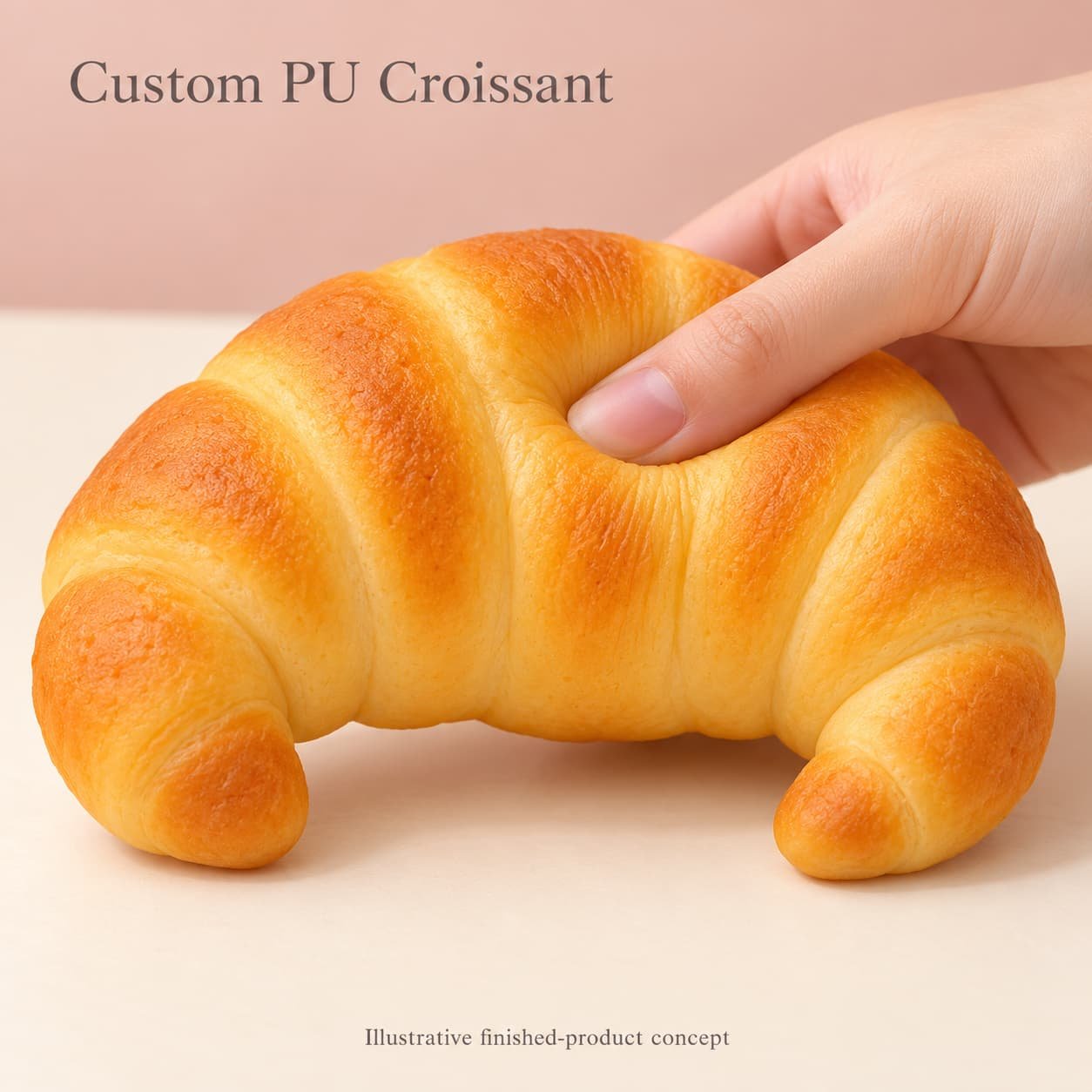
Custom PU croissant squishy design requires a different brief from a simple bread block. The crescent, rolled bands, inward-facing tips, and baked-color shading must read as one coherent product. At the same time, the buyer needs a shape that can be evaluated through physical samples rather than approved solely from a realistic pastry image.
This guide follows an original rounded-band croissant concept from sketch to colored views, 3D review, and finished-product appearance. It focuses on the design decisions that are specific to this shape: the open crescent gap, rounded tips, broad roll bands, decoration boundaries, and packaging support. The images are illustrative proposals, not actual Dongyu samples, engineering CAD, or test results.
A croissant squeeze toy appears in a public retailer’s Best Sellers collection, while public wholesale listings show PU foam croissant variants. This supports investigating the category, not claiming worldwide sales leadership or identical construction across products. Dongyu includes bread and dessert forms in its food squishy product directions; ask which customization route is available for your proposed croissant.
Use the market reference to define a category, not a replica
A market reference board should separate appearance from construction. A filled crunchy croissant and a PU foam croissant may share a pastry outline, but the filled product’s claims do not establish how your foam project should perform. Use the reference to understand recognizable category features, then specify the material direction independently.
For this concept, retain a plump crescent outline and visible rolled bands. Redesign the band arrangement, tip shape, color transitions, and packaging. Do not copy branded artwork, a competitor’s specific sculpt, or the styling of its retail card. Record what the reference demonstrates and what it does not.
- Observed category feature: a curved pastry shape with a broad middle and smaller ends.
- Original design direction: broad rounded bands and short, blunt tips.
- Material brief: PU foam, with formulation and finished handling to be confirmed.
- Unconfirmed items: actual dimensions, recovery behavior, tooling, decoration route, and commercial terms.
A retailer’s best-seller label is a scoped commercial signal. It is not proof of demand for your exact design, nor a substitute for buyer feedback and a project quotation.
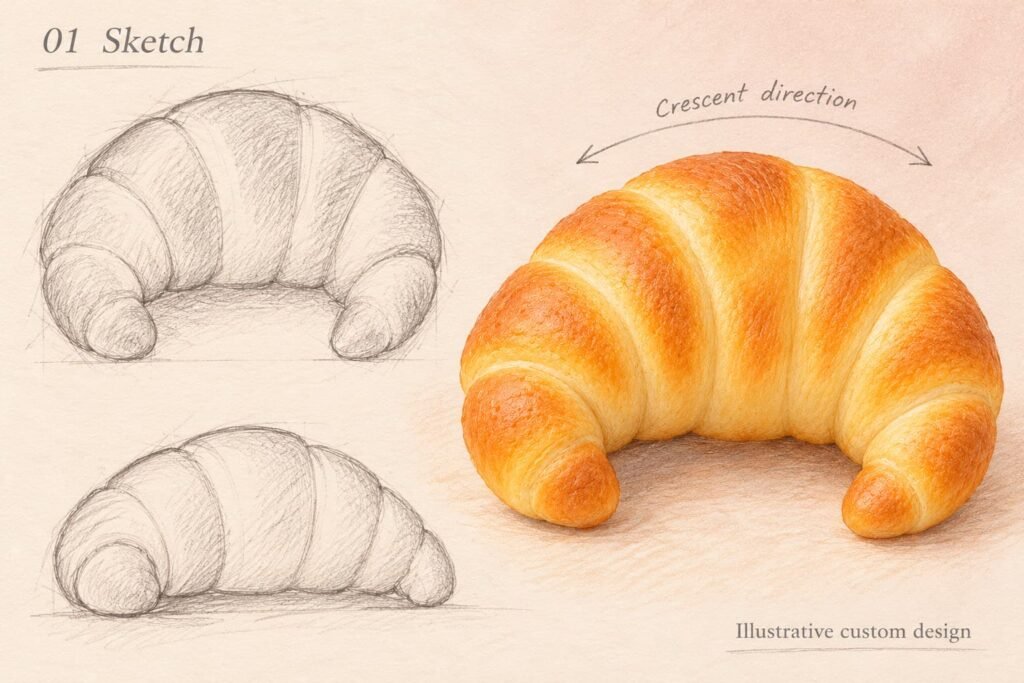
Stage 1: sketch the crescent before adding surface detail
Begin with a top view. It should show the outer arc, inner arc, overall span, and opening between the tips. Add a side view to show how the central body rises from the supporting surface. These two views explain the basic geometry more reliably than one dramatic three-quarter image.
Write a silhouette lock: plump curved body, broad central region, broad visible roll bands, short inward-curled tips, and rounded transitions throughout. The band count is a design choice for this project, not a manufacturing rule. If it changes, update the views and revision record.
Keep the tips readable without making them fragile-looking
A pastry photograph may show thin sharp ends and delicate flakes. A squishy brief should not reproduce every edible detail automatically. Ask the supplier to assess the proposed tip shape, narrow sections, and transitions. For the original concept, the tips are deliberately blunt and compact, with their exact geometry still subject to review.
Do not approve the tips only because they look neat in a render. Include them in physical sample handling and appearance checks. Record any simplification recommended by the supplier so the approved toy and the marketing illustration remain aligned.
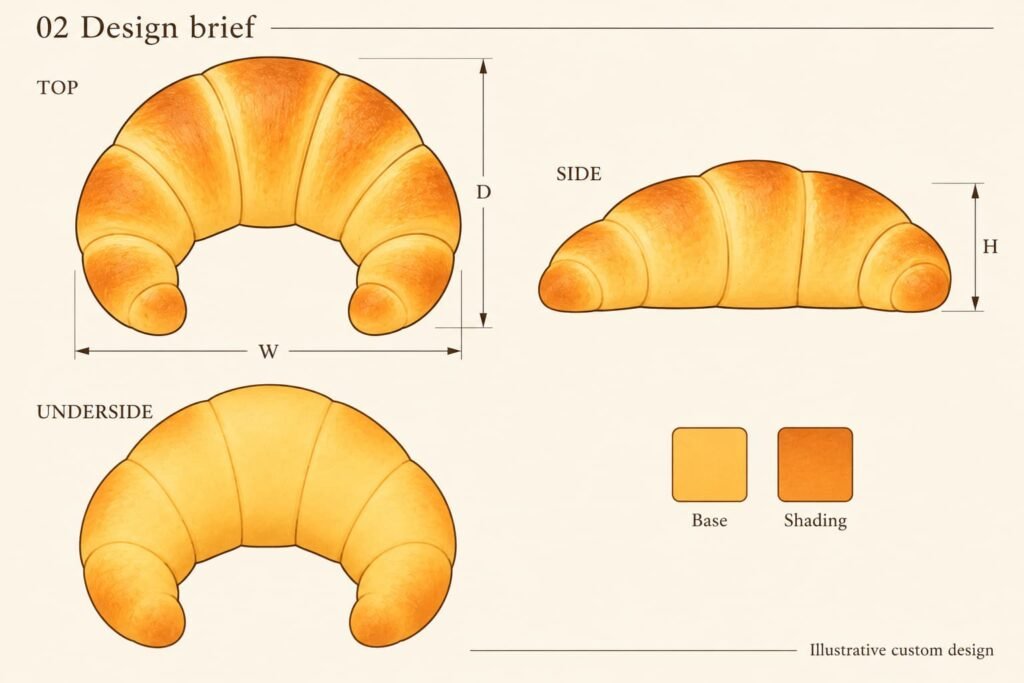
Stage 2: specify dimensions and roll-band geometry
Define W as the widest tip-to-tip span of the uncompressed product, D as its front-to-back footprint in the top view, and H as maximum height in the side view. Mark the measurement points and units. If your supplier uses another convention, reconcile it before approving a drawing.
The illustrations use letters rather than numerical production dimensions. A buyer should provide proposed values, then agree actual dimensions and acceptable variation with the supplier. Avoid measuring an AI image or treating its proportions as a complete engineering specification.
| Geometry field | What to record | Question for review |
|---|---|---|
| Outer crescent | Top-view outline and proposed W/D | Does the sample retain the intended silhouette? |
| Body height | Side-view H and central profile | Is the bulk consistent with the intended handling? |
| Tip opening | Inner-gap shape and measurement points | Do the tips remain distinct in the packed sample? |
| Roll bands | Count, direction, and broad transition notes | Which details can be reproduced and checked? |
| Tips | Blunt-end direction and rounded roots | Does the physical sample need revision? |
| Underside | Supporting surface and decoration direction | How will the product sit and pack? |
This is a design communication template, not an industry standard or an approved tolerance schedule. Technical values require a project-specific agreement.
Distinguish roll bands from loose-looking pastry flakes
Use broad molded-looking transitions to communicate the rolled form. Fine crumbs or peeling flakes may make a render look appetizing while adding little value to the toy brief. Decide which detail belongs in the shape and which belongs in color shading or a subtle finish. Ask the supplier for feasibility advice rather than assuming every visual layer must be modeled.
Map baked-color shading to the shape
The original color direction uses a buttery golden-tan base, slightly deeper caramel on selected band crests, and lighter valleys. Specify where shading should begin and end. “Make it realistic” is less actionable than a colored view showing the intended zones.
Review the underside as well as the main face. Decide whether it shares the base color, uses a lighter tone, or follows another approved direction. A product photograph that hides the bottom should not leave its finish unspecified.
Use physical references for color approval where appropriate. Screens, generated images, and digital swatches do not establish the appearance of decorated foam. If a shade or finish changes between sample rounds, keep the old and new references clearly identified. For broader color decisions, see the color matching guide.
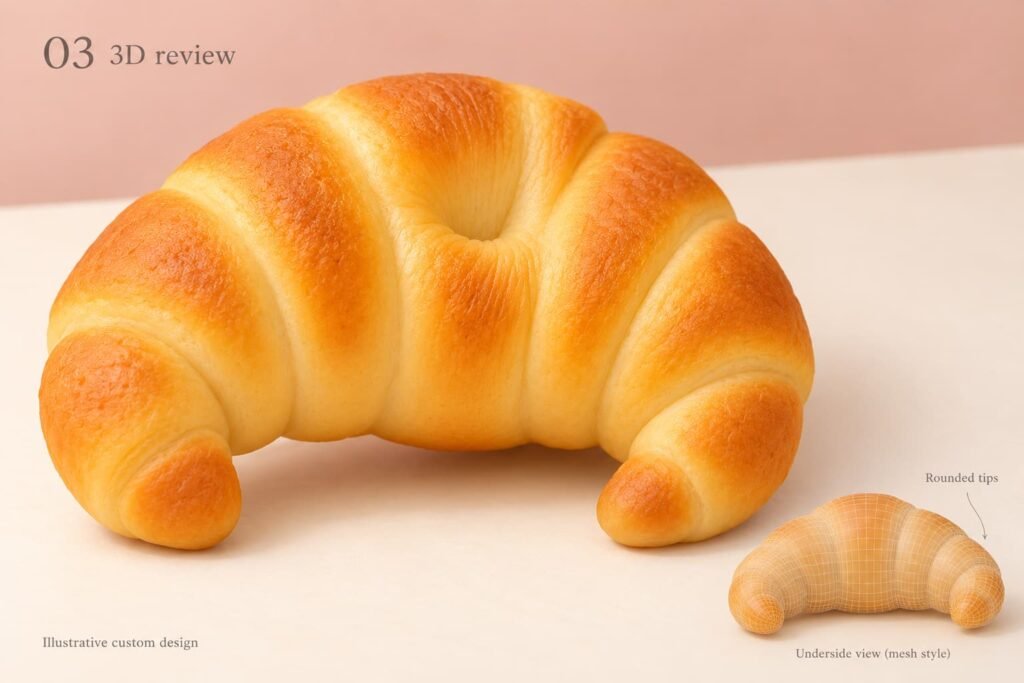
Stage 3: check the 3D form for hidden design changes
Review the croissant from top, side, and underside-oriented angles. The crescent should not turn into a closed donut, the short tips should not become long horns, and the broad bands should not turn into separate stacked pieces. Compare the render against the locked drawing rather than treating each new image as an independent approval.
Ask the supplier to assess tooling-related features and possible surface transitions. A visually smooth model does not prove mold release, process capability, or finished-product performance. Keep the discussion of geometry separate from any assumed manufacturing method.
Record modifications using a change log: revision ID, affected area, reason for change, expected visual effect, and required re-approval. A change to the inner arc may influence the tip opening and package fit. Reviewing those linked effects together reduces ambiguity.
The general mold design guide covers broader development considerations. This article concentrates on the crescent and rolled-band features of a croissant project.
Stage 4: approve the physical sample at the center, bands, and tips
The finished-product concept illustrates a soft-looking golden croissant. It does not prove foam density, squeeze resistance, recovery time, coating behavior, or durability. Those points need a physical sample and an agreed review method.
For this shape, inspect more than the thick center. Review the curved ends and the valleys between bands as well. Record the sample condition and observations without presenting informal handling as a safety or durability test.
- Center: compare handling with the agreed reference and check the overall body profile.
- Band valleys: inspect the surface and decoration in the recessed areas.
- Tips: examine appearance, rounded transitions, and any observed change after the agreed handling review.
- Whole shape: check the crescent opening and whether it matches the approved views.
- Underside: review contact surface, finish, and package orientation.
If slow-rise behavior is part of the specification, agree a method and target range for this product. Do not borrow a recovery figure from another toy or infer it from the PU name. See the recovery-time guide for that separate review.
Use a sample acceptance matrix with unresolved items visible
Give each requirement a review method and a result. A practical record can use “approved,” “revise,” or “pending information.” A pending construction, decoration, or documentation question should not disappear because the sample looks attractive.
| Approval item | Evidence to retain | Release decision |
|---|---|---|
| Crescent and dimensions | Matched views and agreed sample measurements | Approved or revised by version |
| Bands and tips | Detail photos and handling observations | Accept or specify the change |
| Color and coating | Physical reference and complete-surface review | Keep zones and method aligned |
| Feel and recovery | Agreed reference and repeatable review record | Confirm product-specific criteria |
| Packaging | Actual packed sample and orientation | Approve fit and presentation |
| Documentation | Product identity and destination-market review | Resolve before order release |
Retain the approved sample and its corresponding brief. A geometry, decoration, or packaging revision may require re-approval of the affected fields. The sample approval checklist can support version control across those records.
Check packaging around the crescent, not just a rectangular footprint
A croissant’s open center and projecting ends make orientation important. Review the actual product in the proposed pack. Confirm that its presentation keeps the crescent recognizable and that the agreed packing method does not create an unreviewed tip position.
Specify the main viewing face and where the product should sit. Evaluate a bag, tray, or carton against your channel’s needs rather than assuming a window box is always best. Ask for the actual retail and shipping pack specifications in the project quotation.
Keep the first version’s branding on the agreed package panel if a direct product mark would interrupt the pastry appearance. Any product logo placement should be assessed and sampled. Identify the item as a toy, review age positioning and required information for the destination, and avoid unsupported edible, food-grade, therapeutic, or certification claims.
Prepare a quotation-ready PU croissant brief
Send matched artwork and a clear list of unknowns. Include proposed W/D/H, the crescent direction, band count, tip notes, color zones, desired handling reference, estimated quantity, target market, and packaging preference. Mark generated renders as illustrative.
- Confirm whether an available croissant direction or a new design is the starting point.
- Ask which geometry and decoration changes affect development scope.
- Define what each sample round must demonstrate.
- Agree approval responsibilities and version identification.
- Confirm inspection, documentation, packing, MOQ, pricing, and schedule for the actual project.
Do not turn another supplier’s terms into Dongyu commitments. Use Dongyu’s development process to organize the discussion, then obtain a project-specific quotation.
Frequently asked questions
Can a PU croissant squishy have realistic roll bands?
Roll-band appearance can be discussed through drawings, color zones, and samples. Ask which details belong in geometry or decoration and confirm feasibility rather than expecting every pastry flake to be reproduced.
What dimensions should a croissant brief include?
Define overall span, footprint depth, and height, with units and measurement points. Include the inner-gap direction where important. Actual values and acceptable variation must be agreed for the product.
Can a 3D render replace sample approval?
No. It supports appearance and geometry review. Physical samples are needed for handling, finish, dimensions, and package fit; appropriate testing and documentation remain separate.
Does a best-seller croissant reference guarantee demand?
No. It is a reason to investigate the category, not a sales forecast. Validate the original design with your channel and commercial assumptions before an order decision.
Discuss your custom PU croissant squishy project
Send Dongyu Toys your custom PU croissant squishy design brief with authorized references, proposed dimensions, color zones, quantity estimate, and destination market. Ask for feasible development options and a sample-review plan that connects the drawing, 3D direction, physical product, and packaging.