Dongyu Insights
Custom Pickle Squishy Toys: TPR OEM & Private Label Guide
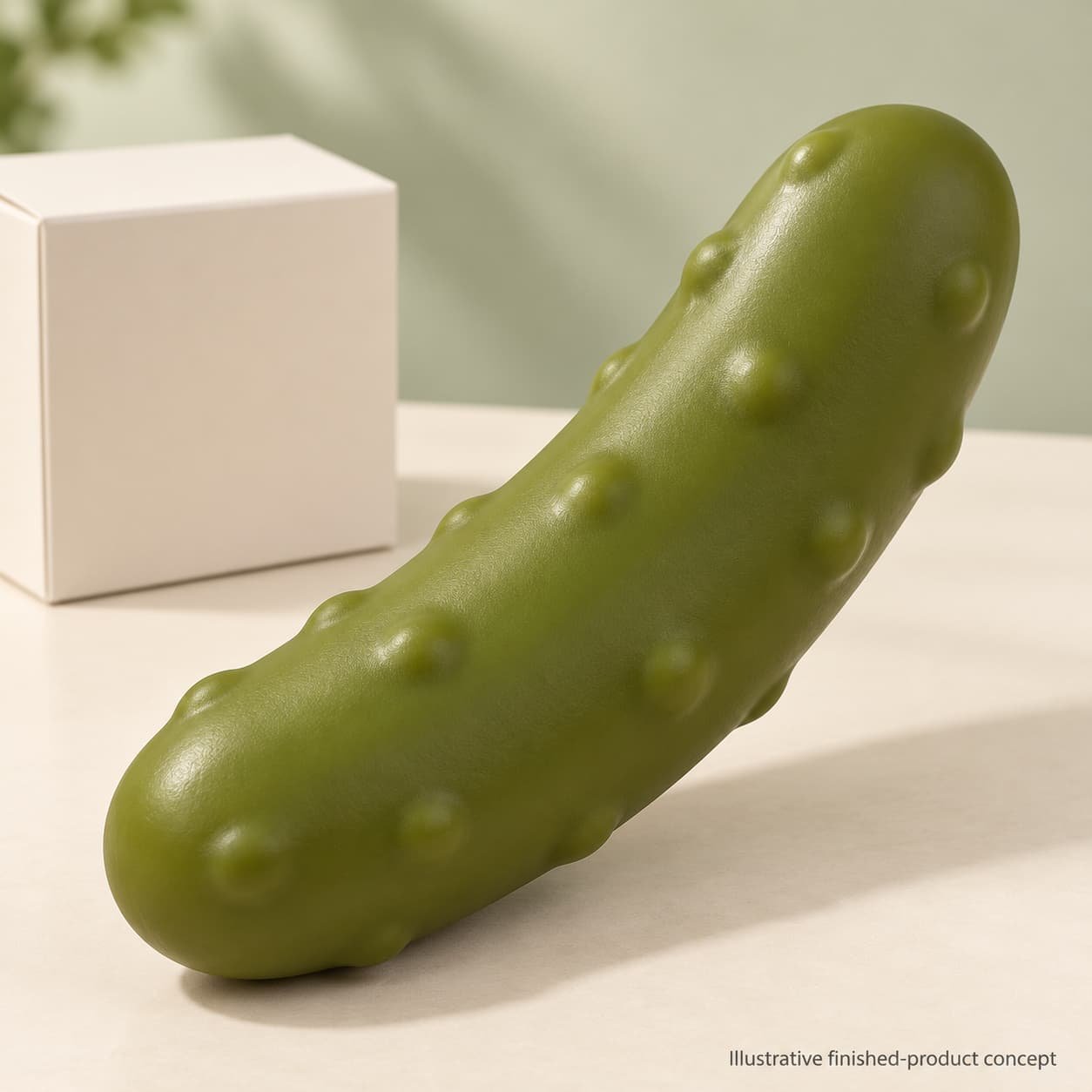
Custom pickle squishy toys need more than a popular food shape. A wholesale buyer must define the grip size, surface feel, decoration, packaging and sample checks before a supplier can quote a repeatable product. This guide focuses on an original TPR pickle concept for private label and OEM sourcing, not a replica of a branded retail toy.
Start with a simple question: what should the customer receive and experience? A compact desk squeeze toy, a jumbo novelty gift and a retail display assortment are different projects, even when all three resemble a pickle. The brief below turns that decision into information a manufacturer can review.
What overseas retail signals actually tell buyers
During research on October 29, 2026, Five Below’s US Best Sellers search result included SmushMart Squishy Pickle. That is retailer category evidence, not a numbered sales ranking: the displayed sort was Featured and no sales window was supplied. Target separately listed Sunny Days Squeezy Pickle, TCIN 94757101, with material information and customer reviews. Its listing supports category presence but did not establish a current bestseller rank for that SKU.
These are different branded products, not interchangeable specifications. Their visibility supports researching pickle-shaped squeeze toys; it does not prove global leadership or guarantee demand for a new private label line. Check your own customer profile, selling price and distribution channel before committing. The opportunity here is an original, well-specified product that answers a buyer’s sourcing questions.
Define the custom TPR pickle project before requesting a quote
For the illustrated concept, the design language is deliberately restrained: one gently curved, elongated body, rounded ends, low rounded surface bumps and a single olive-green color. There is no borrowed face, logo, character or branded package. The shape is a proposal for supplier feasibility review, not confirmation that Dongyu has an existing mold or stock.
Use Dongyu’s custom project page to discuss the development route. Ask whether a suitable existing tool is available, whether modifications are possible, or whether a new tool would be needed. Do not treat an AI rendering as evidence that a mold is ready.
Copyable buyer design brief
| Field | Buyer input | Supplier confirmation |
|---|---|---|
| Project and version | PK-01, Rev A; original pickle concept | Quote and sample reference use the same revision |
| Market and channel | Country, intended audience, retail or online channel | Applicable evaluation and documentation plan |
| Size | Overall length L and maximum diameter D in mm | Feasible dimensions, measurement method and tolerances |
| Material and feel | TPR direction; desired squeeze and surface behavior | Compound, construction and any filling proposal |
| Appearance | Olive color C1; rounded ends; low rounded bumps | Color reference, finish and manufacturable detail |
| Branding | Packaging artwork; optional on-product mark | Suitable placement and decoration method |
| Order plan | Quantity per SKU and color; repeat-order expectations | MOQ breakdown, costs and order assumptions |
| Packaging | Individual pack, display needs, barcode information | Pack fit, compatibility and carton proposal |
| Schedule | Required arrival date and destination | Sampling, revisions, production and freight separately |
Stage 1: use the sketch to settle silhouette and grip
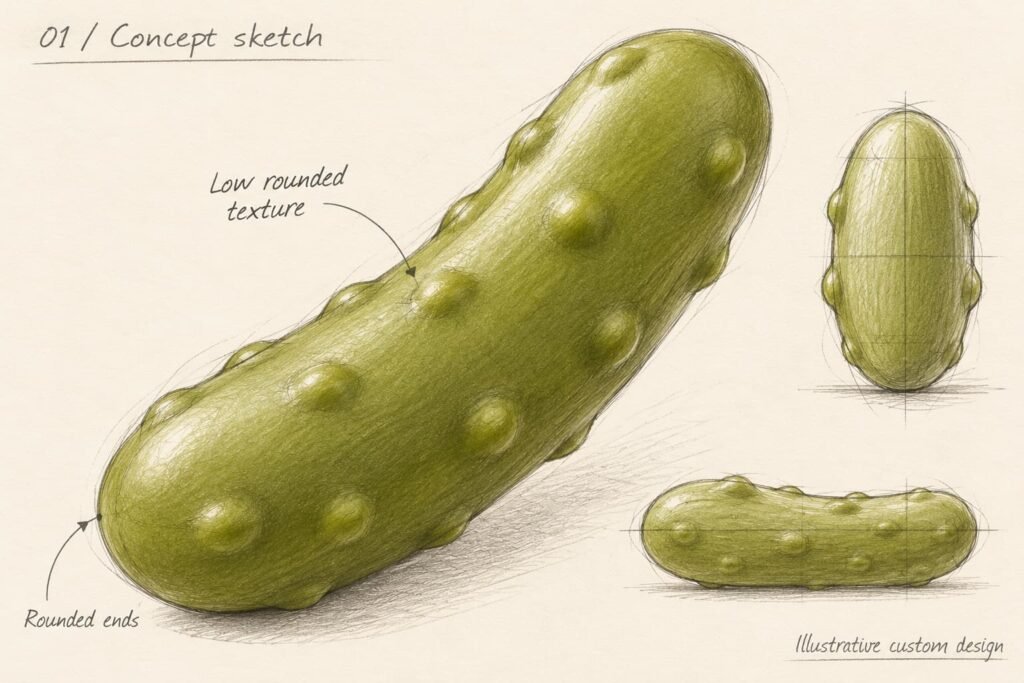
The sketch should explain the design, not merely make it look attractive. Show the curve, both rounded ends and the distribution of bumps. Keep the outline readable at the intended size. A long narrow end or an exaggerated protrusion can change how the product feels and where it is stressed during squeezing; ask the manufacturer to review these areas.
Discuss the intended handling action explicitly. Is the user expected to compress the body in one hand, or is the project a larger novelty item? Avoid casually promising stretching, twisting or extreme compression in marketing. Any such intended use needs a construction and evaluation plan agreed for the actual product.
The illustrated sketch is a communication aid. Its small thumbnails explore the same product, not additional SKUs. Approving this stage means agreeing the silhouette direction only; it does not approve material, dimensions, durability or production tooling.
Stage 2: annotate the colored views without inventing engineering values
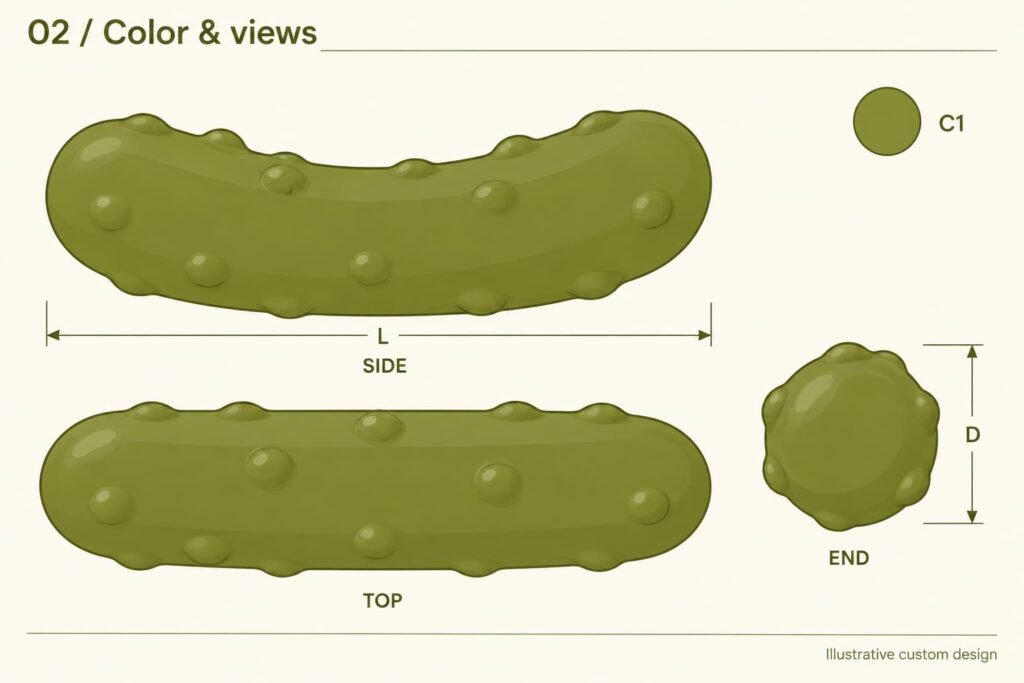
Prepare side, top and end views with a consistent orientation. Label overall length L, maximum diameter D and the color zone C1. Put numerical values in the controlled specification once buyer and supplier agree them. A letter on a concept sheet is a reference label, not a dimension.
Define how the relaxed product will be measured: orientation, resting condition and points of contact. Otherwise two people can report different lengths for the same curved soft object. Ask the factory to propose a practical measuring method rather than assuming a rigid-part drawing convention will work unchanged.
- Use one unit system and identify the approved drawing revision.
- Reference a physical color target where possible; screen colors are only directional.
- Separate molded texture from any printed or painted features.
- Identify proposed branding zones without claiming a decoration method is already approved.
- Record unresolved features as pending, not as silent assumptions.
Keep the original source artwork and a dated review PDF together. Once physical color samples exist, attach their identifiers to the specification. Dongyu’s color matching guide can support that discussion without turning this page into a general color tutorial.
Stage 3: review the 3D form, then confirm the construction
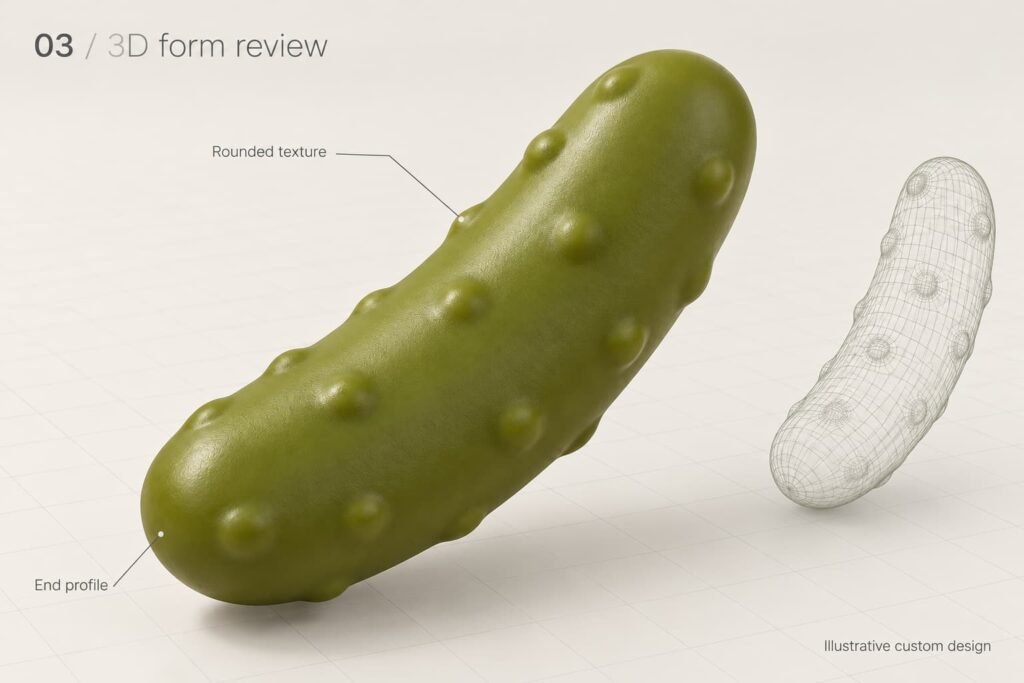
A colored 3D concept helps reveal whether the bumps are too prominent, whether the curve is balanced and whether the ends look abrupt. Review the object from more than one angle and compare it with the approved views. A smooth render can hide awkward transitions, so ask for a form review rather than approving a beauty image alone.
The generated 3D image is illustrative, not editable CAD, a mold drawing or a test result. The supplier still needs to confirm how the product would be made. If a filled construction is proposed, obtain the exact outer material, filling identity, closure approach and compatibility evaluation. Do not infer the contents from the word TPR or from another retailer’s product.
Engineering questions that remain open
Request confirmation of compound selection, construction, wall or section requirements where relevant, tooling split, closure or fill point if applicable, allowable surface features, decoration compatibility and packaging contact materials. Also agree how recovery and squeeze feel will be assessed. No universal value for hardness, recovery time or wall thickness should be copied from a competing SKU.
Compare MOQ and quotations on the same specification
Ask for minimum quantities by shape, color, decoration and packaging version. A quoted total order minimum may still leave an individual color below its production requirement. Separate the first order from repeat orders, and clarify whether quantities depend on an available tool or a new development.
Request itemized costs for tooling or modifications, samples, sample shipment, unit production, branding, individual packaging, display cartons and freight assumptions. State the destination and requested trade terms. A low unit price is not comparable if one quote includes retail packaging and another assumes loose bulk packing.
For a smaller trial order, ask which specifications can remain unchanged to simplify the project. An existing approved construction with one color and one package may be easier to evaluate than several simultaneous variations. That is a question for the supplier, not a promise that a low MOQ is available.
Use the custom squishy quotation checklist to compare the full scope. Obtain written lead-time assumptions and identify when the clock starts: artwork approval, sample approval and order confirmation can be separate milestones.
Approve physical samples with a clear acceptance matrix
Do not approve bulk production from the four concept pictures. Request physical samples representing the intended material, construction, finish and packaging. Record observations against an agreed reference sample and specification. The following matrix is a project worksheet, not a legal or industry standard.
| Check | Review method | Decision record |
|---|---|---|
| Shape and dimensions | Compare relaxed sample with approved views and agreed measuring method | Actual measurements; agreed tolerances; pass or revise |
| Squeeze and recovery | Use the agreed handling sequence and recorded conditions | Reference sample ID; acceptable behavior |
| Surface and color | Compare physical color and finish under agreed viewing conditions | Transfer, tack, defects and color observations |
| Texture and ends | Inspect transitions and handle as intended | Unwanted sharp-feeling details or visible damage |
| Construction integrity | Apply the supplier-agreed evaluation for the actual construction | Damage, opening or leakage observations where applicable |
| Packaging contact | Review packed samples after agreed storage and handling | Sticking, staining, deformation and pack fit |
| Branding and documents | Check artwork version, placement and product-specific records | Correct files and unresolved requirements |
For each row, identify who evaluates it, what evidence is retained and who can authorize a deviation. If a sample fails, document the cause and retest the revised version. A verbal “looks fine” should not replace a traceable approval record. See the sample approval checklist for a broader workflow.
Make private label packaging part of the product decision
Food-shaped toys need packaging that communicates their purpose clearly. Keep the retail identity distinct from edible pickle packaging; avoid presentation that encourages confusion with food. Agree the intended audience, instructions, labeling and destination-market review with appropriate specialists for the final product.
For online sellers, confirm individual pack protection and the space needed around the curve and rounded bumps. For retailers, check how the product sits in a display and whether a customer can identify the toy without opening every pack. Compare package dimensions and packed weight before estimating delivered cost.
Branding can begin on the package if on-product printing would interfere with the texture or feel. If a printed logo is required, ask the supplier to propose a suitable zone and demonstrate its appearance and durability on a representative sample. Do not assume ink adhesion from a digital mockup.
Control revisions from first design to approved sample
Use a simple naming convention such as PK-01-RevA for the initial brief, RevB for a changed outline and RevC for a revised packaging layout. Keep a change log stating the date, change, reason and approver. Record separate artwork and sample IDs when their revisions differ.
Before issuing the production approval, check that the quotation, drawing, material description, approved sample and packaging all reference the current agreed specification. A color revision should not silently alter the construction, and an updated package should not reset the approved shape. Ask how changes after approval affect price and schedule.
Frequently asked sourcing questions
Can a custom pickle squishy use my own shape and packaging?
Submit the original design for feasibility review. The supplier must confirm the tooling route, construction and package options. A custom request does not establish that a suitable mold or packaging line already exists.
What is the MOQ for private label pickle squishy toys?
Request a project-specific minimum by shape, color and package. Provide quantities for each version and ask which setup choices affect the minimum. Do not rely on another supplier’s advertised MOQ.
Can the finished product match the AI concept exactly?
The concept establishes visual direction only. Material behavior, texture and manufacturing constraints may require changes. Approve the final specification and physical sample before treating an appearance as the production target.
What should I send for an OEM quotation?
Send original artwork or sketches, target dimensions, quantity per SKU, destination, intended audience, desired feel, branding, packaging and arrival deadline. Mark unknown parameters and ask the supplier to propose options instead of guessing.
Request a custom pickle squishy feasibility review
Ready to develop an original TPR pickle squeeze toy? Send Dongyu Toys your project brief with the drawing revision, target size, quantities and sales market. Request confirmation of the tooling route, material construction, MOQ, sampling steps and itemized quotation. Keep unresolved engineering and market requirements visible until they are agreed.