Dongyu Insights
Custom TPR Peanut Squishy Design: Waist, Shell Texture and Sampling
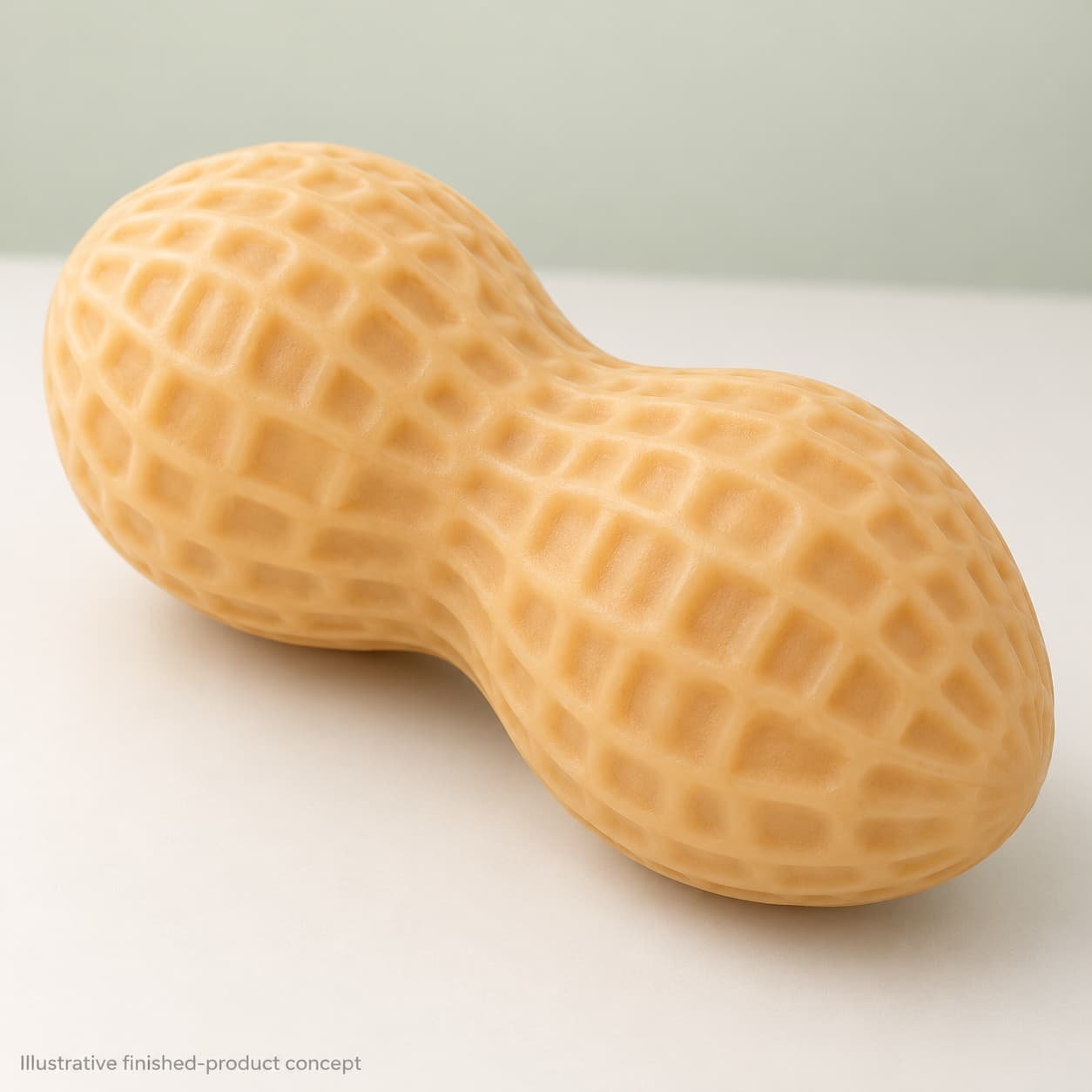
A custom TPR peanut squishy can look convincing in a sales image and still be difficult to approve for production. The important decisions are not simply “make it beige” or “add a peanut texture.” Buyers need to define the two-lobe silhouette, the transition through the waist, the surface relief, and the intended squeeze experience separately.
This guide turns one original peanut concept into a supplier-ready discussion package: sketch, colored views, illustrative 3D review, and sample acceptance records. It is a project communication framework, not an industrial or legal standard. All dimensions, construction details, performance limits, and market-specific requirements must be agreed with the supplier before production approval.
Why develop a peanut-shaped squishy?
On October 19, 2026, the publicly accessible Faire peanut-crunch directory displayed Bestseller labels beside several peanut-shaped squishy listings. These are platform merchandising signals, not independently audited unit sales or proof of worldwide leadership. They support investigating the category, not predicting sales for a new design.
A separate merchant product page explicitly offers a TPR peanut toy. Its filling and specifications belong to that listing; they do not define this project. Likewise, Dongyu’s peanut squishy product page provides a relevant shape reference, but buyers should request written confirmation of the material and construction proposed for their own order.
The design opportunity is a familiar, easy-to-recognize whole-shell silhouette with an original texture layout and private-label presentation. Copy category cues, not another seller’s exact sculpt, distinctive graphics, packaging, or brand identity.
Start with a custom TPR peanut squishy design brief
Use the following table as a working brief. Replace every open field before requesting a production quotation. A blank field is a question, not permission for an undocumented substitution.
| Brief field | Project direction | Approval evidence |
|---|---|---|
| Project and revision | PN-01; geometry G01; texture TX01; color C01; packaging PK01 | One dated release index naming the approved files |
| Product identity | Whole peanut shell; two rounded lobes; broad waist; no face or detachable decoration | Sketch and aligned orthographic views |
| Envelope dimensions | Overall length L, maximum width W, thickness T; values pending | Dimensioned drawing with units and agreed tolerances |
| Local geometry | Waist width, lobe balance, end curvature and resting orientation | Marked view and supplier feasibility response |
| Surface | Low shell-like relief, rounded transitions, warm honey-beige appearance | Texture detail and physical appearance reference |
| Material and construction | TPR direction; formulation, body construction, any filling and closure pending | Written supplier proposal linked to the sample |
| Feel and sound | Buyer to specify the desired squeeze, recovery and sound separately | Agreed comparison method and acceptance limits |
| Channel and packaging | Buyer to identify market, intended user, retail or online channel and pack format | Approved pack specification and requirement review |
Do not insert a competitor’s dimensions merely because its product looks similar. Establish the intended hand scale, packed size and display use for your own project. Ask the supplier to flag cost and feasibility consequences before the brief becomes a purchase specification.
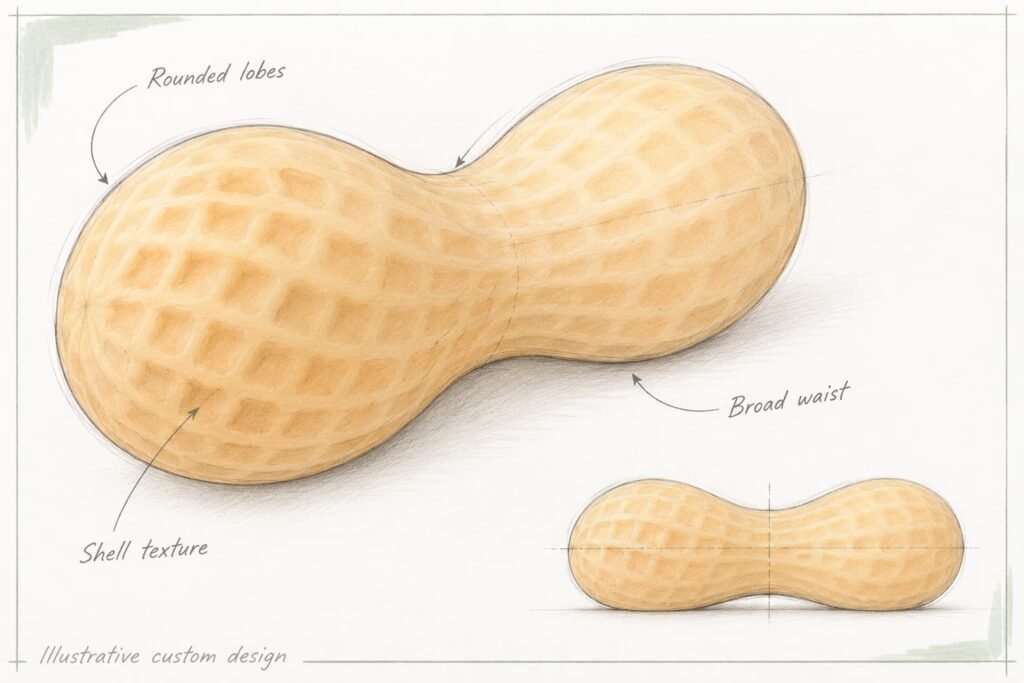
Stage 1: sketch the silhouette before the shell pattern
Draw the outline without texture first. Both lobes should remain recognizable when the sketch is viewed at thumbnail size. A narrow, sharply pinched waist may look dramatic but changes the deformation and appearance during squeezing; its suitability needs supplier review rather than an assumption based on the illustration.
Mark the centerline and the location of the narrowest waist. Decide whether the lobes are intentionally balanced or slightly asymmetric. If asymmetry is intentional, label it. Otherwise, a supplier may “correct” a feature that the buyer wanted to keep.
- Show one principal view and a side study, not four unrelated peanut shapes.
- Keep shell-texture marks light enough that the underlying outline remains visible.
- Use a callout for the resting face if a stable retail display orientation matters.
- Separate essential features from optional styling changes.
The sketch is a direction-setting tool. It does not establish wall thickness, mold release, a closure location or structural performance. Put these questions into the supplier review log instead of drawing invented answers.
Stage 2: build a colored peanut squishy design sheet
Define top, side and end views consistently
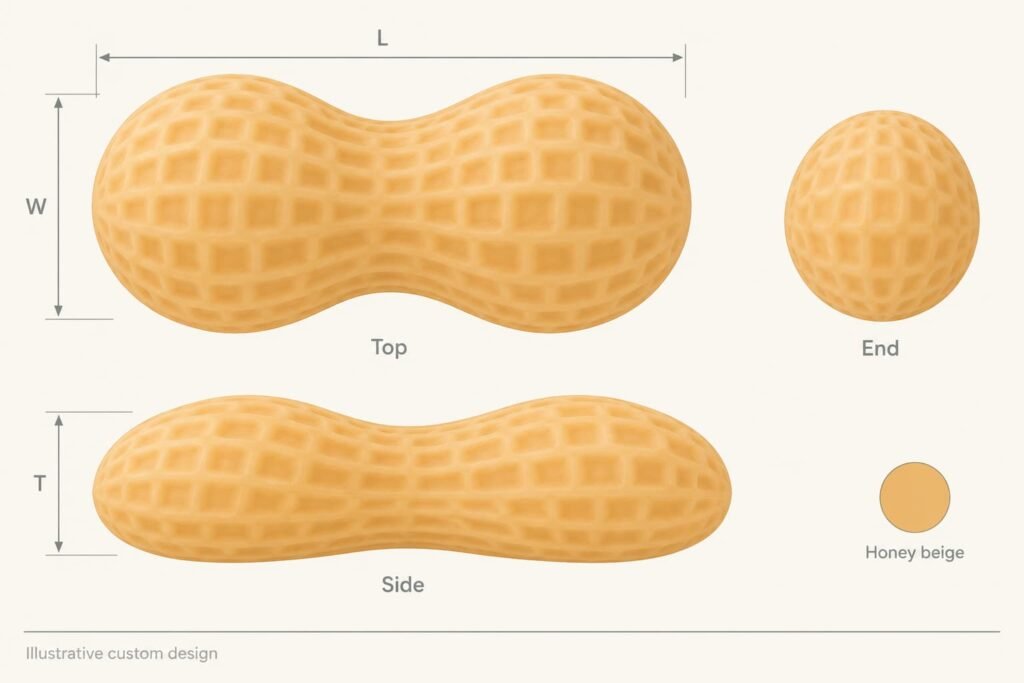
For this elongated product, use a top view with L running horizontally, a side view with the same length orientation, and an end view looking along the length. The end view should describe the cross-sectional envelope, not repeat the two-lobe top silhouette. Keep the views aligned and identify which end is being viewed.
Measure W at the widest lobe and call out the waist width separately. They are different dimensions. Define T from the side view. State whether dimensions describe the relaxed, unloaded article, and agree on the measurement conditions for a soft product. Never read a precise production dimension from a perspective rendering.
Annotate texture as a controlled feature
Use a small set of numbered callouts: G for geometry, TX for texture, C for color and PK for packaging. These are suggested project codes, not standardized engineering symbols. Each code should point to a single note in a legend or issue list.
For TX01, describe the visual character of the relief, its intended coverage and the transition near the waist and ends. A flat grid stretched around a curved body can become crowded at the ends or distorted at the waist. Request a supplier proposal for those transition zones rather than assuming the pattern will wrap automatically.
A decorative longitudinal ridge is not necessarily the mold parting line. Mark an aesthetic ridge as an aesthetic feature. Let the supplier identify the proposed parting line, any filling opening and closure separately, then review their effect on appearance and handling.
Stage 3: use 3D review to resolve shape questions
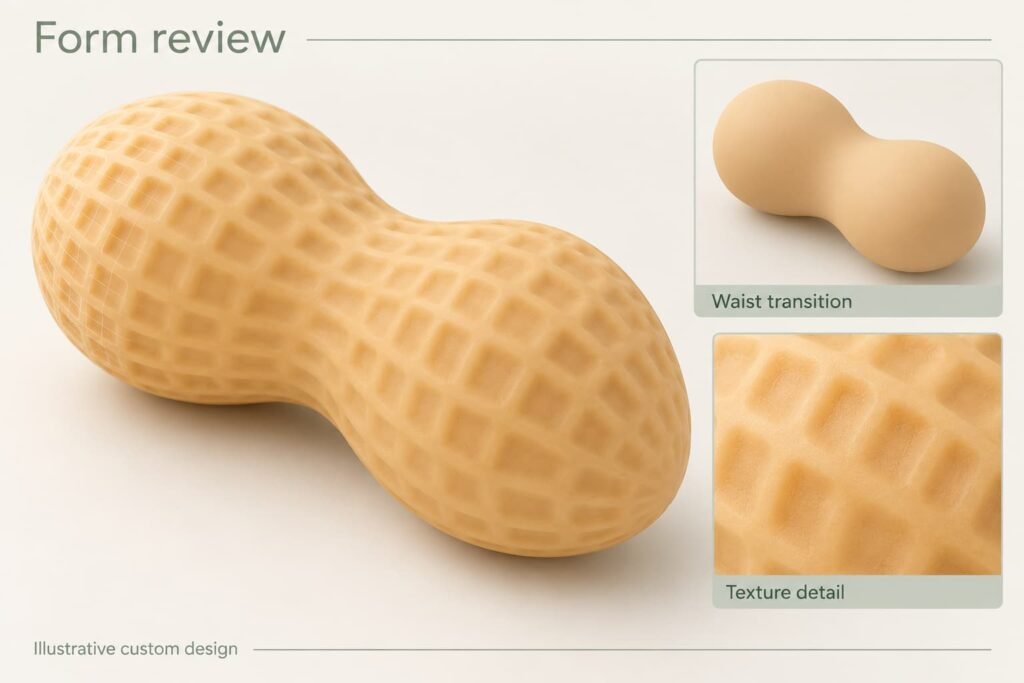
A colored 3D illustration helps buyers review lobe volume, waist transitions and how the shell relief reads under light. It is not an editable CAD file, manufacturing simulation or evidence of a completed sample. Request the actual engineering deliverables separately if the project requires them.
Review the form in a neutral material first, then the intended color. Strong shadows can make shallow texture appear deeper than it is. Ask for consistent lighting across revisions and include an untextured view when judging the silhouette. Do not approve geometry merely because the surface rendering looks attractive.
- Check that the outline agrees with the approved sketch and colored views.
- Review the waist from oblique and side directions, not only from above.
- Check texture transitions at the ends and around the waist.
- Record proposed seam or closure locations as unresolved until the supplier confirms them.
- List every revision with its reason and the files it affects.
Confirm construction before approving squeeze behavior
The word TPR does not identify a complete formulation, internal structure or filling. A peanut-shaped exterior also does not establish whether the toy will be crunchy, quiet, slow-recovering or fast-recovering. Those are separate commercial and engineering decisions.
If a buyer wants sound, describe that requirement explicitly and ask what construction can deliver it. Do not assume molded shell texture creates the sound advertised for a filled competitor product. Request the proposed material and any filling information, closure method, compatibility review and relevant documentation before accepting a sample.
For a quiet product, write that intention into the brief too. A supplier should not add a filling, fragrance, loose component or coating because it is common in another market listing. Any substitution needs a recorded approval and an assessment of the affected requirements.
The supplier should confirm feasible dimensions and tolerances, relief height and spacing, formulation, construction, tooling approach, seam treatment, production variation and suitable inspection methods. Quotation variables such as MOQ, tooling cost, sample cost and timing must be confirmed for the actual project; this guide makes no promises about them.
Create a peanut squishy sample acceptance matrix
Use physical samples to close questions that images cannot answer. Before evaluation, agree on the sample condition, comparison references, inspection method, quantities and pass/fail limits. “Feels good” is useful initial feedback but not a repeatable production acceptance rule.
| Feature | Suggested evaluation | Record before approval |
|---|---|---|
| Silhouette and waist | Compare relaxed sample with approved views; measure agreed locations without unintended compression | Actual results, conditions, tolerances and disposition |
| Shell relief | Inspect under consistent light; compare texture coverage and agreed tactile reference | Approved detail reference and unacceptable deviations |
| Color and finish | Compare with physical color reference using the agreed lighting method | Reference identification, finish and allowable variation |
| Squeeze, recovery and sound | Use the buyer-supplier procedure and intended handling conditions | Procedure, limits, observations and sample identity |
| Seam or closure | Inspect the supplier’s actual construction and agreed handling checks | Location, appearance limits and engineering review outcome |
| Packaging contact | Evaluate the packed sample under agreed storage and distribution conditions | Surface marking, deformation, pack fit and disposition |
| Market requirements | Review the applicable requirements for the defined market, user and product construction | Responsible reviewer, documentation and outstanding actions |
This matrix does not replace a market-specific safety assessment or required testing. A realistic food-shaped appearance should be included in the product review; intended age, warnings and selling market cannot be inferred from an attractive concept image.
Keep an approved physical reference sample when appropriate, with its revision and construction identified. See the custom squishy sample approval checklist for a broader approval workflow.
Control revisions and private-label packaging together
Use a release index such as PN-01_G02_TX03_C01_PK02, with a date, owner and approval status. Keep a change log stating what changed and why. An approved geometry revision must not silently inherit an unapproved texture or filling from another sample.
For example, if the waist becomes broader, revisit the texture mapping and pack cavity rather than changing only the outline file. If texture becomes more pronounced, review its appearance, handling and packaging contact again. Ask the supplier which other approval items are affected.
A textured peanut surface may not be a suitable place for small brand lettering. Request a printing feasibility sample if direct decoration matters; otherwise, consider private-label identity on the package. Provide artwork, placement, language and barcode requirements separately, and verify them on the packed sample.
Keep the product distinguishable from edible goods through the complete presentation and requirement review. Do not add food-contact, non-toxic, certification or therapeutic claims without appropriate substantiation. For broader branding decisions, explore custom logo and packaging options.
Frequently asked questions
Can a supplier quote from a peanut squishy sketch?
A sketch can start a feasibility discussion. A useful quotation also needs target dimensions, material direction, proposed construction, quantity, packaging, market and customization scope. Ask the supplier to state assumptions and exclusions.
Does TPR automatically mean a crunchy peanut toy?
No. Material name, construction, filling, sound and recovery are separate specifications. Review the proposed combination on physical samples rather than importing claims from another seller’s listing.
Is the 3D illustration a production-ready design?
No. The illustrations communicate appearance. Engineering files, tooling decisions and production specifications require a separate supplier review and approval process.
Can the same peanut shape use different brand colors?
A color family can retain the same geometry, but formulation, decoration, appearance and packaging compatibility still need confirmation. Approve each intended color against an identified reference.
Send a focused peanut squishy customization inquiry
Ready to discuss a custom TPR peanut squishy? Send Dongyu your sketch, target market, intended user, quantity, L/W/T targets, preferred squeeze experience and packaging direction. Identify which details are fixed and which need a supplier proposal.
Contact Dongyu Toys to discuss feasibility, sampling and quotation requirements. Include the brief, annotated views and revision index so the conversation can move from a visual idea to an approval plan. The images accompanying this guide are illustrative concepts, not photographs of completed physical samples or verified engineering files.