Dongyu Insights
Custom PU Donut Squishy Design: Hole Size and Frosting Artwork
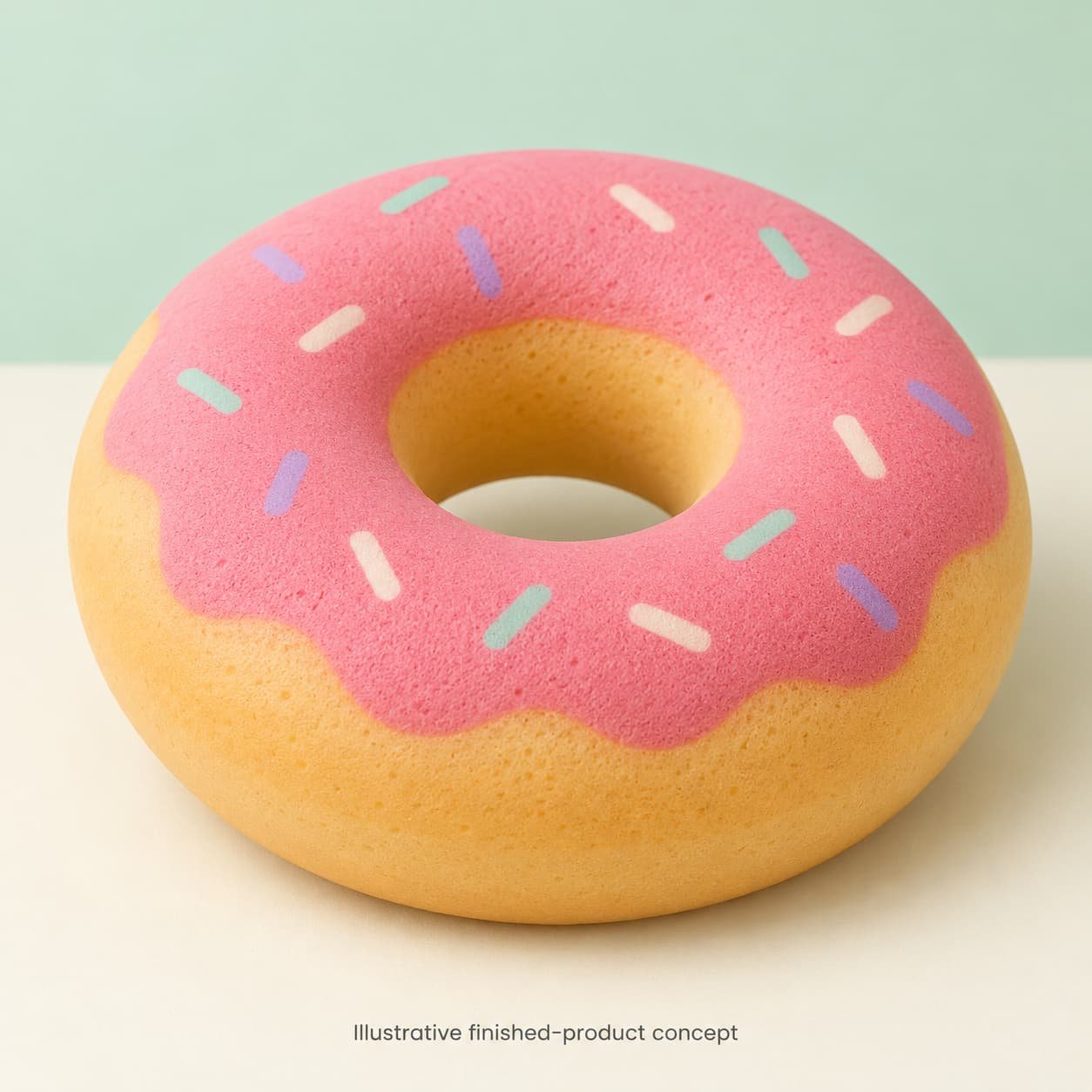
Custom PU donut squishy design is not defined by outside diameter alone. The center opening, ring width, body height, frosting boundary, and sprinkle artwork all affect what a buyer is actually approving. A supplier needs those decisions in one brief, not scattered across an attractive render and several emails.
This guide develops one original ring-shaped concept: a rounded golden-tan body, an open center, a dusty-pink upper color region, and sparse flat sprinkle marks. It explains how to move from sketch to colored views, 3D review, and physical sample acceptance. All four images are illustrative designs; none is a completed Dongyu sample or a calibrated production drawing.
Dongyu’s homepage includes donuts within its food assortment, while its food squishy range describes custom food-shape, color, hand-feel, and packaging development. Request PU foam explicitly and ask the supplier to confirm the construction and development scope for your original design.
Choose a ring-donut brief instead of copying a retail item
Public wholesale listings contain conventional foam donuts, character donuts, removable-topping products, and other squeeze formats. Some indexed marketplace listings carry Bestseller labels, but that does not establish worldwide leadership or prove that a new pink ring design will sell. Use market references to understand familiar product features, not to copy a competitor’s sculpt, pattern, package, or brand.
Define the first project narrowly: one ring body, one lead colorway, flat decoration, and a separate packaging brief. The concept here excludes a face, animal ears, a keychain, removable toppings, and a scent claim. Adding any of these later should trigger an explicit scope review, not a casual change to the hero image.
State the intended channel, destination, proposed users, quantity scenarios, and retail format. A promotional stress item and a children’s toy program are not interchangeable just because both use a donut silhouette. Have the actual project assessed for its intended use and market rather than copying another seller’s labeling.
Stage 1: draw the opening before decorating the ring
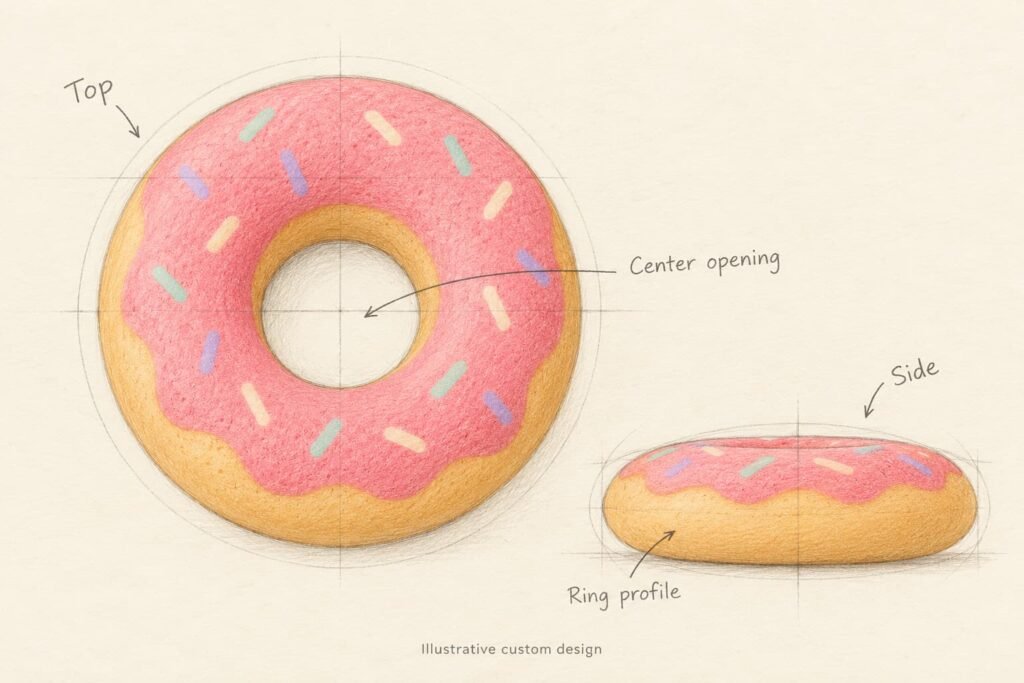
Start with a top sketch showing both the outer outline and the center opening. Add a side profile to define height, rounded shoulders, and the underside. Decide whether the opening is intended to be circular and centered, and whether the ring is visually even around it.
Use three separate size references
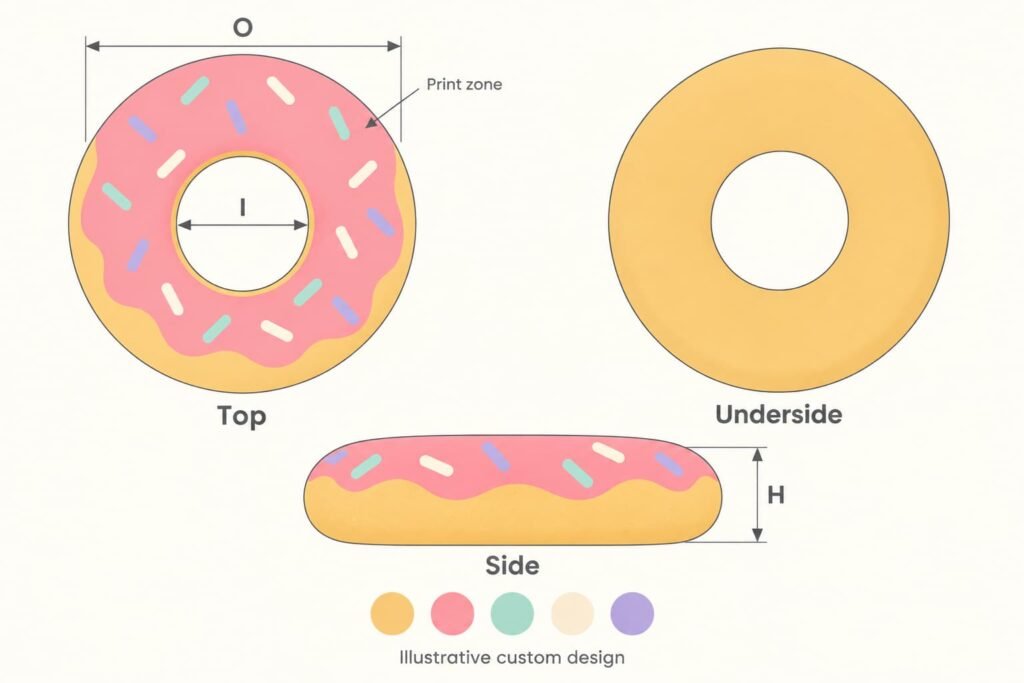
- O: the proposed outer diameter, with measurement points identified.
- I: the proposed clear inner opening, with its measurement plane identified.
- H: the proposed overall height in the agreed uncompressed state.
For a concentric circular plan view, the radial ring width is (O − I) ÷ 2. This is a geometric relationship, not a foam wall-thickness requirement or an approved engineering limit. Increasing the opening while holding the outside diameter unchanged reduces that plan-view width.
If the opening is offset or irregular, one average diameter does not describe the narrowest part of the ring. Ask the supplier to identify the relevant local widths and review the actual geometry. Do not take measurements from an AI image or assume its apparent symmetry is exact.
Keep proposed values, units, measurement conditions, and acceptable variation together in the supplier-reviewed drawing. A label such as “palm size” can help communicate an idea, but it cannot replace the dimensional brief.
Stage 2: separate the shape sheet from the decoration layers
For a donut, top, side, and underside views are more useful than three almost identical overhead pictures. The top shows the opening and decoration map; the side shows height and color coverage; the underside records the base appearance and any proposed marking area. Label the views explicitly.
Keep geometry, frosting color, sprinkle artwork, and optional branding on separate layers. This allows a buyer to change the pink without silently changing the center opening or replacing the ring profile.
| Brief field | Buyer input | Supplier confirmation |
|---|---|---|
| Project identity | Original ring donut; project code and revision | Matching reference on quotations, drawings, and samples |
| Material direction | PU foam and a desired physical feel reference | Proposed construction, finish, and sample approach |
| Geometry | O, I, H; centered opening; rounded ring; underside direction | Values, units, measurement points, variation, and tooling review |
| Frosting appearance | Dusty-pink upper color region and its boundary map | Application method and whether any relief is proposed |
| Sprinkle artwork | Flat mint, cream, and lavender dashes; coverage and exclusion zones | Decoration feasibility, placement method, and sample reference |
| Commercial scope | Market, proposed users, quantity scenarios, pack direction | Quotation inclusions, documentation scope, and schedule |
This is a communication template, not a legal or industrial standard. Leave unresolved engineering cells marked pending, with an owner and next action. Do not fill them with dimensions or performance numbers borrowed from a market reference.
Define what “frosting” means on the manufactured product
A pink region can look like icing without being a separate component. For the lead concept, frosting means a colored region on the upper foam surface. Its gently uneven boundary is a decoration direction, not proof of a thick molded layer or a removable topping.
Ask the supplier whether the requested appearance is proposed through color alone, shaped relief, a coating, or another method. If relief is proposed, review it as a geometry change. A render should not decide construction on the supplier’s behalf.
Show where the pink stops on the outer shoulder and near the inner rim. Review top and side views together: a pleasing top image may hide color extending much farther down one side than intended. Record the underside color separately rather than letting it inherit unexplained shading from a render.
Agree physical color references and viewing conditions. The tan base and pink region should be judged on the actual proposed finish, not only on a screen. Use the color matching guide for the wider reference process; keep this product sheet focused on coverage and boundaries.
Treat sprinkle graphics as an artwork map, not loose decorations
The concept requests flat printed dashes, not attached rods or edible-looking loose particles. State that intent clearly and ask the supplier to confirm the proposed decoration method. If the process requires a different approach, resolve it before approving the artwork.
Mark where the pattern should and should not appear
Define the active sprinkle zone on the pink region and identify areas near the inner rim and outer color boundary that should remain clear. Agree actual distances or placement criteria during technical review; there is no universal exclusion width supplied by this illustration.
Choose whether exact dash positions matter or whether an agreed coverage pattern is sufficient. If positions are fixed, provide controlled artwork. If controlled variation is acceptable, identify the limits and approve representative samples. Avoid telling inspection to count a specific number while the released artwork allows free placement.
Keep a blank branding area separate if required. Do not simply print a logo over the sprinkle field and expect a small curved ring surface to behave like a flat packaging panel. Review product marking and package branding as distinct tasks.
Stage 3: inspect the inner rim and side profile in 3D
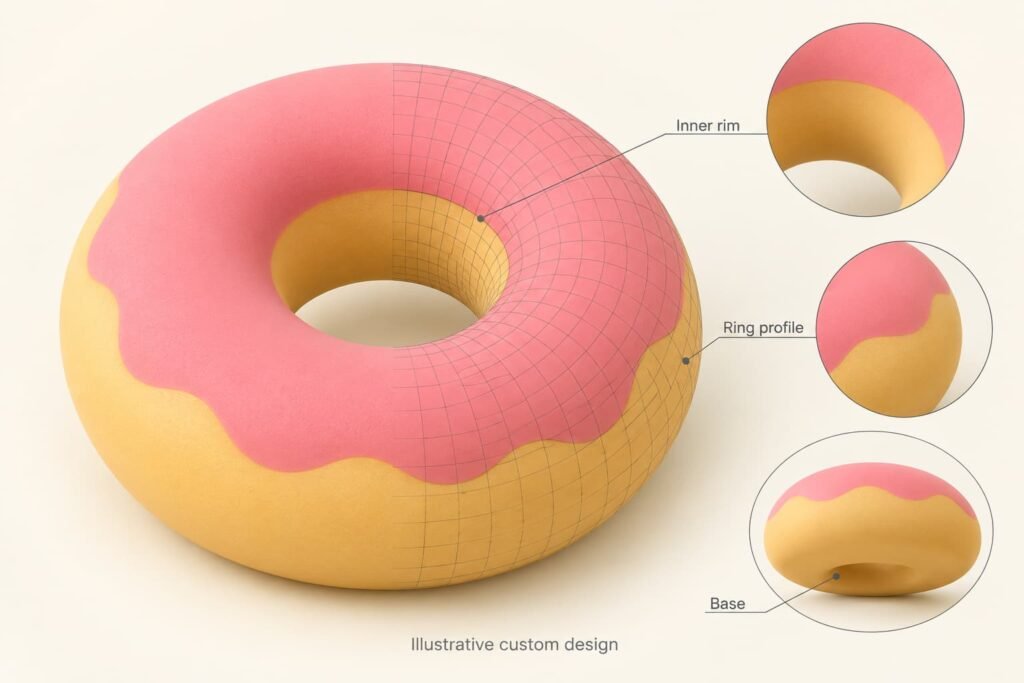
A useful volume review makes the center opening and ring profile visible without relying on realistic pastry texture. Check the curve into the opening, the highest part of the body, the transition to the underside, and the relationship between the outer and inner outlines.
The illustrative 3D review uses a smooth colored form and partial mesh. It is not actual CAD and cannot establish tooling feasibility, material behavior, or manufacturing-line position. Ask the supplier to propose the tooling division, expected surface marks, and any geometry revisions.
A donut may look open from above while its inner profile changes through the height. Ask which opening dimension is being controlled and where it is measured. If a revision alters the inner curve, revisit the drawing, frosting boundary, and artwork exclusion zone together.
Do not approve recovery behavior, squeeze feel, or decoration durability from a 3D picture. Those are physical sample questions requiring agreed conditions, methods, and acceptance rules.
Control geometry and artwork revisions separately
Use linked identifiers for the body drawing, color map, sprinkle file, and packaging artwork. For example, DONUT-A-G02 can identify a geometry revision and DONUT-A-A03 an artwork revision. The naming system is a project convention, not an industry standard.
Record what changed, who requested it, which files are affected, and what approval remains open. A larger opening is a geometry change; a new sprinkle color is an artwork change. A revised ring height may also require another pack trial even when the top view is unchanged.
- Sketch review: agree the ring outline, opening direction, and scope exclusions.
- Supplier review: confirm dimensions, proposed construction, and unresolved engineering points.
- Decoration review: link the current color map and sprinkle artwork to the current geometry.
- Physical review: identify the received sample and record accepted and unresolved items separately.
Use a donut-specific physical sample matrix
The table below helps buyers agree what evidence to keep. It does not invent a minimum ring width, recovery time, squeeze-cycle count, or inspection tolerance.
| Review area | Question to resolve | Evidence to retain |
|---|---|---|
| Opening and ring geometry | Do the outer outline, opening, local ring width, and height match the reviewed drawing? | Drawing revision, sample ID, measurement conditions and results |
| Inner rim and underside | Does the actual profile and surface appearance match the agreed reference? | Top, side, underside, and close-up images; recorded disposition |
| Frosting region | Are color, coverage, boundary, and proposed construction accepted? | Physical color reference, viewing conditions, accepted variation |
| Sprinkle graphics | Do placement, coverage, colors, and agreed handling performance meet the brief? | Artwork revision, procedure, observations, and acceptance rule |
| Tactile behavior | Does the actual sample match the agreed squeeze and recovery reference? | Method, conditions, observations, and comparison reference |
| Packaging | Does the current pack fit without unintended compression or decoration contact? | Pack revision, contact points, and post-pack sample condition |
Use the sample approval checklist for the wider release record. Appearance approval does not replace the appropriate product and destination-market review.
Make private-label packaging follow the approved ring
Plan package branding on its own artwork file. If a product logo is required, review a proposed area with the supplier rather than assuming the underside can accept any mark. The logo artwork guide explains the broader submission workflow.
Trial the package with the current physical sample. Check height clearance, pressure on the ring, contact with the decorated region, and presentation after unpacking. Do not add a center support or hanging feature just because the product has a hole; review any such proposal for the actual project.
The square visualization is labeled Illustrative finished-product concept. Replace concept imagery with verified sample photography when making final sample-specific claims. It cannot establish a completed sample, approved dimensions, or confirmed performance.
FAQ
Can the hole size change without changing the outside size?
It can be proposed, but the plan-view ring width changes. Have the complete geometry reviewed instead of approving the opening independently.
Are the sprinkles separate pieces?
Not in this concept. The brief requests flat decoration; the supplier must confirm the actual method and physical sample.
Does the frosting image specify a separate layer?
No. It defines a color-region direction. Any relief, coating, or separate construction needs explicit review.
What should I send for a quotation?
Send the current geometry brief, proposed O/I/H values, PU direction, color map, sprinkle artwork, quantity scenarios, destination, packaging direction, and open questions.
Request a review of your custom PU donut brief
Contact Dongyu Toys with your custom PU donut squishy design and request a written development proposal. Confirm ring geometry, decoration method, physical sample review, packaging, and commercial scope before authorizing the next stage. MOQ, tooling charges, prices, and schedules should be quoted for the confirmed project.