Dongyu Insights
Custom TPR Squishy Cubes: OEM & Private Label Buyer Guide
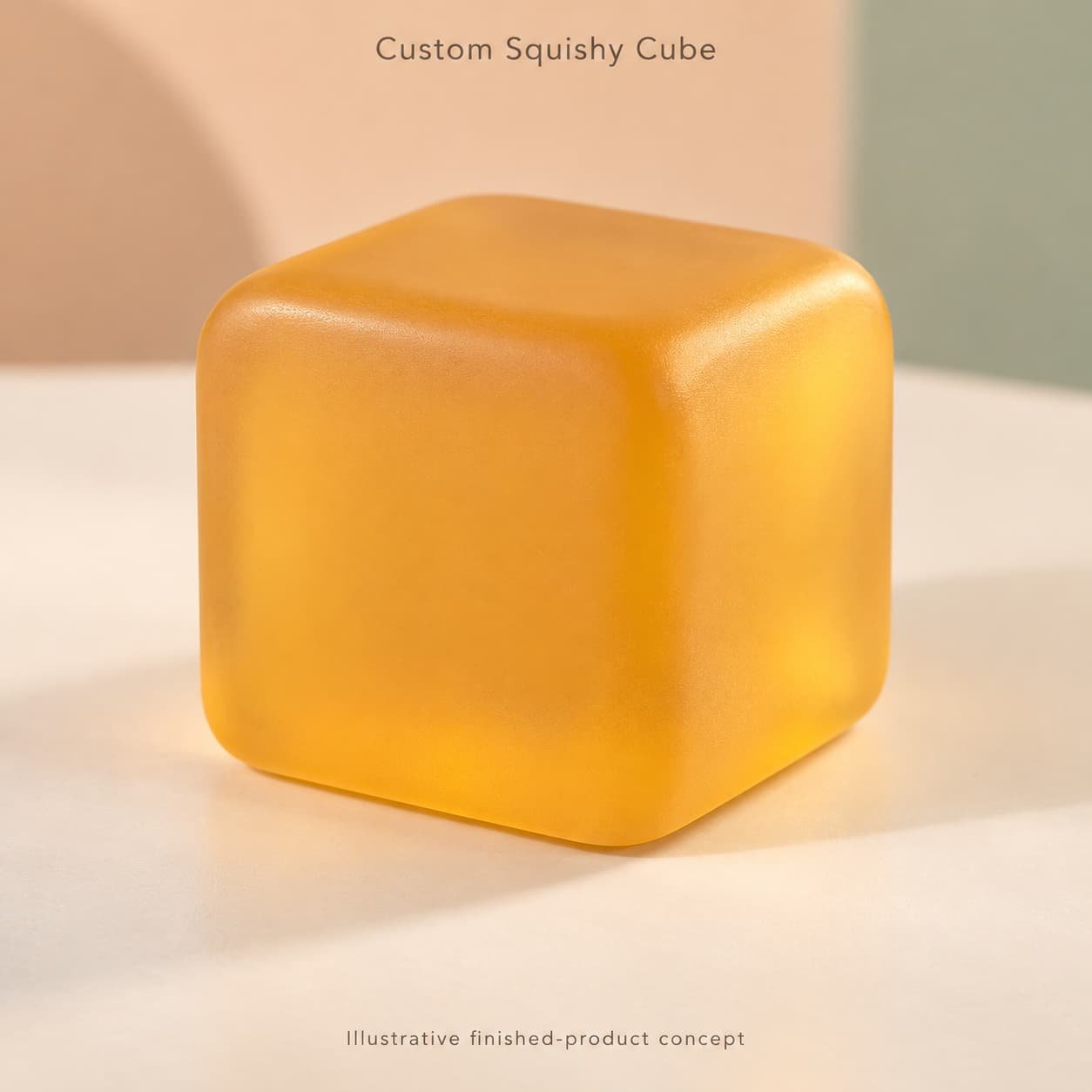
For buyers sourcing custom TPR squishy cubes, the useful question is not simply “Can you make a soft cube?” It is whether the supplier can define the construction, reproduce the approved squeeze feel, provide original branding and deliver a pack that suits your sales channel. A similar-looking cube can have a different surface, filling, recovery response or packing requirement.
This OEM and private-label buyer guide explains what to put in a request for quotation, how to move from an original sketch to a sample, and what to check before a bulk release. The honey-amber cube shown here is an illustrative custom concept, not an existing stock item, manufactured sample or verified engineering model.
Why squishy cubes are a relevant sourcing category
Overseas retail demand provides a reason to investigate the category. Public US retailer results show purchase indicators for branded sensory cubes, while Five Below’s best-sellers category includes multiple soft-cube products. These are retailer-specific signals, not a worldwide sales ranking or a forecast for a new private-label line.
The commercial opportunity is to develop an original offer for your channel, not present an unbranded product as a famous brand. Separate retail trend research from your own specification: a brand’s name, packaging, claimed formulation or performance cannot be transferred to an OEM project.
There is also a genuine customization market. For example, Progress Promotional Products lists a TPR squishy cube with branding and a case. That shows a commercial route for branded cubes; its dimensions, material claims, order terms and delivery promises do not establish the specifications of a Dongyu project.
Specify a soft squeeze cube, not a mechanical fidget cube
“Fidget cube” can describe a hard device with buttons, switches or rotating parts. If you want a soft product, use clear terms such as squishy cube, squeeze cube or TPR stress cube in your inquiry. Include an exterior reference and explain the intended handling experience.
TPR is a material direction, not a complete construction specification. Ask the supplier to identify the proposed compound, whether the design is solid or uses a shell, the proposed filling if any, and the relevant closure or process details. A translucent image cannot answer those questions.
A useful inquiry also distinguishes a request for an available form with new colors and packaging from a request for new geometry. Tell the supplier which elements are fixed and where you want proposals. Do not assume that custom packaging, a custom color and a new mold have the same commercial requirements.
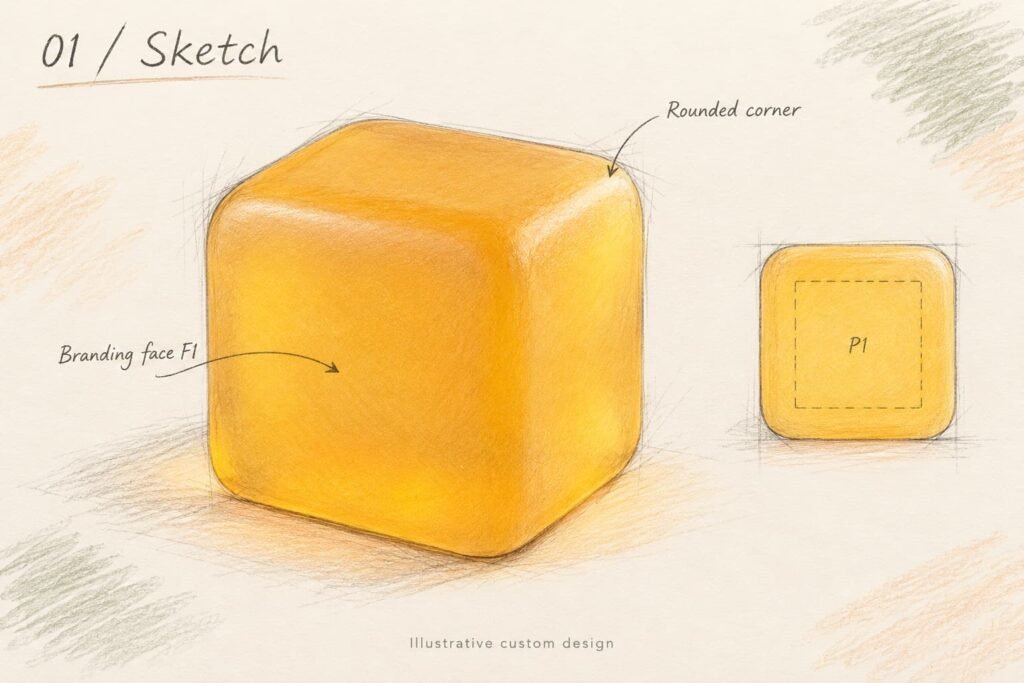
Illustrative custom design. Select the rounded form and nominate a branding face before engineering review.
A reusable OEM and private-label design brief
Use the following fields to compare proposals on the same basis. Keep a column for buyer requests and another for supplier-confirmed values. Anything still unknown should remain visibly pending.
| Brief field | Buyer input | Supplier confirmation |
|---|---|---|
| Program and channel | Retail, online resale or promotional use; destination and intended users | Appropriate construction and documentation scope |
| Product identity | CUB-01 original rounded cube; no third-party branding or copied packaging | Available-form or new-tooling proposal |
| Geometry | Preferred width, height, depth and corner appearance | Feasible dimensions, radii, relaxed shape and tolerances |
| Construction and feel | TPR direction; a reference feel and desired recovery character | Compound, shell/filling proposal if relevant and evaluation method |
| Appearance | Honey-amber, semi-translucent, softly frosted finish | Physical color/opacity reference and achievable surface |
| Branding and pack | Artwork, preferred marking route, unit pack and display direction | Marking feasibility, contact compatibility and pack samples |
| Commercial request | Quantity by color, launch window and delivery destination | Itemized quotation, minimums and proposed schedule |
Do not replace this brief with “same as the popular cube.” That phrase leaves the supplier guessing and creates avoidable brand confusion. Describe the experience and commercial requirements in your own terms.
Stage 1: Sketch the cube and identify the branding face
Draw a simple three-quarter exterior and nominate front, side and top faces. Choose the corner character before adding a logo. A strongly rounded cube and a nearly sharp block can have the same overall envelope but different usable face areas and handling impressions.
Label width W, height H and depth D in the working specification, with units and nominated views. Ask how the relaxed product will be measured and what resting conditions apply. A soft cube need not maintain a mathematically perfect profile in every photograph.
Mark a proposed branding face as F1 and a possible marking zone as P1. Keep it away from corner transitions and any supplier-proposed closure or process area. The sketch selects appearance intent; it does not approve a print process, shell thickness or internal construction.
Stage 2: Turn the sketch into coordinated color artwork
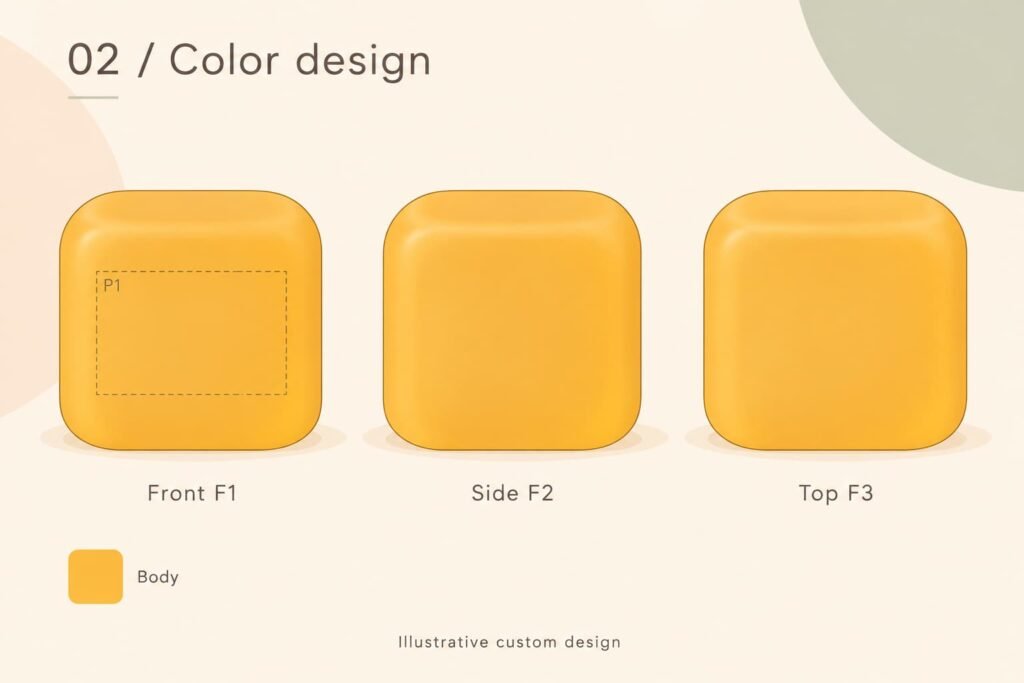
Prepare front, side and top appearance views of the same concept. Identify F1 and P1 consistently. If artwork moves from one face to another, revise the face map instead of relying on an email comment such as “logo on the other side.”
Supply artwork independently from shaded presentation images. State its intended size, position and color, and ask the supplier to propose a suitable application method. An embossed-looking shadow in a rendering is not permission to add molded lettering or an attached element.
Choose product marking, package branding or both
A package offers more space for readable brand information, while an approved product mark can remain visible after opening. Neither option should be chosen solely from a digital mockup. A printed sample needs evaluation on the proposed surface; a package needs a real fit and contact review.
Do not assume a logo remains readable across a strongly curved edge. For detailed artwork, ask whether a simpler mark or a package-first approach is more practical. The custom logo and private-label packaging guide explains the broader choices.
Approve color, opacity and surface separately
“Amber” is a starting direction, not a production color tolerance. Ask for a physical appearance reference and agree viewing conditions. Translucency can change how color appears against a light or dark background, so approve both color and opacity rather than judging a single studio image.
Keep frosted, glossy, glitter-look and patterned variants separate in the brief. A plain sample does not automatically approve another formulation, additive or surface treatment. This concept uses one restrained amber appearance; it makes no claim about glow, freezing, fragrance or a specific internal filling.
Stage 3: Review the 3D exterior and engineering questions
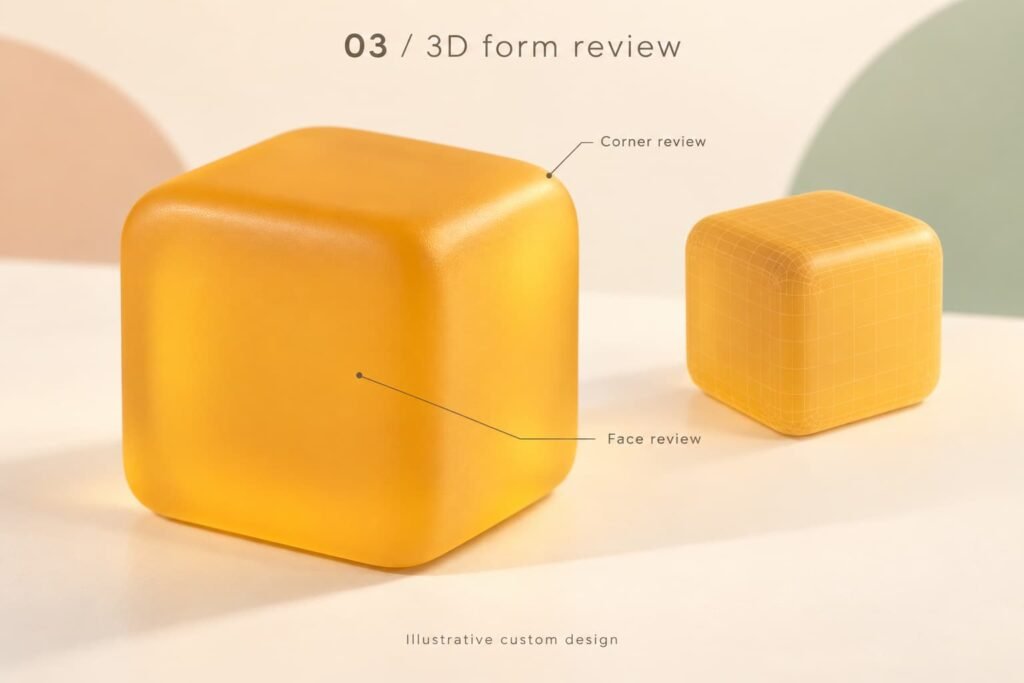
A colored 3D concept helps the buyer inspect the rounded corners, face proportions and proposed branding area together. Review it against the selected views. Check that the cube has not become a tall rectangular block or acquired a narrow edge simply to improve the rendering.
Request separate engineering information from the supplier. An AI appearance image does not contain verified sections, draft, shrinkage compensation, seam design or closure details. If a filled construction is proposed, identify the relevant containment and closure questions without assuming the rendering proves either.
- Which construction and process are being quoted?
- What geometry changes are needed for the proposed route?
- Which surfaces or process areas should remain clear of decoration?
- How will the supplier evaluate the requested feel and recovery?
- Which approved drawings, models or physical references will control production?
Return engineering-driven appearance changes to the coordinated design sheet. Keep the visual concept, technical proposal and sample approval linked, but do not treat them as interchangeable deliverables.
Compare quotations beyond the price per cube
Send the same brief and variant quantities to each supplier. Ask for tooling or setup, sample development, product, decoration, unit packaging and display packaging to be identified separately where applicable. Confirm the commercial basis and destination assumptions rather than comparing isolated headline prices.
Ask which minimum quantity applies to the selected configuration. A minimum per color, per artwork or per packaging version is different from a total order minimum. Request the proposed sampling sequence and schedule after the supplier has reviewed the specification; do not borrow another company’s published lead time.
Keep exclusions visible. A quotation for a plain cube in a basic bag is not equivalent to a decorated cube with retail artwork and a display carton. Use the custom squishy quotation comparison guide when normalizing offers.
Build a sample approval matrix for the actual construction
Agree methods, conditions and acceptance limits before evaluating samples. The table is a buyer planning tool, not a laboratory protocol or claim that testing has occurred. Tie it to the proposed construction and your target market.
| Review item | Evidence to request | Approval record |
|---|---|---|
| Envelope and corners | Relaxed sample in nominated views and agreed measurements | W/H/D, corner appearance and accepted variation |
| Construction | Supplier specification and relevant physical evaluation | Approved compound/route; filling and closure if applicable |
| Squeeze feel and recovery | Reference sample and agreed compression/release observations | Conditions, result and acceptable range |
| Surface and appearance | Physical color/opacity reference and agreed handling review | Finish, tack, appearance and accepted cosmetic variation |
| Branding | Marked sample at P1 or actual branded unit pack | Artwork version, placement and marking performance |
| Packed condition | Actual sample after agreed packed evaluation | Shape recovery, surface contact and package condition |
A reference video can help communicate feel, but it does not establish a repeatable acceptance method by itself. Record how a sample was handled and observed. Do not infer durability, containment performance or a recovery time from a still photograph.
Use sample IDs linked to a revision set, for example CUB-01-GEO-R02, CUB-01-ART-R01 and CUB-01-PACK-R01. Maintain a change log naming the feature, reason, approver and affected samples. Keep appearance selection, engineering review, physical approval and bulk release as separate gates. The sample approval checklist can support that record.
Make private-label packaging suitable for the sales channel
For retail, define unit identification, face visibility and display orientation. For online sellers, also discuss the shipping pack and how the product should arrive after transport. For promotional programs, decide whether the message belongs on the cube, the package or both.
A case or insert can help presentation, but its suitability must be checked with the actual sample. Review whether contact pressure leaves unwanted impressions, the cube sticks to a contacting surface, decoration rubs or the pack changes the relaxed shape. Do not assume that a competitor’s clear case proves compatibility with your construction.
Confirm required product information and appropriate target-market documentation with responsible specialists. Do not use broad “non-toxic,” universal age or medical-benefit claims without relevant support. Retail popularity is not evidence of compliance for a different product.
Frequently asked questions
Can I develop a custom squishy cube under my own brand?
Request an original private-label proposal with your artwork, quantities and target market. Confirm available-form versus new-tooling options, customization feasibility and documentation before committing.
Does TPR specify what is inside the cube?
No. Ask for the proposed construction, compound and filling or closure information where applicable. A material name alone does not define the finished product.
What is the MOQ for custom TPR squishy cubes?
It depends on the selected design, color, artwork, packaging and supplier arrangements. Request minimums for your actual configuration, not a copied market-wide number.
Can you reproduce a famous branded cube?
This guide concerns original OEM development, not replicas or unauthorized branded goods. Use your own identity and obtain appropriate rights review where needed. Do not describe a new private-label product as another brand.
What should I send to a squishy cube manufacturer?
Send the brief, quantities by variant, intended feel, exterior views, branding files, packaging direction and destination. Mark unknown construction parameters as questions for the supplier.
Request a custom TPR squishy cube quotation
Share your sales channel, target market, estimated quantities, selected CUB-01 appearance direction or your own original design, reference feel, artwork and unit-pack requirements. Ask for construction, minimums, sampling steps and an itemized proposal. Review Dongyu’s OEM/ODM customization service, then send your custom TPR squishy cube brief for project review. Product feasibility and commercial terms must be confirmed for the specific request.