Dongyu Insights
Custom Squishy Blind Box Series: A Wholesale Buyer Planning Guide
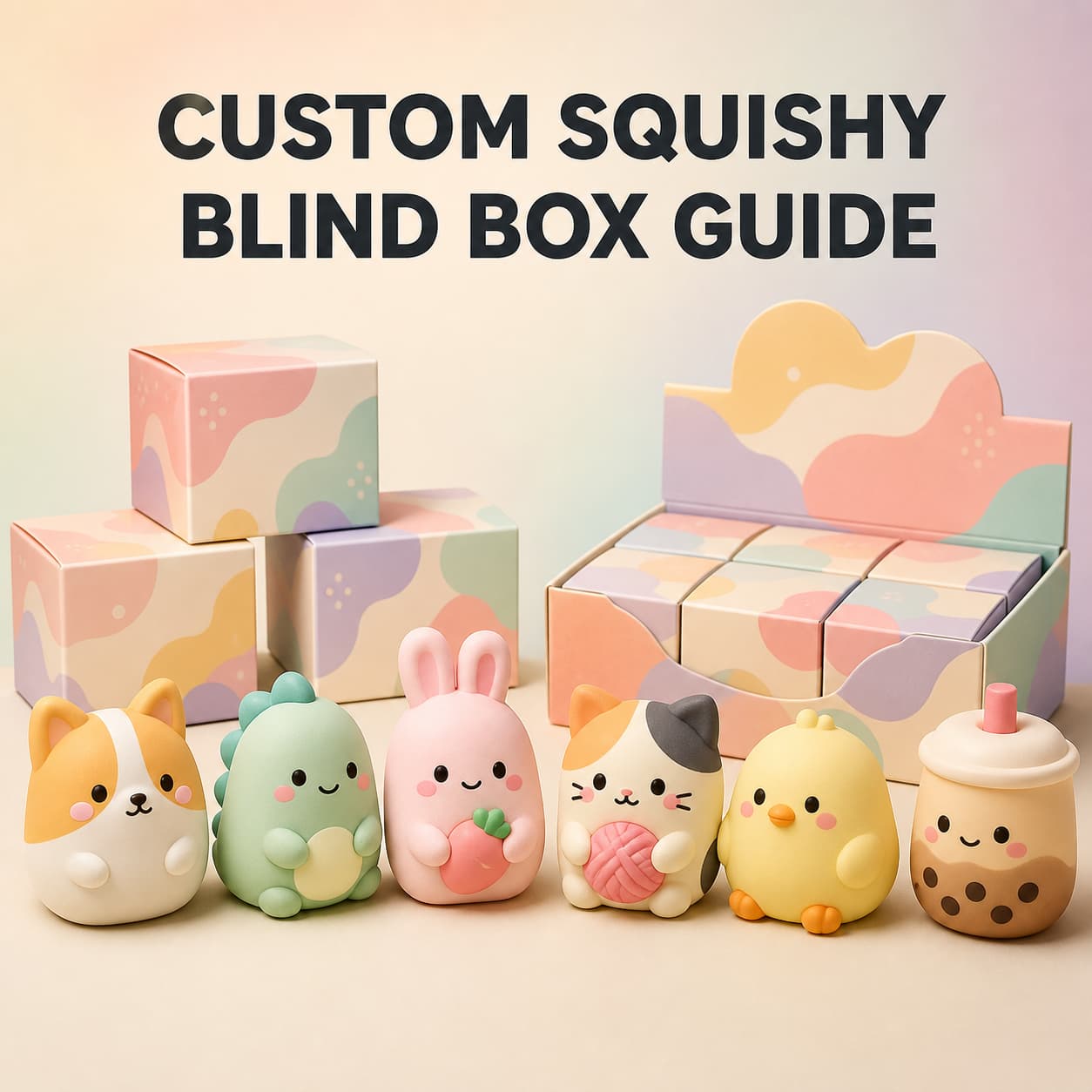
A custom squishy blind box combines a tactile squeeze toy with the surprise of a sealed package. For brands, retailers, importers, gift companies, and online sellers, the commercial idea can be attractive: one coordinated collection, several character variations, compact retail packaging, and a display format that encourages customers to explore the series.
However, a blind box or blind bag project is more complex than placing random squishy toys inside opaque packages. The buyer needs to define the collection theme, character system, materials, number of designs, quantities per variation, packaging structure, internal identification method, artwork, display carton, and approval process.
This guide explains how to plan a custom squishy blind box series for wholesale and private label orders without relying on unsupported assumptions about minimum quantities, production timing, hidden-edition odds, or target-market compliance.
What Is a Squishy Blind Box or Blind Bag?
A squishy blind box is a sealed retail package containing one squishy toy from a known collection, while the exact style remains hidden until the package is opened. A blind bag follows the same basic concept but uses an opaque bag or pouch rather than a paper box.
The main packaging formats include:
- Blind box: An opaque paper box containing one toy, sometimes with an inner bag, insert, or collector card.
- Blind bag: An opaque sealed pouch containing one toy, with or without a header card or insert.
- Display carton: An open retail display holding several sealed blind boxes or bags.
- Multi-pack: A larger pack containing several mystery units.
- Confirmed set: A full collection sold as an identified set rather than random individual units.
The best format depends on product size, squeeze material, target price position, sales channel, presentation, labeling, and shipping volume.
Start With a Collection Theme
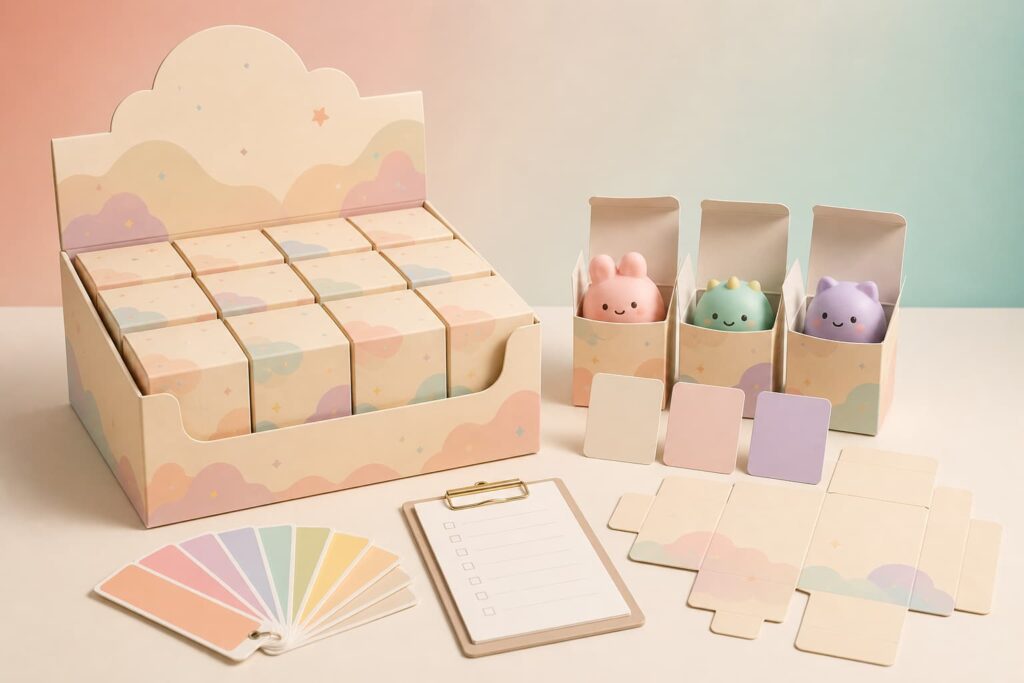
A blind box series should feel like a collection rather than a group of unrelated products. Begin with one theme that can support several recognizable variations.
Possible directions include:
- Garden animals
- Desserts and drinks
- Fruit characters
- Ocean creatures
- Seasonal mascots
- Food-shaped mochi squishies
- Slow-rising bakery characters
- Gel-feel fantasy creatures
- Brand mascots in different expressions or accessories
The theme should match the intended customer and channel. A small rounded animal series may suit stationery, gift, party, and impulse retail. A larger slow-rising collection may need a higher-value box and more shelf space. A promotional program may use one company mascot in several brand-approved variations.
Write a one-sentence collection statement before developing individual designs. For example: “A pastel garden series of compact rounded characters, each holding a different flower or fruit.” This gives designers and suppliers a consistent direction.
Build a Shared Character System
A strong collection usually shares visual rules. The characters do not need to have identical shapes, but customers should recognize that they belong to the same series.
Create rules for:
- Approximate product size
- Body proportion and silhouette
- Eye and mouth style
- Color palette
- Surface finish
- Level of molded detail
- Painted or printed details
- Material and hand feel
- Accessory or theme element
- Package artwork style
One character should not be dramatically larger, firmer, heavier, or more complex unless the difference is intentional and accounted for in cost, packing, and customer communication.
If the series begins with a mascot sketch, see our guide on turning mascot artwork into a custom squishy toy.
How Many Designs Should a Series Include?
There is no universal number that works for every project. The appropriate design count depends on the buyer’s budget, material, customization level, quantity, tooling route, package size, assortment strategy, and sales channel.
Before choosing the number of designs, ask:
- Does each design require a new shape, or only a color and expression change?
- Will every design use the same material and approximate weight?
- Does each variation need its own paint, print, scent, or finish?
- How many units of each design can the buyer realistically sell?
- Will the collection be packed equally or use a controlled ratio?
- Does every design need its own sample and approval?
- How many boxes fit in the display carton and master carton?
A smaller, well-coordinated first series may be easier to sample, approve, explain, pack, and reorder than an overly large collection with weak visual differences.
Choose a Material That Fits the Blind Box Concept
The material affects the hand feel, product size, shape complexity, surface finish, packaging protection, and customer expectation.
PU Foam Slow-Rising Squishies
PU foam can suit bakery shapes, desserts, animals, mascots, and larger novelty products. A slow-rising effect can add a clear tactile feature, but the buyer should review rebound, surface coating, painted details, scent direction, and packaging fit.
TPR or TPE Gel-Feel Squishies
TPR and TPE directions can create compact, stretchy, translucent, or gel-feel squeeze toys. Packaging should protect the surface and keep the product separated from materials that may cause unwanted contact or transfer.
Mochi-Style Squishies
Small mochi-style characters can work well for blind bags, stationery channels, party programs, counter displays, and online bundles. Their simple rounded forms also make it easier to create a coordinated character family.
The final material should be confirmed against the actual design, target market, age grading, hand-feel requirement, and packaging. Read our squishy toy material guide for wholesale buyers for a wider comparison.
Define Every Variation in a Master Assortment Sheet
Do not manage a blind box series using product nicknames in scattered messages. Create one master assortment sheet connecting the product, artwork, package, quantity, and packing plan.
Useful fields include:
- Series name
- Design or character name
- Internal style number
- Buyer SKU
- Shape reference
- Color reference
- Expression and printed details
- Material and surface finish
- Scent, if applicable
- Approved sample version
- Individual packaging file
- Internal identification code
- Quantity per design
- Quantity per display carton
- Quantity per master carton
Add a clear product image or drawing for each variation. This makes it easier to distinguish designs that have similar names or colors.
Plan the Assortment Ratio Before Production
The assortment ratio tells the packing team how many units of each design belong in a defined quantity of sealed units, displays, or cartons. It should be based on the actual production quantity and packaging configuration.
A buyer may choose:
- An equal quantity of every design
- A controlled uneven assortment
- A regular assortment plus a separately managed special design
- Confirmed full sets in addition to random single units
Do not use vague instructions such as “mostly equal with a few special ones.” Write the exact quantity for every design and explain how those units should be distributed across displays and master cartons.
If a hidden or special edition is included, confirm:
- Its exact production quantity
- Whether it replaces another design in a display or is added separately
- How it is identified internally
- Who controls the final packing record
- Whether any customer-facing probability statement will be made
- Who is responsible for reviewing that statement for the target market
Never publish a rarity ratio unless it reflects the actual approved packing plan and has been reviewed for the destination market and sales channel.
Keep the Package Blind but the Supply Chain Traceable
The consumer may not know which character is inside, but the buyer, supplier, and inspection team still need a controlled way to manage the collection.
An internal identification method can help with:
- Production counting
- Sample approval
- Assortment packing
- Warehouse receiving
- Quality investigation
- Reorders
- Customer-service issues
The method should not unintentionally reveal the contents to customers if the product is marketed as blind. At the same time, it should be clear enough for authorized production and quality personnel to verify the assortment.
Keep the internal code, character name, package version, and packing quantity connected in the master assortment sheet.
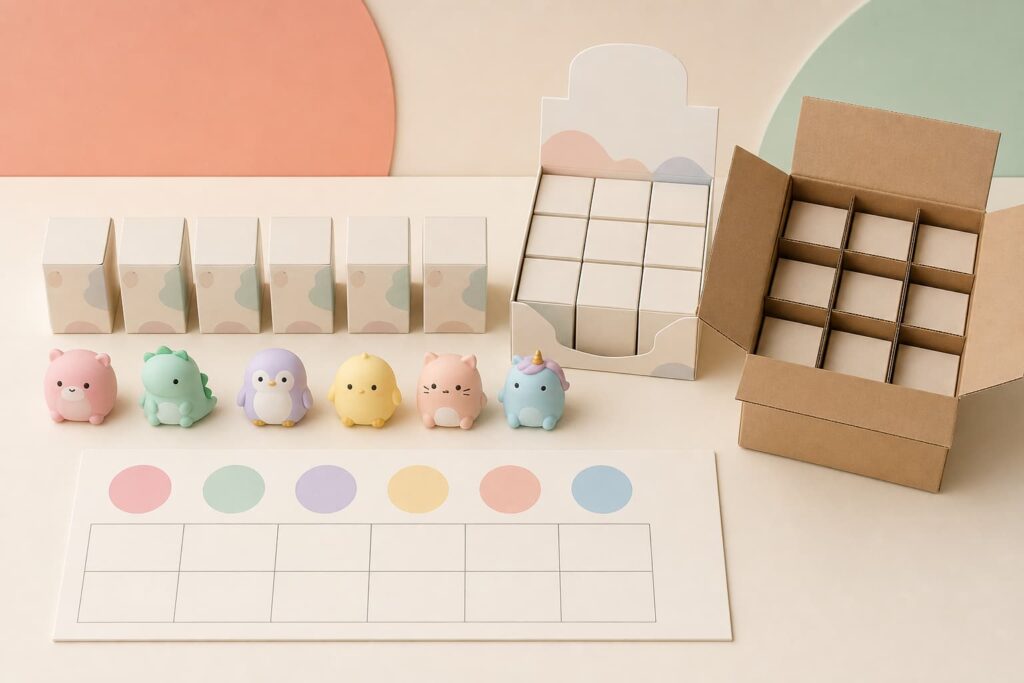
Choose Between a Blind Bag and Blind Box
Blind Bag Advantages
- Lightweight packaging
- Compact shipping volume
- Suitable for small mochi or mini squishy products
- Can work with a display carton or hanging retail presentation
Blind Bag Questions
- Is the material sufficiently opaque?
- Can the product shape be identified by touch through the bag?
- Does the bag protect the surface?
- How will required information and artwork be displayed?
- Is a header card or insert needed?
Blind Box Advantages
- Larger area for artwork and product information
- Stronger shelf presentation
- Better support for a collector card or internal bag
- Can provide more shape protection
Blind Box Questions
- Does one box size fit every design?
- Will smaller designs move excessively inside the box?
- Does the box require an insert or inner bag?
- Can the box be opened and resealed without obvious evidence?
- How will individual boxes fit inside the display?
For further structural options, see our guide on custom squishy toy packaging.
Design the Display Carton as Part of the Product
The display carton is not simply a shipping container. In many retail programs, it becomes the product’s shelf presentation.
Confirm:
- Number of units per display
- Box or bag orientation
- Display header height
- Front opening and product visibility
- Countertop or shelf dimensions
- How the display opens
- Whether the display travels inside a master carton
- Display artwork and barcode direction
- Whether a complete display uses a controlled assortment
Make and review a physical display sample with the actual filled boxes or bags. An empty display mockup may not reveal bowing, poor fit, excessive movement, or difficult retail setup.
Plan Packaging Artwork for the Whole Series
Blind packaging usually shows the collection without revealing the exact enclosed design. The artwork should explain the series clearly while preserving the intended surprise.
Artwork planning may include:
- Series name
- Original character illustrations
- Collection overview
- Product and brand information
- Buyer-supplied barcode
- Required labeling and traceability information
- Age grading and warnings where applicable
- Required languages
- Opening instructions when needed
- Collector card or insert
Any words such as “rare,” “secret,” “hidden,” “limited,” or a numerical probability should be accurate, approved by the buyer, and reviewed for the intended market. Packaging artwork should not copy another brand’s characters, visual identity, trade dress, or unlicensed intellectual property.
For barcode, label, and carton-mark planning, review our private label squishy toy packaging checklist.
Approve Every Character, Not Just One Representative Sample
A shared series style does not mean one sample can automatically approve every design. Different shapes, paint areas, colors, protrusions, and facial details can create different risks.
Review each design for:
- Overall shape and dimensions
- Material and hand feel
- Rebound or squeeze behavior
- Color and surface finish
- Facial expression and printed details
- Weak or thin shape features
- Base and rear appearance
- Fit inside the common package
- Correct character card or insert
- Correct internal identification
Then review the complete sealed pack. The buyer needs to approve both the toy and the retail presentation.
Use our custom squishy toy sample approval checklist to create a structured record.
Test the Complete Pack-Out System
Before bulk packing, test the planned relationship between individual packages, display cartons, inner cartons, and master cartons.
Check:
- Every character fits the same individual package as planned
- Sealed packages fit the display without excessive gaps or pressure
- The display closes or ships correctly
- The planned assortment fits the display quantity
- Displays fit the master carton
- Carton quantities match the packing list
- Internal identification remains controlled
- Retail and carton labels use the correct version
Product and packaging dimensions affect shipping volume, so confirm the final pack-out before relying on an early freight estimate. Our guide on squishy toy size, packaging, and wholesale shipping volume explains this relationship in more detail.
Plan Quality Checks for a Mixed Series
A blind box order needs product-level checks and assortment-level checks. A carton may contain good individual toys but still be incorrect if the design ratio, packaging file, or display quantity does not match the approved plan.
A pre-shipment checklist can include:
- Representative checks from every design
- Comparison with each approved sample
- Shape, color, hand feel, surface, and print review
- Correct toy inside the correct internal packaging system
- Correct collector card or insert
- Correct package artwork version
- Controlled assortment check
- Display-box quantity and presentation
- Master-carton quantity and marks
- Packing-list comparison
Because the consumer package is sealed, the buyer should define how inspection samples will be opened, recorded, and handled. See our pre-shipment inspection checklist for squishy toys for additional guidance.
Consider E-Commerce and Retail Requirements
A blind box series may be sold as individual mystery units, sealed displays, confirmed sets, or online bundles. Each format can require different product identifiers, listing images, descriptions, and fulfillment labels.
Confirm whether:
- The listing sells one random unit or a complete set
- The display carton is also a saleable unit
- Each variation needs a separate internal SKU
- The individual package and master carton need different barcodes
- The fulfillment warehouse requires special unit labels
- The product page must disclose that the style is randomly selected
- Returns or damaged-package handling need a defined process
Do not use product images that imply customers will receive the entire series when the listing sells only one random unit.
Common Blind Box Planning Mistakes
Designing Too Many Characters Before Checking Feasibility
Every additional shape, color, print, and package variation adds development and approval work. Confirm the commercial and production structure early.
Leaving the Assortment Ratio Until Packing
The ratio affects quantities per design, displays, master cartons, internal identification, and customer-facing claims. It should be defined before production.
Making One Character More Expensive Than the Others
A significantly larger or more complex design can affect costing and equal pack-out assumptions. Review size, material, decoration, and packaging for every variation.
Using Transparent or Easily Identified Packaging
If the concept depends on surprise, the product should not be visible or easily identifiable through the packaging unless that is an intentional feature.
Approving Only the Display Artwork
The individual package, inner bag, collector card, labels, display carton, and master carton may all require separate approval.
Publishing Unsupported Odds
A marketing ratio must reflect the real packing plan. The buyer should also confirm whether probability disclosure or random-product marketing is restricted in the target market or sales channel.
Using Unlicensed Characters
The buyer should own or have permission to use the character artwork, brand elements, and packaging graphics supplied for production.
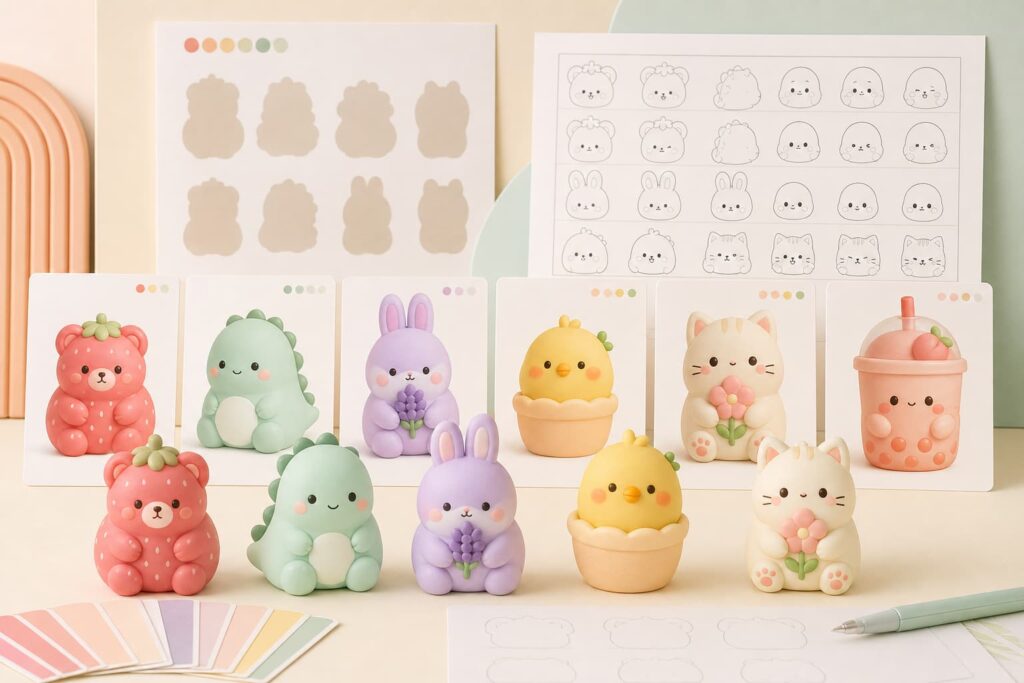
What to Send With a Custom Squishy Blind Box Inquiry
Prepare the following information for a more useful quotation and feasibility discussion:
- Collection theme
- Character sketches or reference images
- Number of planned designs
- Target size
- Material and hand-feel direction
- Color and surface-finish references
- Estimated total quantity
- Proposed quantity per design
- Blind bag or blind box direction
- Units per display carton
- Special-design or assortment logic, if applicable
- Private label artwork requirements
- Target market and sales channel
- Buyer-specific testing, labeling, or warehouse requirements
Frequently Asked Questions
Can squishy toys be packed in blind boxes?
Yes, suitable squishy products can be planned for opaque boxes or bags. The material, size, surface, shape, packaging fit, required labeling, and display system should be reviewed for the actual project.
What is the difference between a blind box and blind bag?
A blind box uses an opaque paper box, while a blind bag uses a sealed opaque pouch. Boxes provide more artwork area and shape protection; bags can reduce packaging weight and volume. The best option depends on the product and retail channel.
How many designs should a squishy blind box series contain?
There is no universal number. The decision depends on the design complexity, quantity, material, budget, packaging configuration, and how many units of each design the buyer can support.
Do all designs need separate samples?
Each design should be represented in the approval system because shapes, colors, printing, and packaging fit can vary. The exact sampling arrangement should be confirmed for the project.
Can a blind box series include a hidden design?
A special design can be discussed, but its production quantity, packing logic, identification, customer-facing claims, and target-market requirements should be defined clearly. Do not publish an unverified probability.
How does the factory know which toy is inside?
A controlled internal identification and assortment record can help production and quality teams manage the sealed units. The method should not unintentionally reveal the contents to consumers.
Can blind box packaging be private labeled?
Depending on the project, packaging can include buyer-approved artwork, series branding, character illustrations, labels, barcodes, inserts, display cartons, and master-carton information.
Can PU, TPR, TPE, and mochi squishies all use mystery packaging?
Different materials can use mystery packaging when the structure is suitable for the actual product. Packaging compatibility, surface protection, size, transparency, squeeze characteristics, and market requirements should be reviewed during sampling.
Start a Custom Squishy Blind Box Project
Jinhua Dongyu Toys supports OEM and ODM squishy toy development for brands, importers, distributors, retailers, gift companies, and online sellers. Project directions can include custom shapes, PU foam, TPR or TPE hand feel, slow-rising products, mochi-style squishies, colors, surface finishes, individual packaging, display boxes, labels, and carton coordination.
Send your series concept, character references, target size, material direction, number of designs, estimated quantity, assortment plan, packaging format, and destination market. You can review our squishy toy product directions, learn about the OEM and ODM process, or contact Dongyu Toys to discuss a new collection. “`