Dongyu Insights
Mini Dumpling Squishy Toys Wholesale: TPR OEM Size & Sample Guide
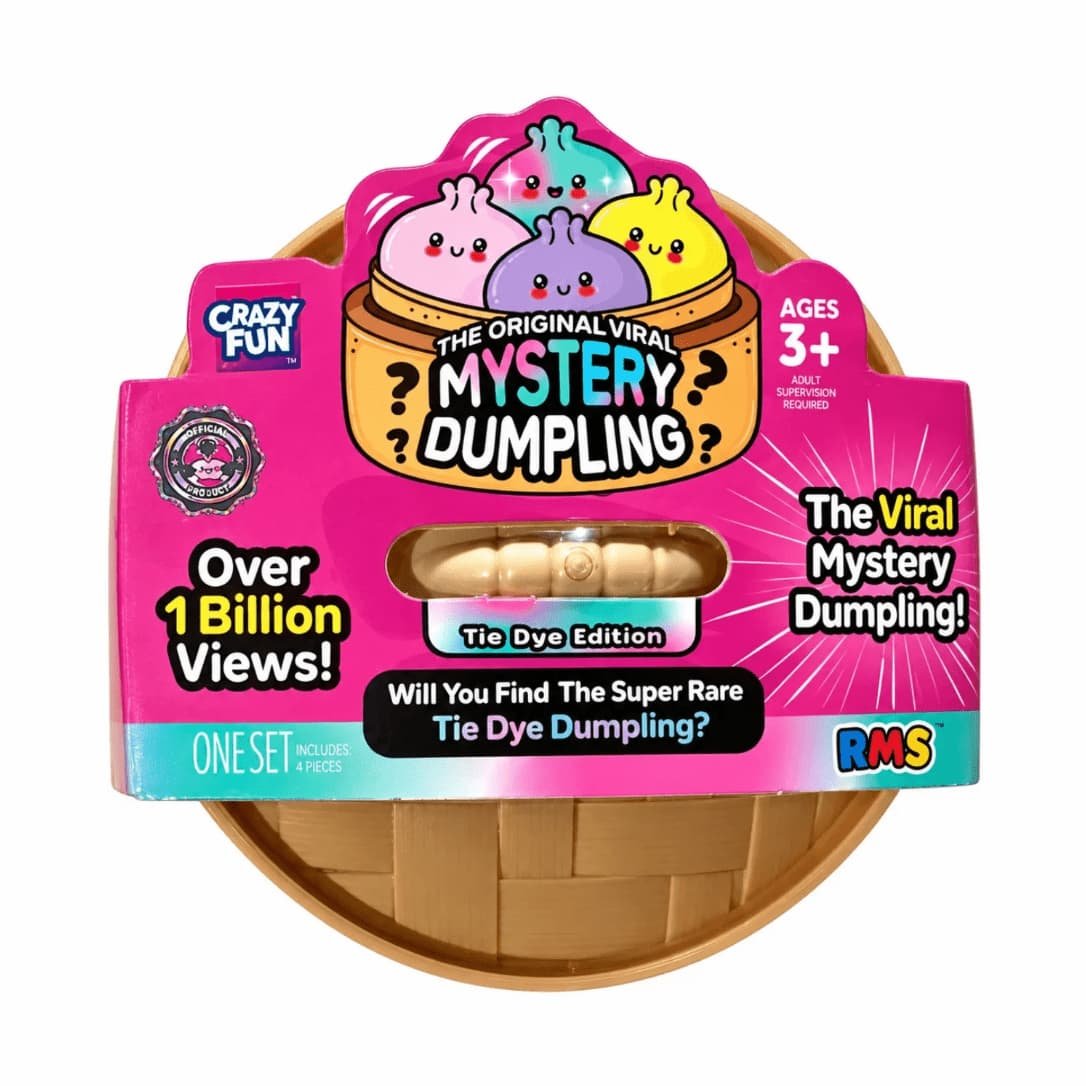
Mini dumpling squishy toys wholesale buyers should approve the selling unit before approving a smaller mold. A miniature squeeze toy is not simply a large dumpling scaled down: the crown, folds, hand feel, package fit and SKU identity must still make sense together. This guide focuses on an original TPR mini bao concept for private label and OEM enquiries.
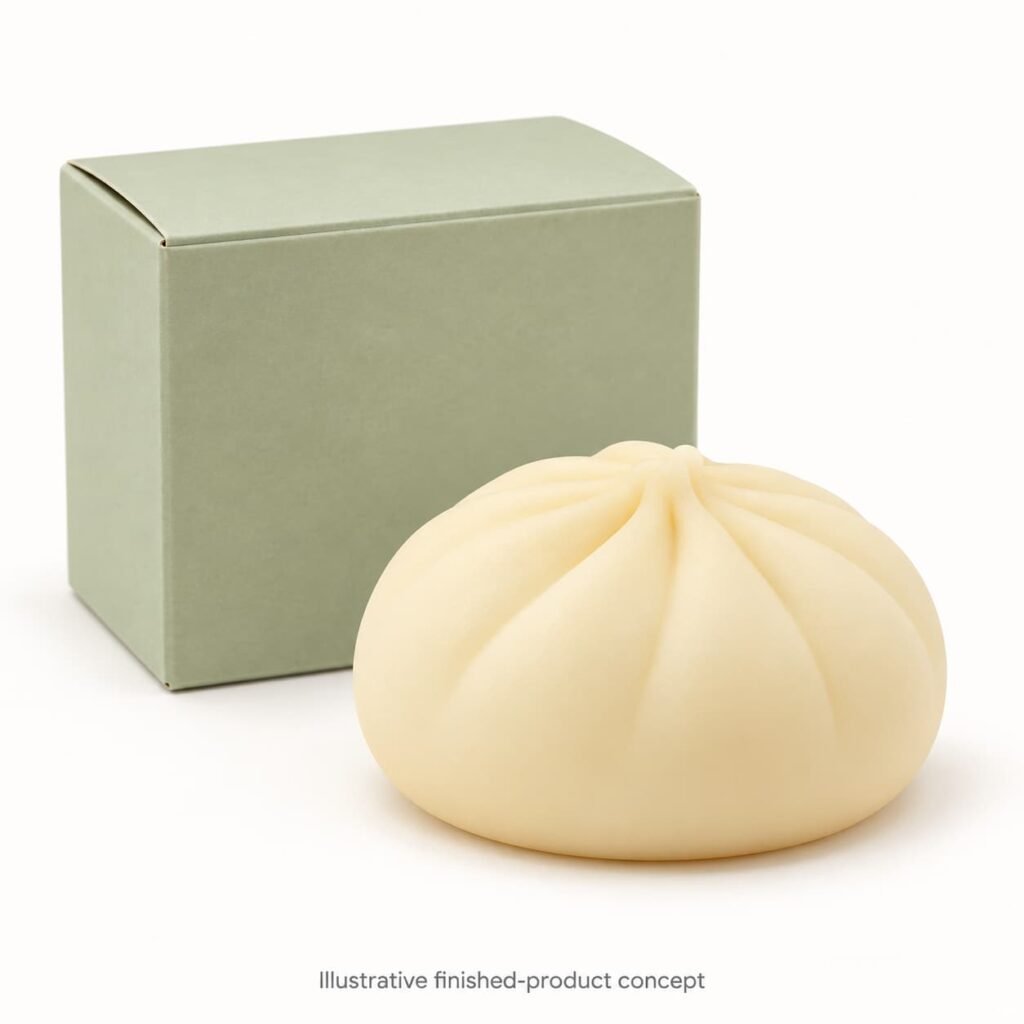
The proposed product keeps familiar market features: a squat rounded body, flattened base and broad folds meeting at a short crown. The illustrations show one cream-colored concept from sketch to finished appearance. They are not a physical sample, a branded replica or confirmation of an existing Dongyu tool.
Use search evidence to choose a category, not to promise sales
An October 2026 ToyDirectory report cited US Google Trends related-query data for the preceding 90 days and placed “dumpling squishy” at the top of its reported shape-related examples. That is a relative search-interest signal, not a count of buyers. The original Trends link returned a rate-limit error during this review, so the result remains a secondary-source observation.
US and UK retail pages also carry dumpling squeeze toys, including mini formats. They establish real product formats to study, not a global sales ranking. A new private label product still needs its own audience, price and distribution plan. Do not use a famous brand name or copy a character to substitute for that work.
Define what mini means in your purchase order
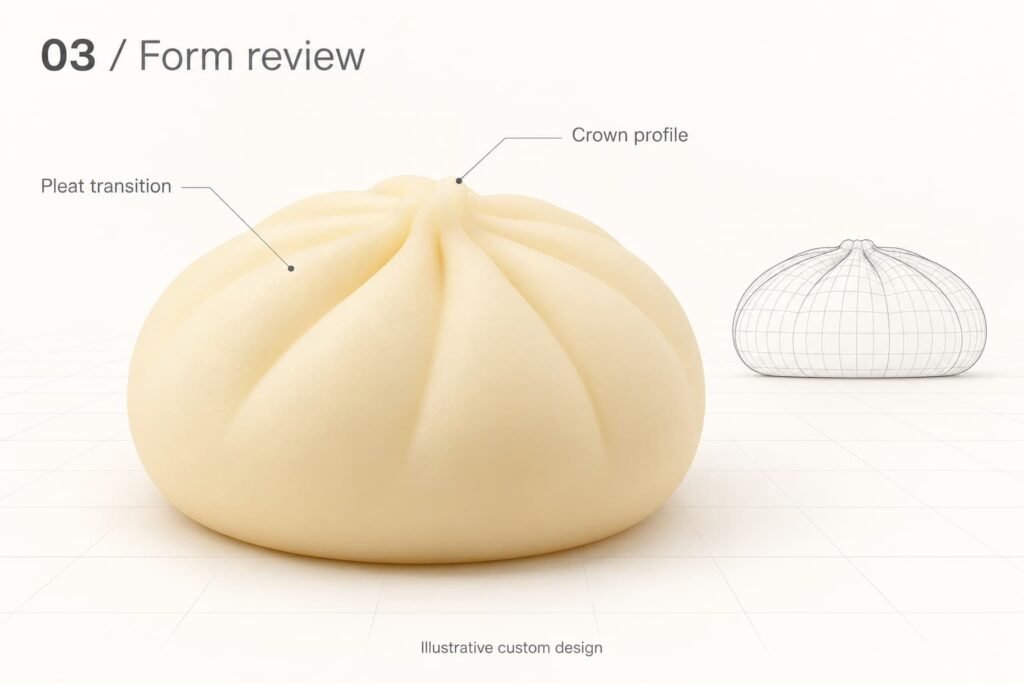
Decide whether one SKU is one toy, a multi-piece set or a toy packaged with a container. Those units have different costs, labeling space and inspection counts. A carton quantity is not the MOQ, and a display quantity is not automatically the consumer selling unit.
| Decision | Buyer supplies | Factory confirms |
|---|---|---|
| Project identity | MD-01, original mini bao, Rev A | Tooling route and quotation revision |
| Selling unit | Single toy or named set; exact contents | Assembly and packing method |
| Size | Target diameter D and total height H in mm | Feasible dimensions and measuring method |
| Shape | Broad folds, short crown, flattened base | Fold depth and crown transition feasibility |
| Material | TPR development direction; desired feel reference | Compound, construction and contents if applicable |
| Variants | Color and quantity for each SKU | MOQ by version and mixing terms |
| Market | Destination, audience and sales channel | Product-specific review and documentation plan |
| Timing | Required arrival date | Sample, revision, production and freight stages |
Use Dongyu’s custom enquiry service to review the brief. Keep unconfirmed dimensions open. A retailer’s advertised mini size does not prove that a different compound or construction can reproduce its behavior at the same dimensions.
Stage 1: preserve the real bao silhouette
Start with photographs showing the actual category from the side and above. Identify the rounded base, full body and gathered crown. A generic dome loses the product identity; an exaggerated stalk changes it into something else. The sketch should retain recognizable bao proportions without borrowing a proprietary face or package.
For the illustrated proposal, broad shallow folds are the visual direction. A smaller toy should not acquire needle-like details merely because the original drawing contained many creases. Ask the supplier where the form should be simplified, and approve those changes explicitly rather than accepting an unexplained sample difference.
Stage 2: annotate scale and folds consistently
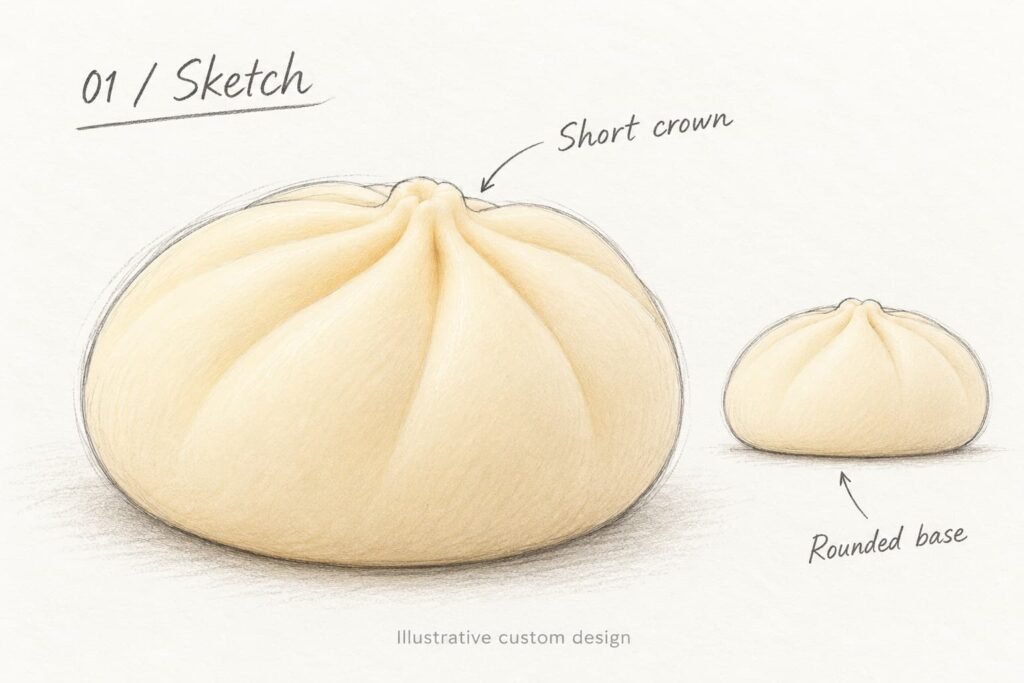
Prepare front, side and top views. Use D for the relaxed base diameter, H for the overall height and C1 for the cream color reference. These labels are not numerical specifications. Agree the dimension values and measuring conditions in the controlled brief.
Mark the crown as a separate review zone. Ask how its height and transition will be measured and what variation is practical. Identify the intended fold directions rather than assuming the concept image supplies manufacturing coordinates. The final engineering drawing must be rebuilt and checked by the supplier.
- Keep one orientation across drawings, photos and inspection records.
- Separate molded folds from printed artwork.
- Reference a physical cream color sample rather than a screen alone.
- Record whether the base should sit flat when relaxed.
- Leave unresolved tolerances marked pending.
For a broader overview of shape development, see the existing dumpling design and packaging guide. This page addresses mini-format purchase decisions rather than repeating that general workflow.
Stage 3: check the crown before approving a sample
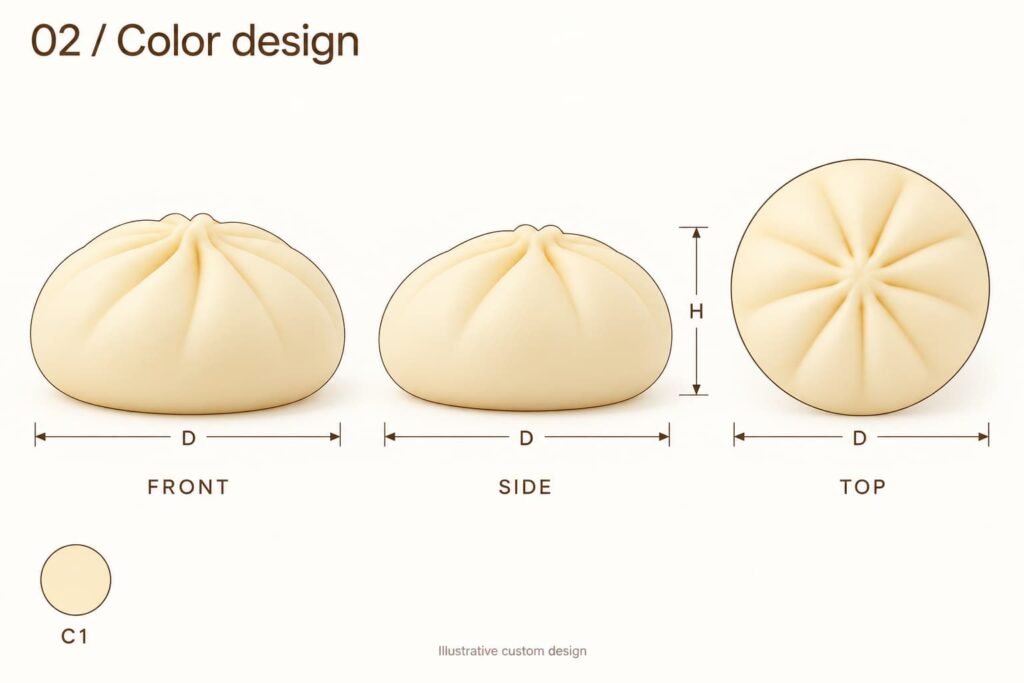
A colored 3D appearance helps reveal whether the crown looks too tall, folds merge awkwardly or the body loses fullness. Review several angles and compare them with the same reference photos used for the sketch. Do not approve a different silhouette just because the rendering is attractive.
The generated wireframe-style view is not actual CAD. The manufacturer still needs to confirm the tooling split, construction, section requirements and any closure approach. Material identity and internal contents cannot be inferred from an external picture. Request the exact proposal rather than assuming every dumpling has the same filling.
Ask whether miniaturization changes squeeze resistance or recovery compared with the desired reference. A smaller sample must be reviewed on its own. Do not carry over approval from a larger product or describe a particular recovery time without an agreed method and evidence.
Build an RFQ that avoids hidden unit differences
Request an itemized quote for development, tooling or modifications, samples, sample delivery, toys, decoration, individual packaging and display assembly. State destination and delivery terms. If a set contains several pieces, identify the number of toys and accessories included in the quoted unit.
Ask for the MOQ per shape, color and selling-unit version, plus whether mixed variants are possible. If one color falls below its minimum, ask for options; do not assume the total order quantity solves it. Confirm how changes to folds or packaging after sampling affect the schedule and cost.
Use the quotation comparison guide to compare equivalent scopes. No fixed MOQ, unit price or lead time is promised for this concept. An existing-tool route and a new-development route should be clearly distinguished.
A mini-format sample acceptance matrix
Approve representative physical samples in their intended pack. This is a project worksheet, not a legal or industrial standard. Agree methods, conditions and limits with the supplier before evaluation.
| Check | Review method | Record |
|---|---|---|
| Diameter and height | Relaxed sample with agreed measuring points | Actual D/H and approved tolerances |
| Crown and folds | Compare side and top references | Accepted transition and visible deviations |
| Feel and recovery | Agreed compression sequence and conditions | Sample ID and acceptable behavior |
| Construction integrity | Supplier-agreed evaluation for actual construction | Damage, opening or leakage where applicable |
| Pack fit | Check intended assembled selling unit | Crown pressure, sticking and deformation |
| Contents and identity | Reconcile pack, barcode and SKU list | Correct quantity, color and version |
Give every issue a disposition: accept, revise or retest. Retain the approved physical sample and connect it to the order revision. The sample approval checklist provides a broader record structure.
Package the toy as a toy, not food
The food-inspired shape should not obscure its non-edible purpose. Review the intended audience, instructions, labeling and destination-market requirements with suitable specialists for the actual product. Do not copy another brand’s age grading, safety claims or certification symbols.
For a mini toy, check how much room is available for information on the pack. A tiny product does not justify omitting necessary labeling. If accessories are proposed, include them in the product review and inspection plan rather than treating them as unrelated packaging.
Confirm packed dimensions, weight and display arrangement before calculating delivered costs. Review whether the crown touches the lid and whether a packed sample keeps its approved outline after agreed storage and handling. The plain box in the concept image is only a proposed presentation.
Keep variants and revisions traceable
Name the initial brief MD-01-RevA. Record every approved change to size, crown, folds, material, color or packaging. If a revised sample changes more than the requested feature, list the additional differences before approving it.
Keep separate IDs for artwork, physical samples and packaging files. Before production approval, reconcile those records with the quote and SKU list. A new color should not silently authorize a new construction or a different toy count in the consumer pack.
Frequently asked purchasing questions
Can I order a miniature version of a larger dumpling?
Submit the reference and target dimensions for feasibility review. The supplier must check whether the folds, construction and feel remain appropriate. Scaling a picture does not establish manufacturability.
Can I customize the cream color or packaging?
Request project-specific options and approve representative samples. Package compatibility and color acceptance remain separate decisions, even when the design has only one color.
What MOQ should I expect?
Ask for a written minimum by shape, color and selling unit, identifying any tooling assumptions. Another supplier’s MOQ is not a confirmed Dongyu order term.
Are these pictures completed physical samples?
No. They are illustrative custom designs and a finished-product concept. Physical sample approval and engineering review are still required.
Request a mini dumpling feasibility quotation
Send Dongyu Toys your mini dumpling brief with original references, target D/H, quantity by SKU, desired feel, selling-unit contents, market and deadline. Ask for tooling feedback, MOQ, an itemized quote and sampling steps. Confirm the unresolved engineering and market requirements before authorizing development.