Dongyu Insights
Custom PU Butter Squishy Toys: Artwork & Packaging Guide
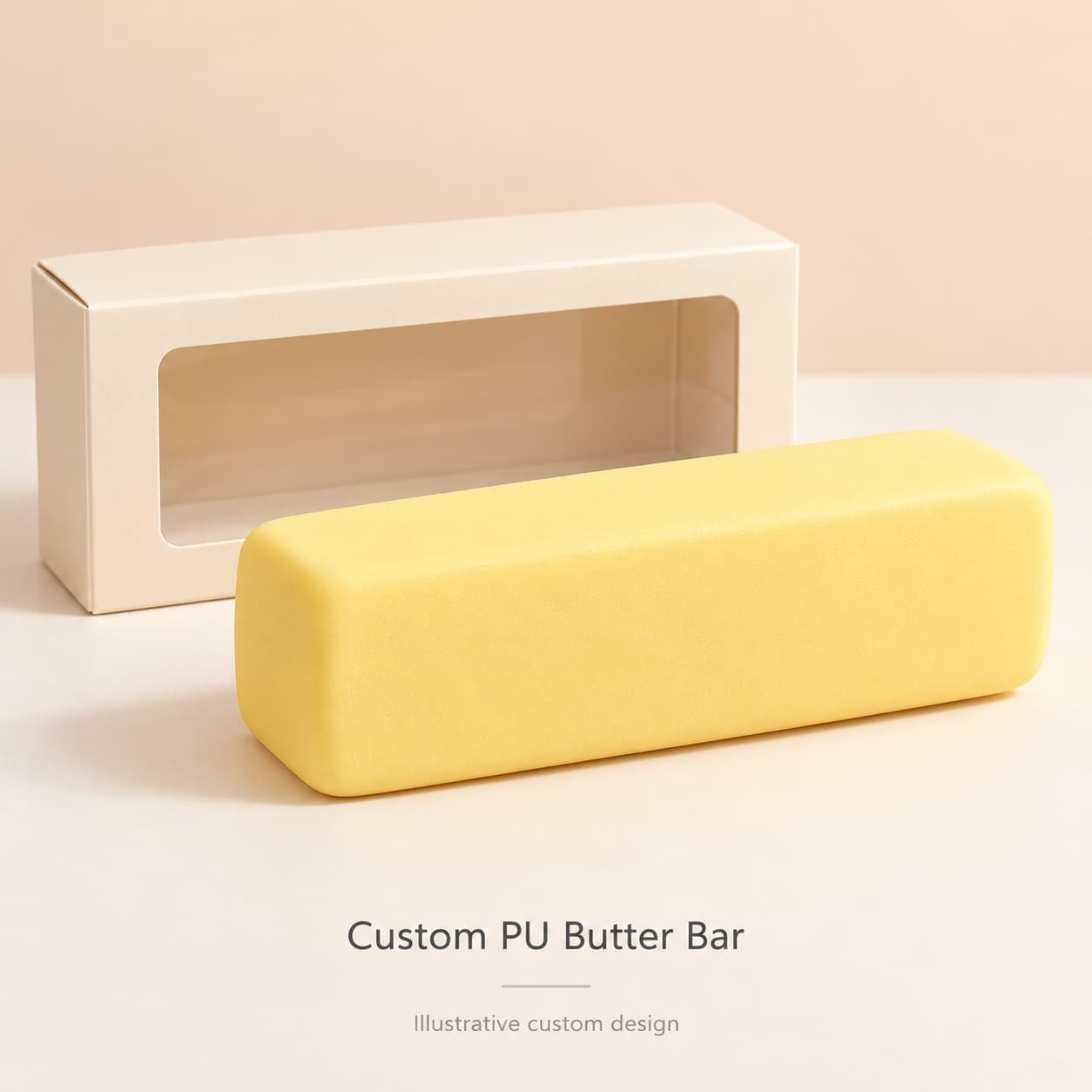
Custom PU butter squishy toys give buyers a simple food-inspired shape with a broad surface for original artwork. The important sourcing question is not just which yellow looks attractive. It is how the bar shape, foam feel, decoration and retail pack work together after the product has been sampled and handled.
Dongyu’s butter bar squishy product page lists soft PU foam and custom colors, packaging and designs. Use that listing as a starting point for a project discussion, not as a complete specification for your order. This guide focuses on one rounded rectangular PU bar and the buyer decisions needed to develop an original branded version.
Define the butter bar before designing the label
A short block and a long bar may share a food theme but provide different artwork space and packaging requirements. Choose the intended silhouette first. Record the length, width and height separately, and show the bar in its intended shelf position. A photograph without those notes leaves room for misunderstandings about scale and orientation.
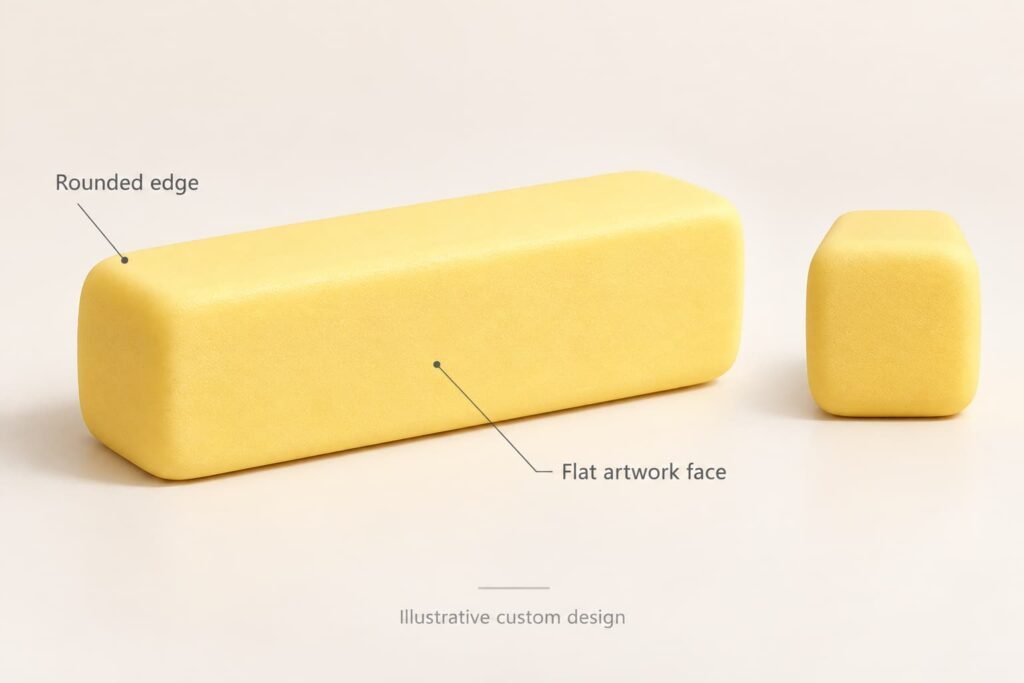
For the illustrated project, the concept is an elongated yellow bar with softly rounded edges and an undecorated broad face. The accompanying images are illustrative custom designs, not photographs of an approved production sample. Their proportions communicate a direction; the final dimensions, foam specification and manufacturing feasibility must be confirmed separately.
- Identify the broad face intended for the primary artwork.
- Mark which edges should remain rounded and free of small decoration.
- Specify whether the same design is viewed horizontally or vertically in the retail pack.
- State target quantity, destination market and sales channel with the design brief.
Keep this first project to one shape. Color variants can be discussed later without changing the underlying form. A buyer can then compare color and decoration decisions against the same physical product rather than accidentally approving several different bars.
Use the broad face as an artwork zone, not a full-wrap canvas
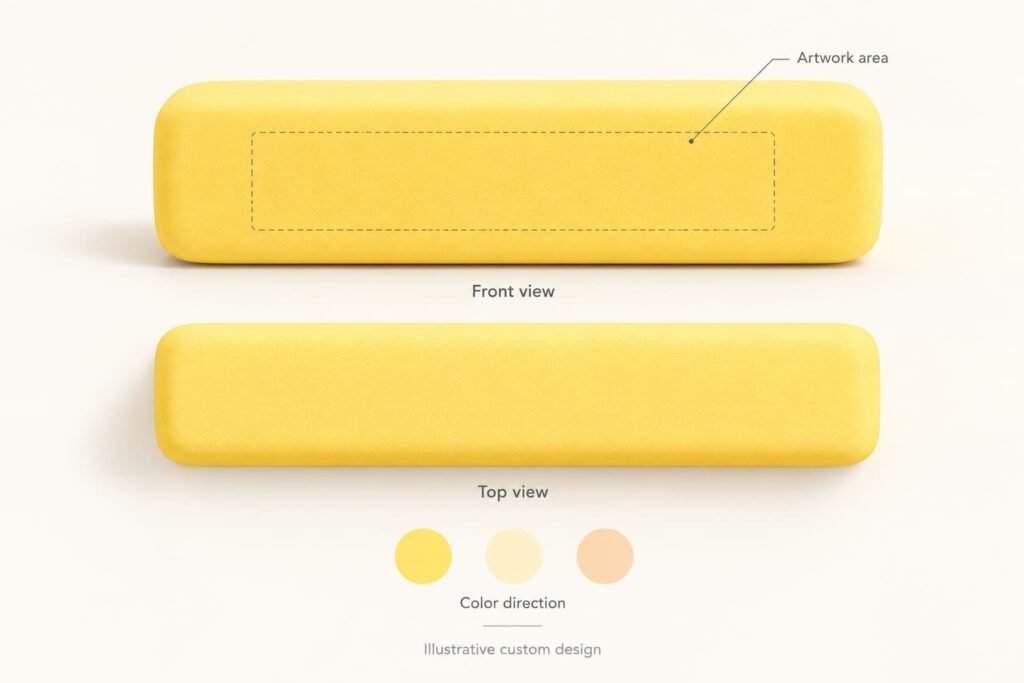
The broad face is the obvious branding location, but usable artwork space is not identical to the total face area. Leave room around rounded edges and any surface transitions identified during supplier review. Those margins help keep the composition legible and make placement changes easier to communicate.
Start with a simple visual hierarchy
Prepare a primary mark, an optional short product phrase and any essential supporting artwork as separate elements. Decide which element should be readable at the normal viewing distance for your sales channel. A detailed food-style label copied onto a small toy face can become crowded before printing feasibility has even been discussed.
Do not copy another supplier’s brand, distinctive label layout or protected character. The butter-bar category can inspire an original rectangular form, but your artwork should belong to your project. Use a temporary placement outline in the design sheet while the final brand assets are being prepared.
Avoid unsupported food-style quantities
Reference products sometimes display ounce values or food-style weight statements as decoration. Do not carry those values into your design automatically. A number on a toy can be mistaken for a verified product measurement or an edible-food claim. If any quantity is printed, confirm what it means and whether it is appropriate for the actual toy and its market.
Make the retail presentation clearly identify the item as a toy. The exact labeling and age-grade requirements need a separate destination-market review. An AI-generated package or an attractive artwork sheet does not establish that a label is compliant.
Prepare color and print instructions that can be sampled
“Butter yellow” is a useful visual direction but not a precise approval standard. Define the main body color and describe whether the intended appearance is pale, warm or strongly saturated. Supply an agreed physical color reference where possible, and identify which parts of the design require close matching.
Keep body color and artwork color separate in the specification. A cream body with dark artwork may create a different shelf impression from a bright yellow body using the same mark. Review these decisions on the proposed decorated sample, not only on a monitor.
- Provide an editable source file or a suitable vector artwork file for the supplier to review.
- Include a placement drawing with the front face identified.
- State the intended artwork size and distance from relevant edges.
- Explain which colors are critical and which allow a reasonable approved variation.
- List anything the supplier should not change without a new approval.
For the technical file preparation, refer to Dongyu’s custom squishy logo artwork guide. This butter-bar project adds a specific placement question: how the artwork reads on a long flat-looking face with rounded ends.
Check rounded edges and face orientation in a 3D proposal
A colored 3D proposal should answer geometry questions, not simply provide a dramatic product image. Review the transition between the main face and rounded edges. Confirm that the front, top and end views describe the same bar and that the artwork zone stays on the intended face.
Ask for a clearer end view if the bar appears too thin or too tall. Ask for the packaging-facing view if the main mark seems hidden at the intended display angle. Comments such as “retain the body length but round the end transition” are more useful than a general request to make the product softer-looking.
The generated 3D image in this article is a visual concept only. It is not verified CAD, tooling geometry or evidence of achievable dimensions. Confirm how the supplier will review feasibility and what drawings or samples form the basis of your order.
Approve the decorated PU sample, not just a plain foam bar
A plain sample helps discuss shape and foam feel, but it cannot establish how your final artwork will look or behave. Before approving production, review a representative decorated sample with the proposed body color and finish. Where the project has several decoration variants, agree which variants need separate approval.
Record the feel and recovery method
Evaluate the proposed sample using a consistent handling method. Describe the initial resistance, depth of compression and return toward the original shape. If recovery behavior is part of the product brief, agree how it will be observed or measured. Do not borrow a recovery-time claim from another supplier’s butter squishy listing.
Keep the evaluation relevant to normal intended use. An informal squeeze check is not a laboratory safety test, and a short demonstration video does not justify a durability claim. Any advertised performance statement should be supported by appropriate evidence for the actual product.
Review artwork after handling
Inspect the print before and after the agreed handling checks. Look for placement changes, unwanted marks, cracking, lifting or changes in readability. Record any observed issue with the sample version and a clear photograph. Ask the supplier to explain a proposed revision rather than accepting an unexplained change in decoration.
Pay particular attention to artwork close to rounded ends. The uncompressed product may look correct while the design becomes hard to read during ordinary squeezing. That does not automatically rule out the placement, but it needs an explicit buyer decision before the artwork is approved.
Use the sample approval checklist to document the final agreed appearance, feel and decoration. Retain the approved sample reference and the matching artwork version together.
Let packaging preserve the branded face
A retail pack should make the approved artwork visible without holding the foam bar in an unnecessarily compressed position. Develop the pack around the physical sample dimensions. Check whether a bag, window box or insert keeps the product facing correctly and whether the rounded ends fit without distortion.
For a window box, review the window position alongside the artwork zone. A narrow opening may obscure the important mark even when the toy fits. For a bag, evaluate reflections, folds and label placement that could interrupt the front view. These are packed-sample questions, not details that should be guessed from a flat packaging file.
- Check how the toy sits after the pack is picked up and put down.
- Confirm whether an insert or other support is needed for the chosen format.
- Inspect the decorated surface after contact with the proposed packaging materials.
- Reserve a clear label area without covering the intended product display.
- Record the retail unit count, pack dimensions and outer-carton arrangement.
Packaging can carry detailed brand messaging when the toy face should remain simple. Do not force every piece of copy onto the foam. Confirm the label content, product identification and required documentation for the intended market before final print approval.
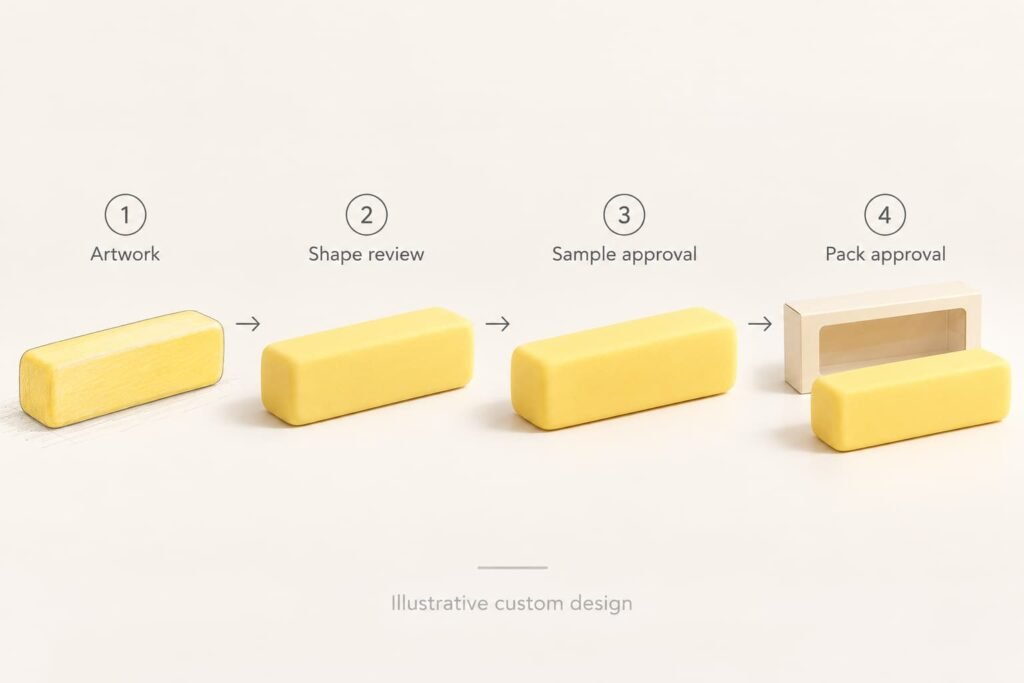
Control revisions with four connected approval stages
Keep the project organized around artwork, shape review, decorated sample approval and packed-sample approval. Each stage should point to the same product specification. An updated illustration must not silently replace the sample that the buyer previously accepted.
- Artwork brief: select the butter-bar silhouette, primary face, color direction and original brand assets.
- Shape review: resolve proportions, rounded ends and artwork-zone position using consistent views.
- Sample approval: review the proposed PU feel, body color, finish and decoration together.
- Pack approval: check visibility, fit, surface contact, labels and the packed presentation.
Use a revision identifier and date for each drawing, artwork file and sample decision. When requesting a change, say whether it affects appearance only or requires another physical sample. Obtain confirmation of any resulting cost or schedule change rather than assuming a revision has no commercial impact.
A useful custom PU butter squishy quotation brief
Send a compact project summary with your references. Mark open decisions clearly so the supplier can separate fixed requirements from options that need feasibility review. This produces a more meaningful quotation than asking for the price of “a butter toy” without specifying the artwork or packaging.
- Rounded rectangular PU butter-bar direction, with target length, width and height.
- Primary artwork face, placement drawing and editable brand assets.
- Body-color reference and decoration-color requirements.
- Desired handling feel and the sample evaluation approach to discuss.
- Expected quantity and allocation across color or artwork variants.
- Retail pack direction, destination market and planned selling channel.
- Request for sample scope, tooling terms, MOQ and schedule against this brief.
No fixed MOQ, sampling duration or unit price is established by this guide. Ask Dongyu to confirm commercial terms for the actual design and order. Clarify which quotation lines cover sampling, tooling, decoration, packaging and freight, and compare equivalent specifications when reviewing supplier offers.
Frequently asked questions
Can the same PU butter bar carry different artwork?
That is a project option to discuss. Keep the base shape fixed and identify each artwork version separately. Confirm quantities, decoration feasibility and approval requirements for every version before treating them as one interchangeable SKU.
Must the logo be printed directly on the foam?
No. Private-label packaging can carry the main branding if direct decoration does not suit the proposed surface or appearance. Review the toy and packaging together so the retail identity remains clear.
Does a 3D view prove that the printed bar is ready for production?
No. A 3D proposal clarifies shape and placement. A physical decorated sample is needed to review the actual appearance and agreed handling criteria, followed by a packed sample for packaging approval.
Can I copy the ounce number shown on a reference product?
Do not assume it applies to your toy. Confirm any printed quantity against the actual specification and review whether the wording could mislead buyers about product weight or edible-food use.
Start with an original butter-bar artwork brief
Share your shape reference, target dimensions, body color, artwork files, quantity and pack direction. Explore Dongyu’s OEM/ODM custom service and request a custom PU butter squishy project review. Ask for a decorated sample and packed-sample approval plan before confirming the final order specification.