Dongyu Insights
Custom Waffle Squishy Toys: TPR Grid Design & OEM Sample Guide

Custom waffle squishy toys need a specification that separates the waffle pattern from the squeeze behavior. A convincing photograph can show the grid and color, but it cannot confirm the material construction, pocket depth, surface behavior or recovery after compression. For a TPR OEM project, those decisions belong in the brief and sample approval record.
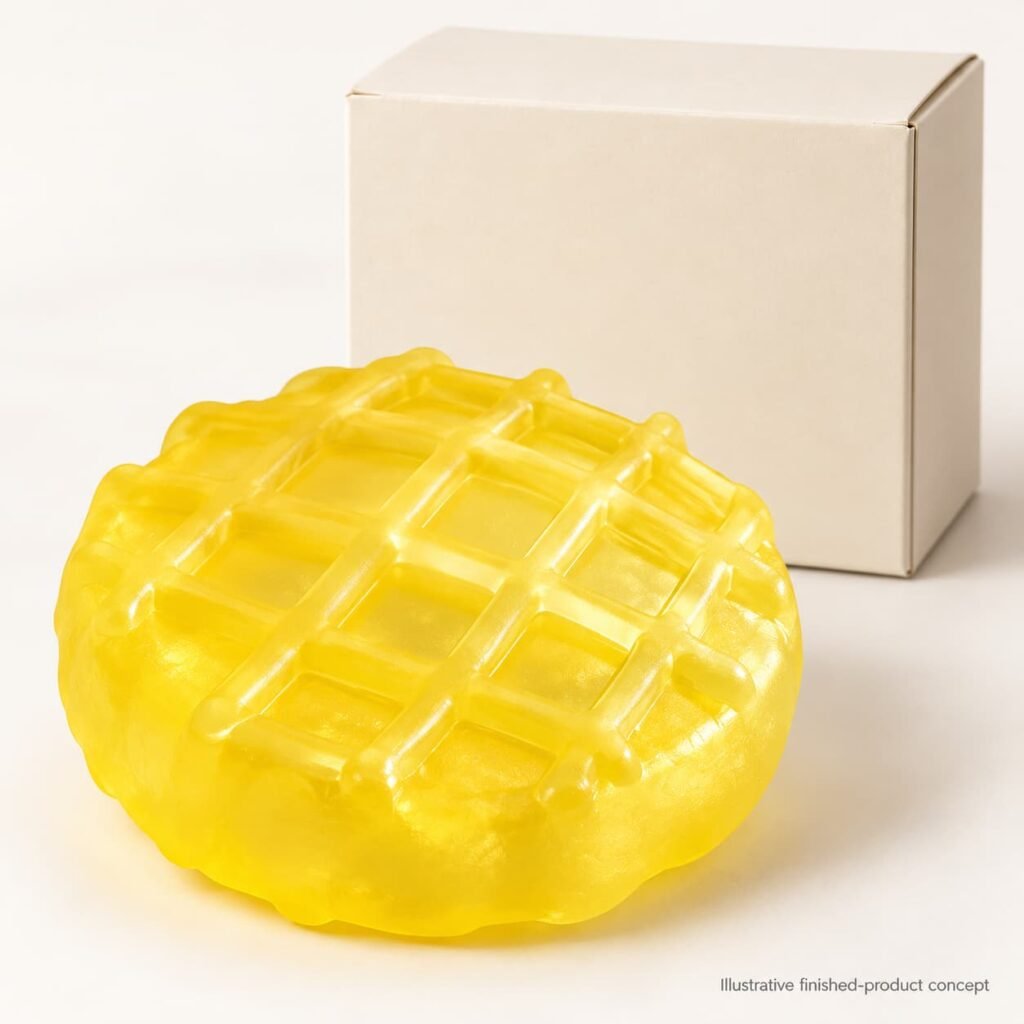
This guide follows an original translucent yellow waffle disk with shallow square pockets and rounded edges. It is a proposed private label product, not a branded retail replica or confirmation that Dongyu holds a suitable mold. The goal is a clear manufacturer enquiry, not an image that implies engineering approval.
What the market research supports
Research on November 2, 2026 found waffle-shaped squeeze toys in both US and UK retail pages. Recent category reporting also identified interest in texture-led squishies. Neither observation establishes waffle as the most-searched SKU, and a texture trend does not prove that a particular waffle is crunchy.
Choose the product brief around your intended customer and selling channel. Do not label a new construction “crunchy,” “slow-rise” or “super soft” simply because those words appear in search results. Ask the manufacturer to propose and sample the actual behavior before using it in a listing.

Build a waffle-specific RFQ
Begin with one product and one selling unit. Decide whether the order is for individually packed toys or a specified set. If the supplier offers an available mold, ask which visual details are fixed and which can change. If a new tool is needed, request a separate development scope.
| Field | Buyer supplies | Supplier confirms |
|---|---|---|
| Project | WF-01, Rev A, original waffle disk | Tooling route and quotation reference |
| Geometry | Diameter D and total thickness T in mm | Measuring method and feasible tolerances |
| Pattern | Square pocket layout and rounded ridge reference | Grid depth, spacing and transitions |
| Appearance | Yellow C1, desired translucency and sheen | Physical reference and sample options |
| Feel | Desired compression and recovery reference | Compound, construction and contents if relevant |
| Order | Quantity per color and selling unit | MOQ by version and mixing terms |
| Market | Country, audience and sales channel | Product-specific review and document plan |
| Delivery | Destination and arrival deadline | Sampling, revisions, production and freight separately |
Submit the brief through Dongyu’s custom project service. Mark unknown values as pending. A supplier should be able to identify the open decisions rather than silently filling them with assumptions.
Stage 1: keep the actual waffle silhouette
Use a clear photograph of a relaxed product as the starting point. A squeezed photo helps explain deformation, but it is unreliable for measuring the original outline. Show the circular disk, edge treatment and the relationship between width and thickness.
The sketch should make the waffle recognizable without adding unrelated toppings or characters. In this proposal, the top has a shallow grid and the underside is plain. Confirm that both sides are shown in the brief; an unillustrated underside can become an avoidable approval dispute.
Stage 2: label pockets, ridges and dimensions
Prepare top, side and bottom views with consistent orientation. Use D for diameter, T for thickness and C1 for the yellow color target. The letters in the concept sheet are reference labels, not approved numeric dimensions.
Ask the factory to review where ridges meet the edge, whether pocket corners need softening and how the pattern transitions across the curved surface. Do not equate a deeper grid with a better product. Appearance, tactile comfort and construction feasibility need to be evaluated together.
- Identify the intended number and arrangement of pockets in the controlled drawing.
- Separate the molded grid from printed decoration.
- Record the underside finish and edge profile.
- Approve color and translucency on a physical reference.
- Leave unconfirmed grid depth and tolerance values open.
Translucent yellow can look more saturated under backlighting. Review it under agreed conditions rather than approving a single promotional photo. The color matching guide can help structure that approval.

Stage 3: review form without inventing construction
A 3D appearance review should make the grid transitions easy to inspect. Compare it with the top view and side profile. Ask whether any modeled features must change before tooling, and record the approved change rather than letting the rendering and sample drift apart.
The generated wireframe-style profile is illustrative, not actual CAD. The manufacturer must confirm material, construction, section requirements, tool split and closure approach if applicable. If a filled version is proposed, request the exact outer material and contents, plus the compatibility evaluation plan.
The outside shape does not identify what is inside. Likewise, the appearance of particles or glitter in a market reference does not authorize a filling choice for this project. Do not advertise tactile or acoustic effects until the representative sample demonstrates the agreed behavior.
Compare quotations with the same selling unit
Ask for the MOQ by shape, color, decoration and package. Give the quantity of each version, not just the order total. Clarify whether the quoted unit is one toy, one multi-piece pack or one display. Carton counts should be listed separately.
Request itemized tooling or modifications, development samples, sample shipment, unit production, branding, individual packs, display assembly and freight assumptions. State the destination and delivery terms. An unboxed toy price is not directly comparable with a retail-ready price.
Use the quotation comparison guide to check equivalent scopes. Ask how grid revisions affect cost and timing. No MOQ, price or production lead time is established by the concept images.
Approve the physical sample and packed appearance
Use this matrix as a project worksheet, not an industrial or legal standard. Agree methods, conditions and acceptance limits before evaluating samples.
| Check | Method to agree | Evidence |
|---|---|---|
| Diameter and thickness | Relaxed sample, agreed measurement points | Actual D/T and accepted tolerances |
| Grid and edges | Compare approved top, side and bottom references | Pattern, corners and ridge transition observations |
| Feel and recovery | Agreed compression sequence and conditions | Reference sample ID and acceptable behavior |
| Surface | Check tack, transfer, sheen and unwanted marks | Accepted finish reference |
| Integrity | Supplier-agreed evaluation for the actual construction | Damage, opening or leakage if applicable |
| Pack contact | Agreed storage and handling in final packaging | Sticking, staining, grid pressure and deformation |
Assign accept, revise or retest to each open issue. Keep the retained sample linked to the specification revision. The sample approval checklist provides a broader approval-record structure.

Make the private label pack clearly non-edible
A realistic food shape should still be presented clearly as a toy. Do not use food packaging cues that obscure its purpose. Review the intended audience, instructions, labeling and destination-market requirements with suitable specialists for the actual product; do not copy another supplier’s age label or certification graphics.
Check how the pack contacts the raised grid. A package that compresses ridges may change the displayed appearance. Ask for a packed sample and record its condition after agreed storage and handling. For online selling, obtain packed size and weight before comparing delivered costs.
Control revisions before authorizing production
Start with WF-01-RevA and issue a new revision for changes to grid, thickness, material, color or packaging. Record the date, reason and approver. Artwork and physical samples may need separate identifiers.
Before production approval, reconcile the quotation, drawing, material description, retained sample and package artwork. A new color should not silently authorize a changed construction. Confirm the effect of every approved change on price, MOQ and schedule.
Procurement FAQ
Can a custom waffle squishy have my own grid?
Submit the original design for feasibility review. The supplier must confirm what can be changed on an available tool or whether new development is needed.
Is this concept crunchy?
No crunchy behavior is established. The illustration shows external appearance only. Request a representative sample for any proposed tactile or acoustic effect.
What is the MOQ for private label waffle toys?
Ask for a project-specific minimum by shape, color and package. Another supplier’s listed minimum is not a confirmed Dongyu order term.
Are the pictures actual samples or manufacturing files?
No. They are illustrative design and finished-product concepts. Engineering files, physical sample approval and product evaluation are separate steps.
Request a waffle squishy feasibility quote
Send Dongyu Toys your original waffle brief with target D/T, grid reference, desired feel, quantities, market, package and deadline. Request tooling feedback, MOQ, itemized pricing and sampling steps, and keep unresolved engineering parameters visible until confirmed.