Dongyu Insights
วิธีเปรียบเทียบใบเสนอราคาสยองชี่ของเล่นแบบกำหนดเอง: เช็คลิสต์สำหรับผู้ซื้อขายส่ง
To compare custom squishy toy quotations fairly, a wholesale buyer needs more than several unit prices in a spreadsheet. Two offers can appear to describe the same toy while using different dimensions, materials, decoration, packaging, assortment ratios or delivery scope. The lower number may simply exclude work that another supplier included.
This guide provides a practical comparison method for importers, retailers, private-label brands, promotional buyers and online sellers. It does not publish a target price, MOQ or production time because those details change with the product, quantity, packaging, customization and order window. The objective is to make every assumption visible before a supplier is selected.
Start With One Controlled RFQ Brief
A quotation is comparable only when each supplier receives the same request. If one supplier sees a reference photo, another sees a finished drawing and a third receives only a short message, their replies will be based on different interpretations.
Create one dated request-for-quotation brief and give it a version number. It should identify:
- The product idea, reference image or buyer SKU
- Target dimensions and expected selling unit
- Desired squeeze feel, recovery and surface direction
- Known material or construction preference
- Color, scent, print, logo or decoration scope
- Quantity by design, color and set
- Standard or custom packaging requirement
- Destination market and sales channel
- Required warehouse or launch date
- Questions about samples, documents, inspection and shipping
When the specification changes, send the same new version to every supplier. Do not quietly update only the preferred offer. Dongyu Toys’ custom squishy toy planning guide explains what to prepare before the first quotation request.
Confirm That Every Quote Covers the Same Product
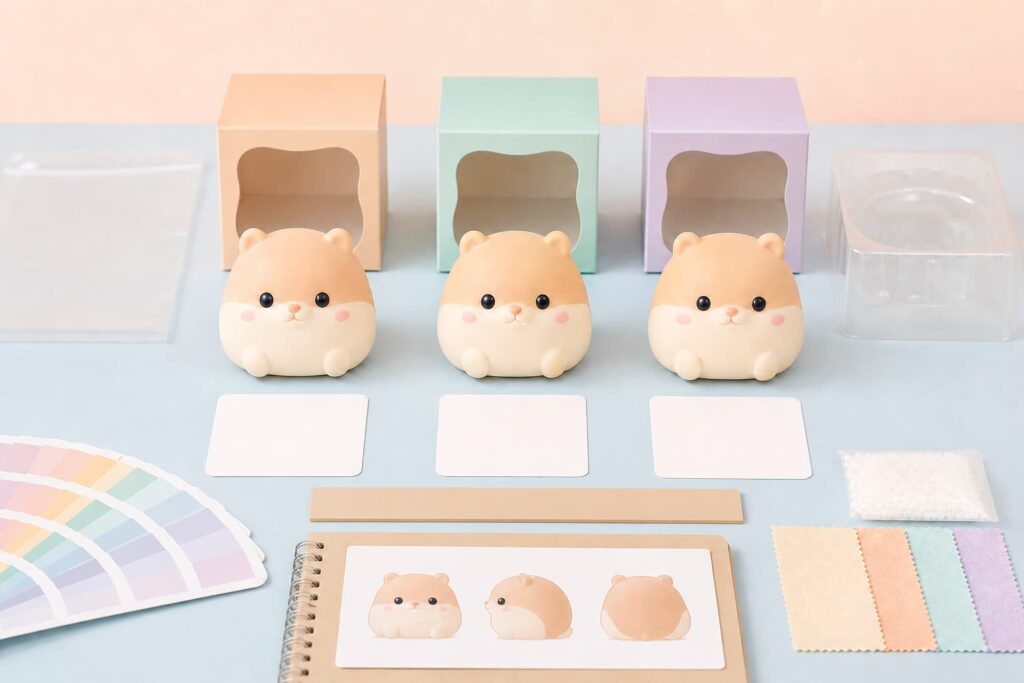
Put product identity at the top of the comparison sheet. A “small animal squishy” can refer to PU foam, a solid TPR/TPE item, a filled squeeze toy or another construction. Similar photos do not prove that the products will have the same weight, recovery, feel or durability.
For each offer, record:
- Supplier item number and buyer item number
- Reference image, drawing version or sample code
- Unpacked product dimensions
- Unit weight and whether it is estimated or measured
- Material and construction description
- Color, surface finish and decoration method
- Included accessory or attachment
- Individual unit, set or assortment definition
If suppliers propose different materials or constructions, show them as separate product options. Do not average unlike offers into one price ranking. A broad PU, TPR and TPE material guide can help define the performance direction, but the final decision should be confirmed with the quoted product and a physical sample.
Define the Selling Unit Before Comparing Price
A price per piece is not useful if the retail product will be sold as a three-piece set. Record the selling unit first, then convert every quote to that same basis.
For example, a mixed display may contain several designs, while the customer buys one individually packed toy. A multipack may contain six toys but use one barcode and one retail box. A blind-box series may price each box separately while requiring a controlled design ratio in the master display. Your comparison should show both the total piece count and the number of finished selling units.
Also confirm whether the quoted quantity is per design, per color, per set or for the full order. A total-order quantity can meet one minimum while still missing a minimum for a printed package, custom color or individual style.
Separate Product, Decoration and Packaging Costs
Ask suppliers to separate the base product from optional work. This makes it easier to compare a stock item, a color change, a logo version and a fully custom private-label program.
Base product scope
Confirm which size, material, color and standard pack are included. If the supplier offers a current design, record whether the quotation is based on available inventory or a new production batch.
Decoration and artwork scope
List logo printing, surface painting, molded details, scent, special finish, label application and artwork preparation separately. Ask whether setup, plate, mold or other development charges are one-time charges, recurring charges or estimates subject to final artwork.
Packaging scope
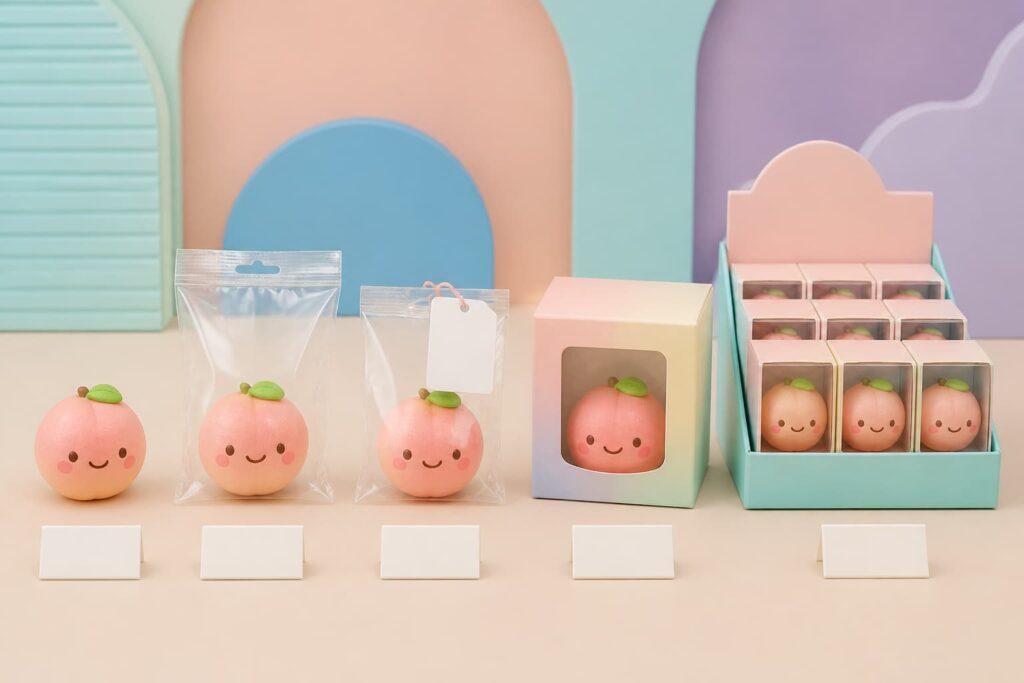
Record the price and minimum for each bag, tag, card, tray, window box, insert or display. Confirm whether packing labor is included and whether excess printed packaging must be purchased or stored. Compare the custom squishy toy packaging options before requesting final pricing.
A clear cost structure lets buyers test alternatives without confusing product quality with presentation cost.
Make MOQ Visible at Every Level
MOQ is not always one number for the entire order. Different minimums may apply to the product, mold, color, logo method, printed bag, box, display or individual SKU.
Create separate columns for:
- Total product MOQ
- MOQ per design or color
- Mixed-style rule and assortment ratio
- Customization or decoration MOQ
- Printed packaging MOQ
- Quantity basis for each price tier
Ask what happens when the product quantity and packaging minimum do not match. The answer could affect leftover materials, future reorders and cash tied up in unused packaging. Do not assume a supplier will hold excess printed material without written agreement.
Compare Sample, Tooling and Approval Stages
The word “sample” can describe very different deliverables. A current stock sample can demonstrate general hand feel, while a color sample may show only a material variation. A prototype can evaluate a new shape, and a pre-production sample can combine the approved product with final artwork and packaging.
For each offer, record:
- Type of sample included
- Sample price and courier basis
- Tooling or mold scope
- Estimated preparation time and its starting point
- Number of revisions included, if stated
- Whether any sample charge is credited to a bulk order
- Which physical and digital items the buyer must approve
Do not treat a rendering, color swatch and finished packed sample as equivalent. Tie every approval to a date, code or file version. Dongyu Toys’ production process shows how a brief can move through sampling, pre-production confirmation, production checks and packing.
Normalize Trade Terms and Included Services
A supplier price should state the delivery basis and a named place where applicable. An offer collected from the factory and an offer delivered to a warehouse do not include the same tasks, costs or risks. Buyers should confirm the current commercial term with their logistics and trade advisers.
On the comparison sheet, mark whether each offer includes or excludes:
- Export packing and origin handling
- Pickup and inland transport
- Export clearance
- Main transport and insurance
- Destination handling
- Import clearance, duty and tax
- Delivery to the final warehouse
Separate supplier-controlled product costs from freight estimates that can change with route, season and booking date. Never compare two totals as though their delivery scope is identical without checking the inclusions.
Require Usable Inner-Pack and Carton Data
Product price is only one part of wholesale economics. Packaging size and carton efficiency affect freight, storage and ecommerce preparation. Early carton data may be estimated, but it should be updated after the product and packaging are finalized.
Capture:
- Units per individual selling pack
- Selling packs per inner pack
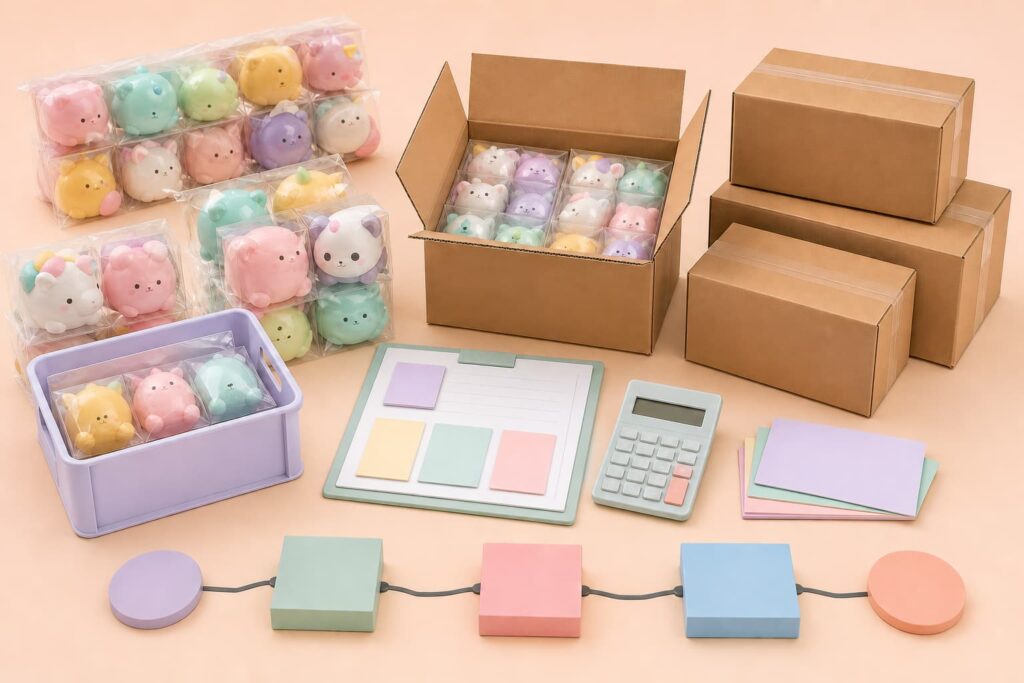
- Inner packs and total units per master carton
- Master-carton length, width and height
- Net and gross carton weight
- Estimated carton count at the quoted quantity
- Pallet information if relevant to the route
Ask whether dimensions refer to an unpacked toy, retail pack, inner pack or carton. One custom box or insert revision can change carton quantity and freight volume, so require final confirmation before transport is booked.
Turn Lead Time Into a Dated Schedule
“Production takes several weeks” is incomplete unless the starting point and dependencies are stated. Ask whether the estimate begins after deposit, mold completion, product-sample approval, packaging-artwork approval, packaging-material arrival or another milestone.
Separate the project into sample development, revisions, packaging proof, packaging production, bulk product production, inspection, correction allowance, export preparation and transport. Work backwards from the required warehouse date. Treat all timing as project-specific and reconfirm it before placing the order, especially for seasonal launches.
Keep Testing and Documentation Product-Specific
A quotation may say that certificates are available without identifying what they cover. Convert this into precise questions:
- Which report or document is available?
- Which product, material, filling, color and components does it identify?
- Which destination market and age positioning were considered?
- Who issued the document and when?
- Would the proposed customization require review or additional testing?
- Which testing or document cost is included or excluded?
Do not treat a generic image or unrelated SKU report as product-specific evidence. Applicable requirements should be confirmed with the buyer’s importer, retailer, laboratory or qualified compliance adviser before claims, labels or purchase decisions are finalized.
Compare Quality and Inspection Scope
Price comparison should show how the product will be approved and checked. Ask whether the supplier will work to a written specification, identified approval sample and packaging artwork version. Record whether buyer inspection or third-party inspection can be arranged and how agreed problems will be handled.
A useful quality basis can include appearance, dimensions, weight direction, color, hand feel, recovery, surface, decoration, package condition, assortment ratio, labels, carton marks and packing quantity. The checks must suit the actual product rather than relying on a universal checklist.
Review Payment Terms and Quotation Validity
Record currency, deposit, balance, payment trigger, method, bank-charge allocation and quotation validity. Verify beneficiary details through the buyer’s normal fraud-prevention process, especially when payment instructions change.
An expired offer should be reconfirmed because materials, exchange rates, capacity and freight can change. A lower deposit does not automatically make an offer safer or less expensive; review the full commercial, quality and delivery position.
Build One Comparable Landed-Cost Scenario
Convert every valid quotation into the same currency, quantity and selling-unit basis. Use one exchange-rate date and label all unconfirmed amounts as estimates.
Possible components include:
- Goods under the quoted delivery basis
- Customization and retail packaging
- Samples, molds, tooling and setup allocated appropriately
- Inspection and product-specific testing
- Origin, freight, insurance and destination handling
- Duty and tax estimates from appropriate sources
- Warehouse or marketplace preparation
Show cost per finished selling unit, not only cost per loose toy. Keep uncertain logistics and tax assumptions separate so they can be updated without altering the confirmed factory offer.
Final Checklist to Compare Custom Squishy Toy Quotations
- Same product version, material direction and dimensions
- Same selling unit, quantity and assortment ratio
- Equivalent decoration and packaging scope
- Visible sample, mold, tooling and setup charges
- MOQ separated by product, variant and package
- Delivery basis, named place and included services
- Usable inner-pack and master-carton information
- Dated schedule with clear starting assumptions
- Product-specific documentation questions
- Approval, quality and inspection basis
- Payment terms and quotation validity
- One comparable landed-cost scenario
FAQ About Squishy Toy Quotation Comparison
Why can two custom squishy toy prices be very different?
The offers may differ in size, weight, material, construction, decoration, packaging, quantity, tooling, inspection, document scope or delivery basis. First normalize those variables, then ask each supplier to clarify remaining exclusions.
Should buyers choose the lowest unit price?
Not by unit price alone. Compare the same product and selling unit, then review sample quality, packaging, landed cost, schedule, documentation, approval controls and supplier communication. The lowest visible number may omit necessary work.
What should be included in an OEM squishy toy quotation?
A useful quote should identify the product version, quantity basis, price scope, packaging, MOQ, development charges, sample stage, schedule assumptions, delivery basis, validity and major exclusions. Carton and documentation details may begin as estimates but should be confirmed as the project develops.
How should buyers compare a PU foam quote with a TPR or TPE quote?
Treat them as different product options unless the required feel and construction are genuinely equivalent. Compare the customer experience, shape feasibility, decoration, packaging and sample result before comparing cost.
When should the final quotation be reconfirmed?
Reconfirm after the physical product, packaging, quantity, assortment, artwork, testing scope, delivery basis and schedule are defined—and again if the quotation expires or an important requirement changes.
Request a Quote on a Clear Commercial Basis
Send Dongyu Toys your product reference or original artwork, target size, squeeze-feel direction, quantity, assortment, packaging, destination market and desired timing. If any item is undecided, mark it as open rather than allowing an assumption to become part of the price.
To compare custom squishy toy quotations with fewer hidden differences, start with one controlled brief and request written clarification of every important inclusion. Contact Dongyu Toys to discuss an OEM, ODM or private-label squishy toy project.