Dongyu Insights
Custom TPR Dumpling Squishy Toys: Design to Packaging
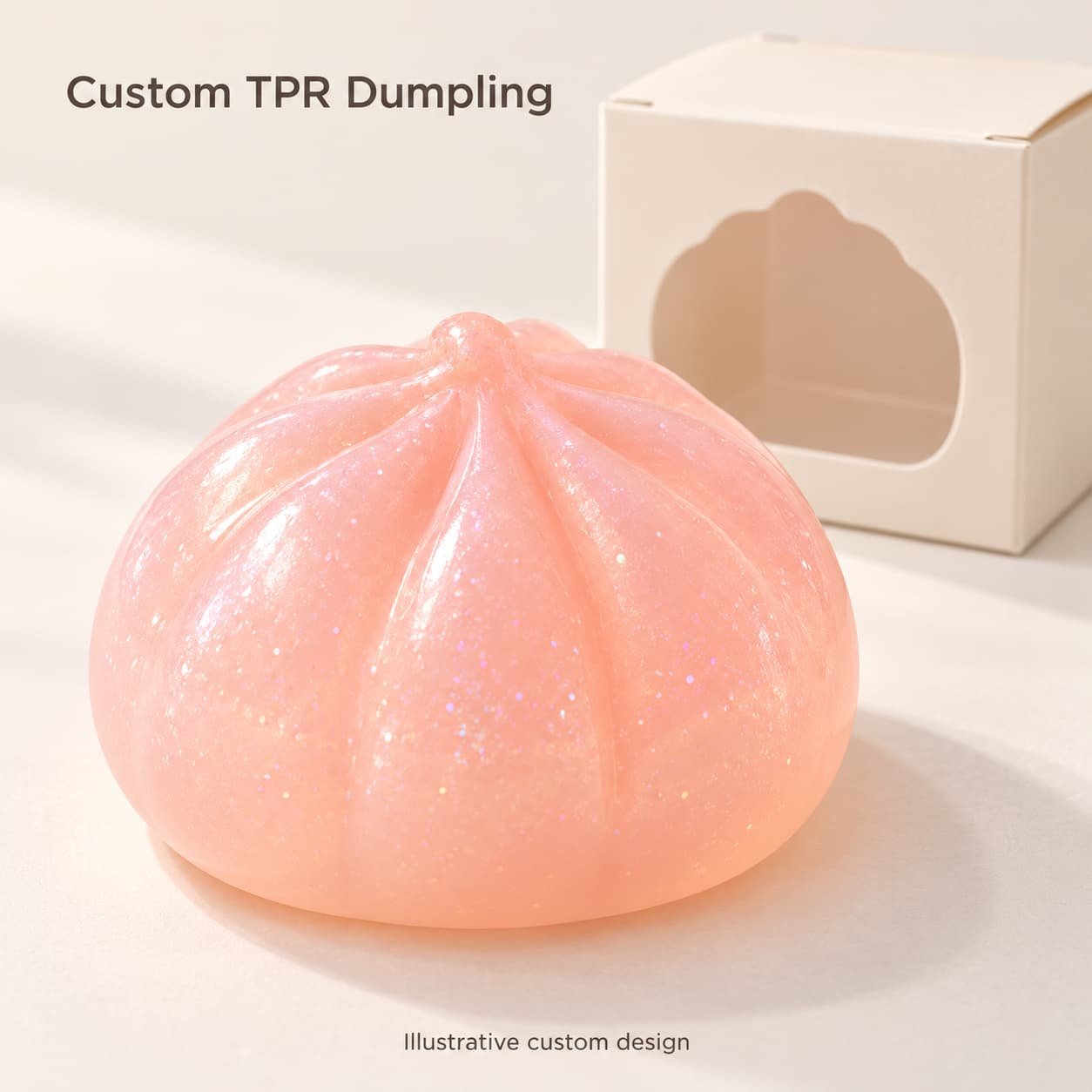
Custom TPR dumpling squishy toys work best as a clearly defined product project, not a collection of attractive but unrelated drawings. A buyer needs one recognizable dumpling shape, an agreed color direction, a physical sample with the intended squeeze feel, and packaging that protects that approved product. This guide shows how to connect those decisions before placing a wholesale order.
The illustrated project uses a rounded bao-style dumpling with broad shallow pleats and a peach-pink color direction. It is an illustrative custom design, not an existing approved TPR sample. Dongyu’s glitter dumpling product page provides a useful visual category reference, but its published material description does not establish a TPR specification. Confirm the proposed material and construction separately when requesting a quotation.
Start with one dumpling shape and one buyer use case
“Dumpling squishy” can describe a crescent jiaozi, a rounded bao, or another food-inspired form. Choose one silhouette before discussing colors or packaging. For a rounded bao, explain the body width, overall height, top pinch and base shape. For a crescent, describe the curved body and folded edge. A supplier should not have to guess which interpretation belongs in the sample.
Then explain the sales channel. A gift-shop single item, a branded promotional toy and a multi-piece online listing need different presentation decisions. Keep the first brief focused on one intended use. Adding several channels later may require different pack formats, labels or assortments even when the toy itself stays unchanged.
- Include front, side and top reference views with a short explanation of what each view demonstrates.
- State target dimensions in millimeters and identify which measurement is width, height or depth.
- Identify essential features and features that may be simplified after a feasibility review.
- Provide expected order quantity, destination market and packaging direction for quotation.
Use references you own or have permission to develop. Familiar food shapes can guide a brief, but copying another seller’s character face, distinctive artwork or branded package is not a substitute for original design.
Build a colored design sheet that can be checked
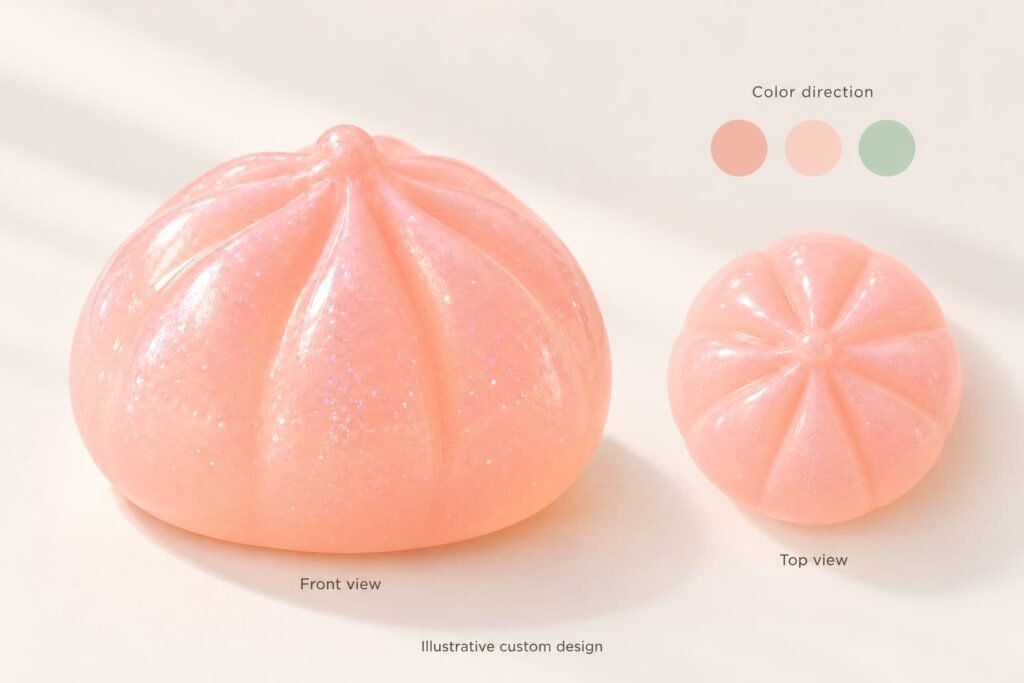
A custom dumpling squishy design sheet should show the same object from multiple views. If the front looks like a round bun but the side looks like a thin crescent, the sheet is not ready for approval. Check the relationship between the broad body, shallow pleats and central pinch before adding decorative details.
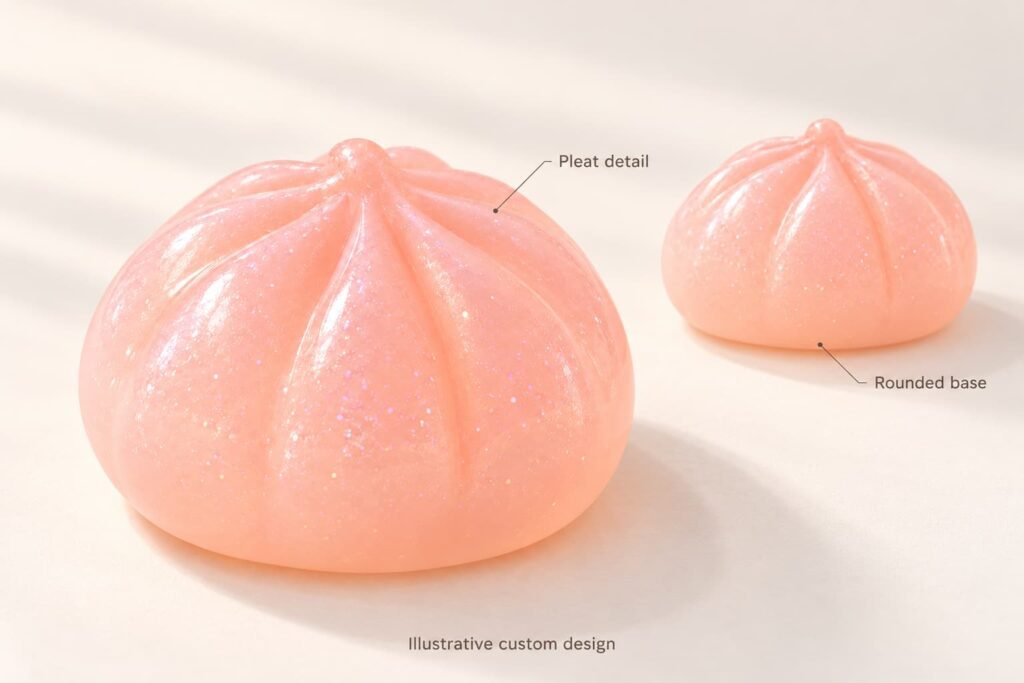
Separate geometry from decoration
Describe pleat count, approximate spacing and the shape of the top pinch as geometry. Record color, translucency, sparkle and printed details as decoration. Keeping these categories separate makes revisions easier to trace. A color change should not quietly alter the body proportions, and a pleat revision should not erase an approved print position.
Broad rounded pleats are a practical direction to discuss, not a guarantee of manufacturability. Ask the supplier to review the complete design and identify any details that require adjustment for the proposed construction. Do not rely on an AI illustration to establish mold feasibility.
Keep the first color plan controlled
Choose a main body color and a limited number of alternatives. For this project, peach pink is the lead direction, while mint and cream can be discussed as additional colorways. Keep all colorways on the same silhouette. Buyers can then evaluate color preference without accidentally comparing different products.
Supply a physical color reference where possible. Screen colors are useful for communication but should not serve as the final color standard. If translucency or a glitter effect is requested, approve how it looks on the actual proposed sample rather than assuming a color chip predicts the finished appearance.
Use colored 3D views to resolve shape questions
A colored 3D concept can expose misunderstandings that a front drawing hides. Check how the top pinch meets the body, whether the base is stable in the intended display position, and whether the pleats remain recognizable from an ordinary shelf-view angle. Ask for the views needed to answer those questions, not an elaborate rendering that only looks impressive.
The 3D illustrations accompanying this article are visual proposals. They are not manufacturing CAD, tooling files, physical sample photographs or test evidence. Any production drawing, dimensional specification or tooling arrangement must be separately discussed and confirmed with the supplier.
Give comments against named views and version numbers. “Reduce the top pinch in side view, retain the body width” is actionable. “Make it cuter” is open to interpretation. After a revision, review the entire object again so one requested change does not create an unnoticed change elsewhere.
Confirm the TPR specification through a physical sample
TPR is a material direction, not a complete product specification. It does not automatically describe the internal structure, recovery behavior, finish or durability of a dumpling toy. Ask whether the proposed item is solid or filled, what components are involved, and which characteristics will be included in sample approval. Do not infer these details from a similar product sold by another supplier.
For a filled proposal, discuss containment, closure and intended handling with the supplier. For any construction, establish what normal squeezing means for the intended product and user group. The evaluation method should reflect actual use without turning an informal handling check into a claimed safety test.
Evaluate feel alongside appearance
Review the sample using consistent handling. Note the initial resistance, how the product deforms, how it recovers and whether it feels comfortable in the intended grip. Record observations in plain language. If recovery time is important to the listing, agree on a measurement method and support any published claim with relevant evidence.
Also inspect the pleats, top pinch, base, visible seams and any closure area. Compare the physical sample against the approved views. Look for unwanted changes in proportion or decoration. For the complete approval workflow, use Dongyu’s custom squishy sample approval checklist.
Approve finish and printing separately
A smooth, translucent or glitter appearance changes how color is perceived. Review the sample under consistent lighting and photograph it without filters. If printing is proposed, specify its location and ask how it will be assessed after handling. Do not assume a printed detail will behave like a label on a rigid object.
Packaging can carry the primary branding when the toy surface is small or visually busy. If direct printing is essential, provide artwork and placement requirements for feasibility review. Dongyu’s logo artwork guide explains the files and placement information buyers should prepare.
Design packaging around the approved dumpling
Set the pack size from the approved physical sample, including any tray, insert or protective layer. A rendering is not enough to establish fit. Check that the top pinch and pleats are not distorted by a tight cavity and that the product stays presented as intended during ordinary handling.
Discuss an individual bag, window box or display arrangement according to the sales channel. These are packaging directions to evaluate, not automatically available specifications. Request a packed sample so appearance, fit and labeling can be reviewed together.
- Confirm the product count and color allocation for each retail unit.
- Check visibility through a window without excessive compression or awkward positioning.
- Reserve space for identification, barcode and destination-market labeling requirements.
- Make the package clearly communicate that the food-shaped item is a toy.
- Record retail pack dimensions and outer-carton details before confirming logistics.
Food-inspired presentation should not encourage buyers to mistake the toy for food. Agree the intended age group and required warnings with appropriate compliance support. A generated package mockup is not proof that its labeling meets the rules of a destination market.
Move from design approval to a controlled order
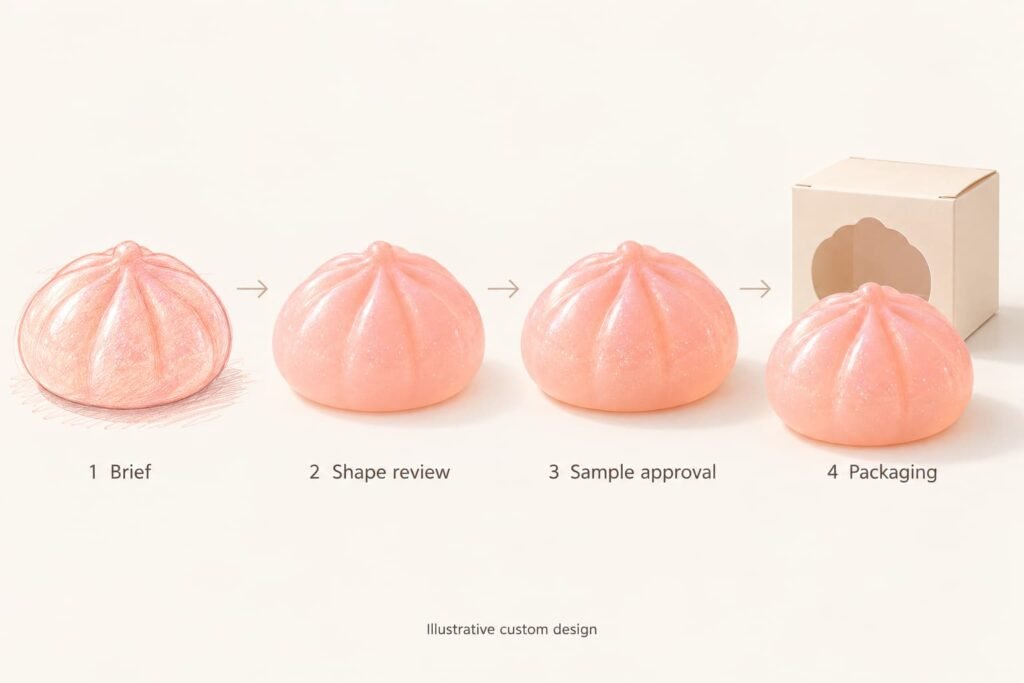
The development sequence should connect the brief, shape review, physical sample and packaging. Do not skip sample approval because the colored illustration already looks finished. Each stage answers a different question, and an attractive image cannot establish the feel or performance of the proposed TPR item.
- Brief: define the same dumpling shape, dimensions, color direction, channel and target quantity.
- Shape review: resolve proportion and pleat questions through annotated colored views.
- Sample approval: confirm the proposed material, construction, feel, appearance and agreed evaluation criteria.
- Packaging approval: inspect the packed product and confirm artwork, labels, assortment and carton information.
Retain a versioned approval record for each stage. Identify which sample and packaging version form the order basis. If any specification changes afterward, ask whether a new approval is required. Avoid mixing an earlier sample, a later illustration and a different packaging file into one ambiguous production instruction.
What to include in a custom TPR dumpling inquiry
A useful inquiry gives enough detail to assess feasibility without pretending every decision is already final. Mark open questions clearly. This helps the supplier separate confirmed requirements from proposals that need sampling or a different quotation.
- Product: rounded bao-style TPR dumpling toy, with reference views attached.
- Shape: target dimensions, broad pleats, top pinch and base requirements.
- Color: lead color, optional colorways and proposed finish.
- Construction: request confirmation of material and solid or filled design.
- Commercial brief: target quantity, sales channel, destination and planned launch.
- Pack: unit count, packaging direction, artwork and labeling responsibilities.
- Approval: request sample stages, evaluation criteria and written quotation terms.
Ask for MOQ, sampling cost, tooling arrangements and schedule against this specific brief. Do not adopt figures from another product page. Those commercial details depend on the final design, construction, decoration, packaging and order requirements.
Frequently asked questions
Can several colors share the same dumpling shape?
That is a sensible design direction to request. Keep the shape fixed and ask the supplier to confirm colorway feasibility, quantity allocation and sampling requirements. Different colors should not be illustrated as different shapes unless a shape change is actually part of the brief.
Does a TPR dumpling have to contain a filling?
No construction should be assumed from the material name alone. Ask for the proposed structure and component specification in writing. A market example with a filling does not establish how your custom project will be made.
Can a 3D picture replace a sample?
No. A picture helps discuss geometry and appearance. A physical sample is needed to evaluate the proposed material feel, handling, decoration and packaging fit against agreed criteria.
Can I use my own packaging without a logo on the toy?
Ask for a private-label packaging proposal. Provide brand artwork, pack format and destination-market requirements. Confirm print files, product identification and the packed sample before approving the order.
Discuss your TPR dumpling design with Dongyu Toys
Send one clear dumpling concept rather than a mixed board of unrelated products. Include reference views, dimensions, color direction, target quantity and packaging needs. Explore Dongyu’s OEM/ODM custom service, then request a custom TPR dumpling project review. Ask the team to confirm feasibility, material construction and sample requirements before relying on any proposed specification.