Dongyu Insights
Custom Squishy Toy Logo Artwork Guide: Imprint Area, Proofs & Durability
A logo that looks clean on a computer screen can become crowded, distorted, or difficult to reproduce when it is reduced onto a soft squishy toy. The surface may be curved, textured, coated, hand-finished, or designed to compress deeply. For wholesale buyers, promotional-product distributors, and private-label brands, the useful question is therefore not simply “Can you print our logo?” It is “What artwork, imprint area, proof, sample, and acceptance record will make this branding repeatable?”
This guide explains how to prepare custom squishy toy logo artwork for quotation and sampling. It covers direct product imprints, molded brand details, tags and retail packaging, along with the checks buyers should make before approving bulk production. It does not promise that one printing method works for every PU, TPR, TPE, coated, or filled product. The final route must be confirmed against the actual product construction and a finished physical sample.
Begin With the Branding Job, Not the Printing Method
Before choosing a decoration process, define what the branding must achieve. A small event giveaway may need a simple one-color mark that remains recognizable at arm’s length. A private-label retail line may need the toy, hang tag, individual package, counter display, and shipping carton to work as one visual system. A mascot replica may use the product shape itself as the strongest brand signal and reserve detailed information for the package.
Write down the commercial priority:
- Recognition: the brand mark should be easy to identify at the actual product size.
- Retail communication: the package must carry product information, market-specific labeling, and channel requirements.
- Collectible design: the toy should remain visually appealing without a large corporate mark across the character.
- Campaign use: the product, event date, distribution method, and packaging should suit a fixed promotional program.
- Repeat orders: artwork revisions, colors, positions, and approved samples must be easy to identify later.
This decision prevents a common mistake: forcing a complex logo onto a small curved toy when a label, header card, window box, or insert could communicate the brand more clearly.
Measure the Real Imprint Area on the Finished Shape
Product dimensions and printable dimensions are not the same. A 75 mm ball does not provide a 75 mm flat canvas. The usable area may be limited by curvature, seams, molded texture, painted features, ears, paws, windows, or the point where fingers naturally compress the toy.
Ask the supplier to mark the proposed imprint zone on a product drawing or sample photograph and provide:
- maximum artwork width and height;
- distance from seams, edges, molded details, and painted areas;
- the viewing orientation when the toy rests naturally;
- whether the area is flat, gently curved, strongly curved, or textured;
- whether more than one print position requires separate setup or alignment;
- the product and artwork revision used to define the area.
Use the actual approved product size. A digital drawing can hide how quickly a logo wraps around a sphere or disappears under a character’s belly. For promotional stress relievers, public product listings commonly show deliberately compact imprint areas even when the overall toy is much larger. That market pattern is useful evidence: successful branding usually respects the stable surface rather than filling every visible centimeter.
Prepare Production Artwork, Not Only a Marketing Image
A supplier needs artwork that can be sized, separated, and checked. Whenever possible, provide the authorized vector file rather than a screenshot copied from a website. Typical working formats may include AI, EPS, PDF, or SVG, but the accepted format should be confirmed with the supplier.
The artwork package should identify:
- brand name and project name;
- artwork filename and revision date;
- vector logo plus a visual reference PDF;
- approved spot colors or other agreed color references;
- required logo width, height, position, and orientation;
- positive and reversed versions where relevant;
- minimum clear space around the mark;
- which elements may be simplified and which must not change;
- confirmation that the buyer owns or is authorized to use the artwork.
Very fine lines, small gaps, tiny registration details, gradients, and small text may not reproduce as they do on a large screen. Ask for an artwork check at actual imprint size. If simplification is needed, approve a dedicated small-format logo version rather than allowing an undocumented change during production.
Choose the Branding Route for the Product Surface
Direct imprint on the squishy
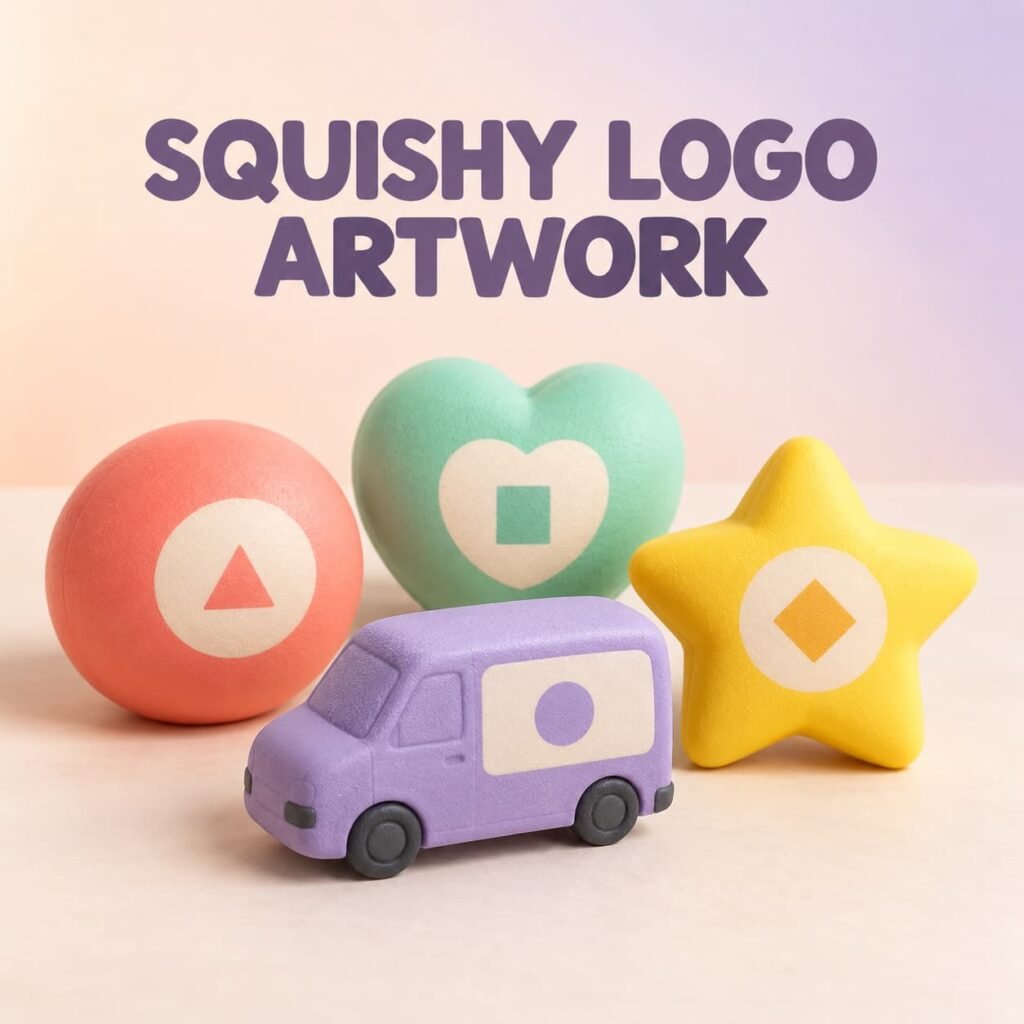
A direct imprint can work well when the toy has a smooth, stable area and the artwork is compact. Public promotional stress-reliever listings frequently use one-color marks on balls, hearts, stars, vehicles, and other simple PU foam shapes. Pad printing is often associated with small or curved objects because a compliant transfer pad can reach surfaces that are not fully flat. However, suitability still depends on the substrate, coating, ink system, artwork, curvature, and expected deformation.
Do not specify a process only because another supplier used it on a visually similar item. Confirm the method for the exact sample and ask what the quotation includes: number of colors, number of locations, setup assumptions, maximum imprint size, and whether the print sits over coating, pigment, or another surface treatment.
Molded or raised brand detail
A molded symbol can become part of a fully custom shape. It may suit a broad, simple element that remains readable as relief, but it changes the geometry and may require new tooling. Thin letterforms and detailed legal text generally do not translate well into soft molded relief. Tool ownership, artwork authorization, sample approval, and the relationship between molded detail and paint should be agreed in writing.
Printed or painted decorative detail
Character eyes, food gradients, vehicle panels, and patterns may use decoration that is different from a promotional logo imprint. Treat every artwork layer as a controlled element. A face print and a buyer logo can have different positions, colors, setup needs, and acceptance limits even when they appear on the same toy.
Branding on packaging or accessories
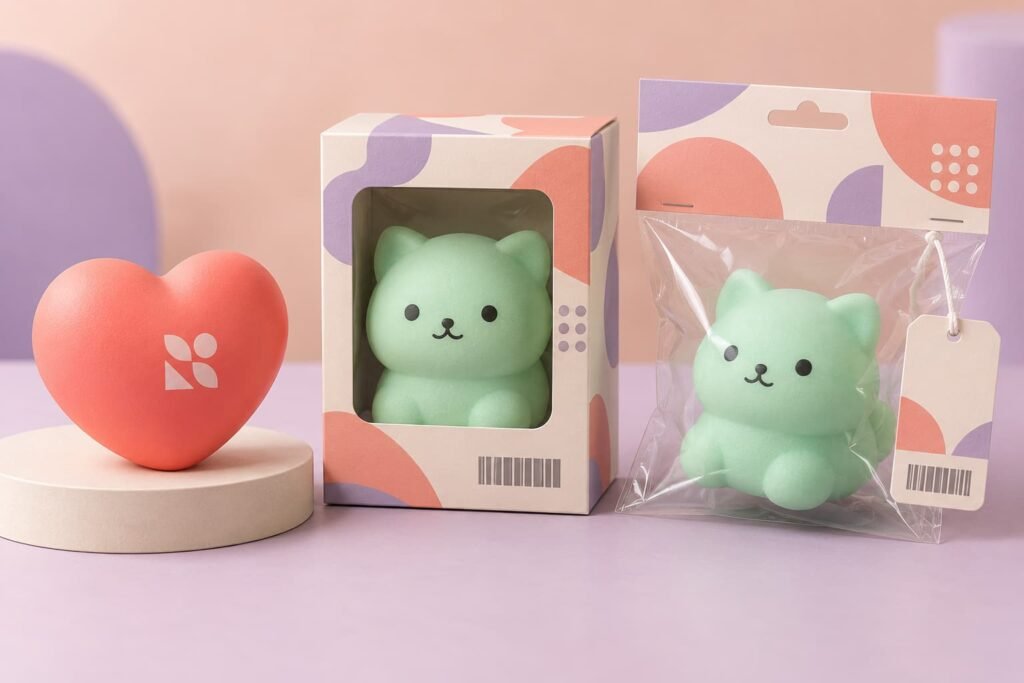
Packaging offers a flatter area for detailed graphics, instructions, barcodes, importer information, and multilingual content. Options can include a label, hang tag, header card, insert, belly band, window box, gift set, or counter display. Packaging branding is not a lesser solution; for small, highly textured, tacky, or strongly deforming products, it may provide the clearest customer-facing result.
For a broader comparison of product, label, and package branding, review Dongyu Toys’ custom logo squishy toys and branding guide. Keep the role of this article narrower: it focuses on preparing and approving the artwork that controls execution.
Use Three Approval Stages
1. Artwork proof
The digital proof should show the correct toy view, artwork revision, imprint size, position, orientation, colors, and print locations. Add dimensions instead of relying on visual scale. Check that the proof has not stretched the logo to fill the available area and that clear space remains around it.
A virtual proof is a communication checkpoint, not proof that the ink will adhere, flex, or look identical on the physical product. Public artwork templates for promotional stress toys make this distinction explicit: a dashed imprint area or digital mockup shows placement, not the final printed result.
2. Decorated physical sample
Approve the actual logo on the actual product construction and finish. Review the sample under useful lighting and from normal viewing distance, then photograph it with a ruler and the artwork revision visible in the record. Check:
- logo dimensions, orientation, and distance from nearby features;
- edge definition, filled areas, gaps, registration, and color contrast;
- visibility of surface texture through the print;
- distortion on the relaxed product;
- appearance during a normal squeeze and after recovery;
- transfer, tack, rubbing, cracking, or obvious loss after agreed handling checks;
- contact with the final bag, tray, insert, or box.
Do not invent a universal squeeze count or rub-test limit. Define a repeatable project-specific check, document the method, and compare production against the approved reference. If formal testing is required, use the applicable standard, target-market requirement, retailer protocol, or qualified laboratory method rather than an improvised claim.
3. Packed sample and approval record
The final approval should combine the decorated toy with its actual packaging. Clear film can change perceived color, a tray can press against the imprint, and a hang tag may hide the mark at shelf angle. The record should connect the product sample, logo artwork, package artwork, barcode data, labels, assortment, and carton instructions to one approved revision.
Use an internal sample approval checklist or the same principle in your purchase-order file: no approval should depend on an unidentified loose sample.
Check the Logo While the Toy Is Used
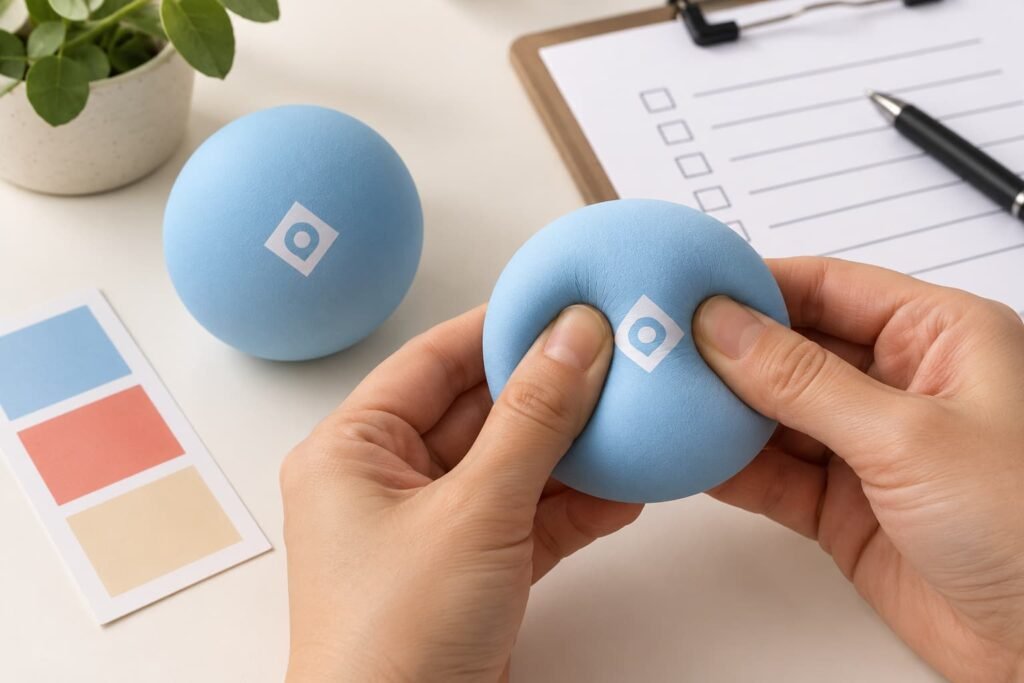
A squishy is not viewed only in its resting shape. The user compresses, rolls, pinches, and releases it. A logo placed across the deepest compression zone may fold sharply or disappear during use. That does not automatically make the placement unacceptable, but the buyer should see the behavior before approving production.
Use a simple comparison sequence:
- photograph the relaxed sample from the agreed viewing angle;
- compress it in the intended direction for a consistent period;
- observe the print during deformation without using excessive or unrealistic force;
- allow the product to recover under the agreed conditions;
- check for visible change against the reference photograph;
- repeat only to the extent defined for the project and record the method.
For slow-rising foam, recovery time and print appearance are related product observations but not the same specification. A toy can recover slowly while the imprint is poorly positioned, or carry a clean logo while the hand feel does not match the brief. Keep those decisions separate in the approval sheet.
Decide When Packaging Should Carry the Main Brand
Move the main brand story to the package when the toy offers only a small imprint area, the surface is highly textured, the character design should remain clean, or the artwork contains detailed text and multiple colors. The toy can still use a small icon, color cue, or authorized molded feature while the package carries the complete logo and product information.
Compare the choices as a system:
- Direct imprint: immediate tactile brand connection, but limited by surface and deformation.
- Hang tag or header card: more graphic space with a visible product, but tag placement and attachment need review.
- Window box: strong shelf communication and protection, but larger volume and insert fit must be planned.
- Label on a standard bag: a practical private-label route for some projects, but adhesion, information area, and package appearance require approval.
- Counter display: supports assortment and retail visibility, but the unit artwork, display artwork, and master-carton packout must stay synchronized.
Packaging versions can multiply quickly when markets, languages, barcodes, or retailers change. Keep one artwork matrix that lists every SKU, product color, imprint version, package version, and carton ratio. Dongyu Toys’ counter display packaging guide explains how unit packs and displays connect to the final packout.
Build Logo Checks Into Production QC
The approved sample becomes useful only when the bulk inspection documents what must match. Add clear, observable checks to the inspection specification:
- correct product, colorway, and artwork revision;
- correct logo size, position, orientation, color, and location count;
- defined limits for obvious offset, missing print, smearing, contamination, or unreadable detail;
- comparison against the identified approved sample or controlled reference;
- package artwork, label, barcode, and assortment matched to the correct SKU;
- agreed handling or squeeze observation performed consistently;
- photo records for nonconforming examples and corrective action.
Soft materials and hand-applied decoration may show some variation. The buyer and supplier should agree what is acceptable before shipment, not debate it after cartons arrive. For a broader inspection framework, see the squishy toy quality control checklist.
Send a Quote-Ready Logo Brief
Include the following information when requesting a custom-logo squishy quotation:
- product reference, shape, material direction, dimensions, and quantity by SKU;
- target market, sales channel, and intended age presentation;
- authorized vector logo and visual reference;
- requested logo size, position, number of colors, and number of locations;
- product body color and required color references;
- surface finish, printed features, and other decoration layers;
- individual packaging, label, tag, display, and carton requirements;
- sample, proof, and approval expectations;
- target delivery window and which details may be adjusted for manufacturability.
Ask the quotation to identify assumptions rather than hiding them inside one unit price. Logo complexity, color count, print locations, product variants, samples, packaging components, and artwork versions may affect setup and minimums. The custom squishy toy MOQ guide explains why the total order quantity alone is not enough.
Frequently Asked Questions
What file format should I send for a squishy toy logo?
Send the supplier’s requested production format, preferably authorized vector artwork such as AI, EPS, PDF, or SVG when accepted, plus a visual reference. Confirm fonts, colors, size, position, and revision. A web screenshot may not contain enough detail for accurate scaling or color separation.
Can a multicolor logo be printed on a squishy toy?
Possibly, but feasibility depends on the product surface, artwork, color registration, print method, order setup, and acceptable appearance. Ask for a project-specific review and decorated physical sample. Packaging may reproduce complex multicolor artwork more clearly.
Why is the available imprint area smaller than the toy?
The usable area excludes strong curves, seams, texture, molded details, painted features, and unstable compression zones. A compact mark inside a controlled area is usually easier to reproduce than artwork that wraps around the whole form.
Is a digital logo proof enough for bulk approval?
No. It confirms artwork placement and scale, but it does not prove physical print appearance, adhesion, deformation behavior, color on the finished surface, or package contact. Approve a decorated product sample and the final packed configuration.
Should the logo go on the toy or the packaging?
Choose according to the product surface and branding job. A simple direct imprint can suit a smooth stable area. Detailed brand graphics, instructions, barcodes, and multilingual information usually belong on a tag, label, card, or box. Many programs use both.
How should buyers check logo durability?
Agree a repeatable project-specific handling check on the finished sample and document the conditions, observations, and acceptance limits. Do not rely on an unsupported universal squeeze count. Where formal requirements apply, use the relevant standard, retailer protocol, or qualified laboratory method.
Prepare Your Custom Logo Squishy Project
Dongyu Toys supports OEM/ODM discussions for custom squishy toys, slow-rising PU foam products, TPR/TPE squeeze styles, mochi squishies, and retail packaging. Send the product reference, intended squeeze feel, size, quantity, target market, authorized logo artwork, proposed imprint position, packaging direction, and sample expectations. The team can review whether direct imprinting, molded detail, packaging branding, or a combined route is the more practical starting point.
Contact Dongyu Toys to review your custom squishy toy logo artwork and request a project quotation.