Dongyu Insights
Squishy Toy Safety Testing & Compliance Documents: 2026 Importer Checklist
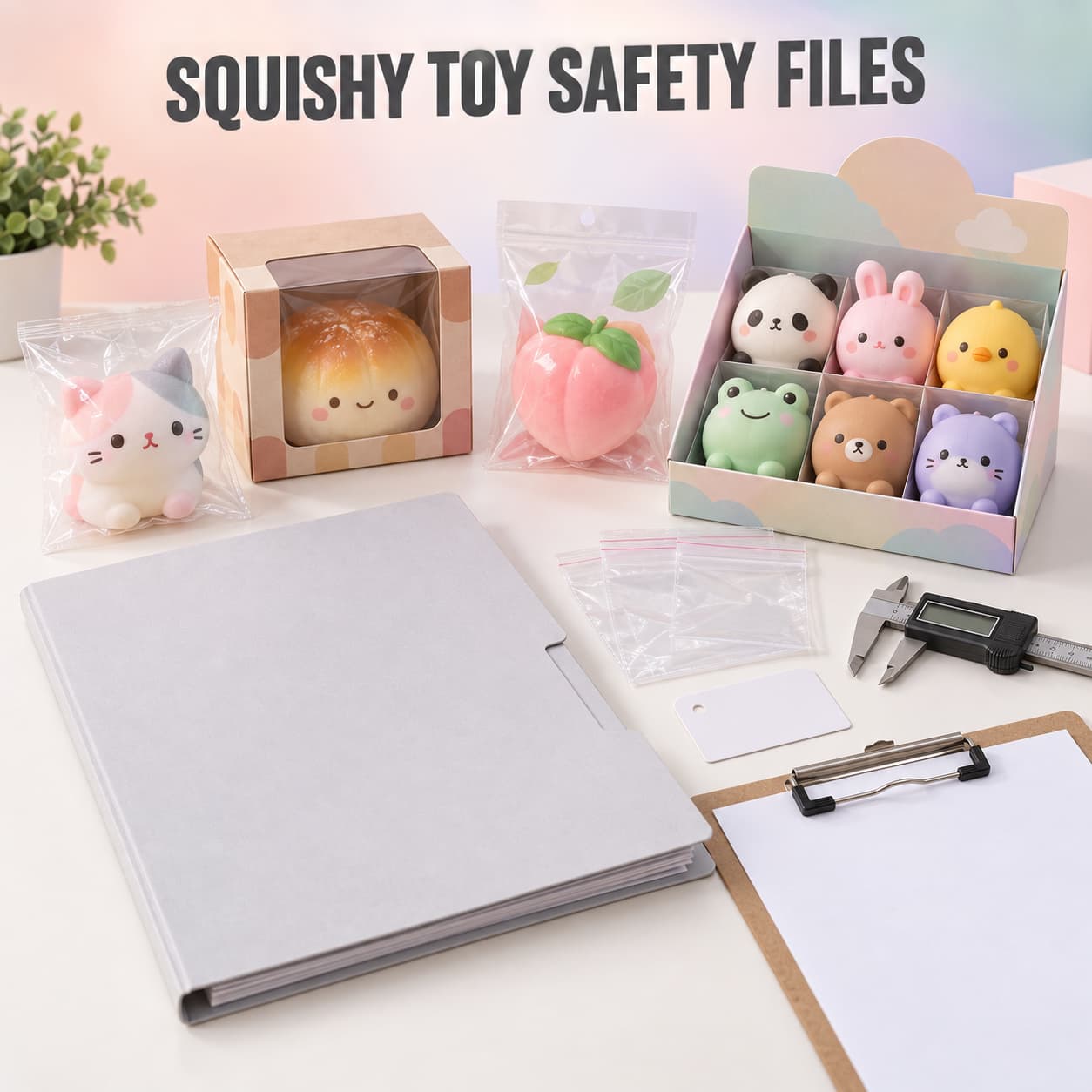
Squishy toy safety testing is not a single certificate that covers every product, age group, material, and destination. For an importer, retailer, or private-label buyer, the useful question is: does the safety file match the exact toy, packaging, production version, and market in this order?
That question has become especially important in 2026. In an August 5, 2026 safety alert, the U.S. Consumer Product Safety Commission (CPSC) warned about fake and counterfeit squishy toys that may lack required testing, certification, age grading, warnings, tracking information, or manufacturer identification. The agency also reported that it had identified 55 shipments of violative squishy toys at U.S. ports and prevented 355,683 units from entering the country. These figures apply to the agency’s enforcement activity, not to Dongyu Toys or to every squishy product.
This guide gives B2B buyers a practical workflow for organizing product identity, applicable requirements, laboratory reports, certificates, traceability, packaging information, and production records. It is general purchasing information, not legal advice. The responsible business should confirm current requirements with the relevant authority, marketplace, laboratory, and compliance professional for its product and destination.
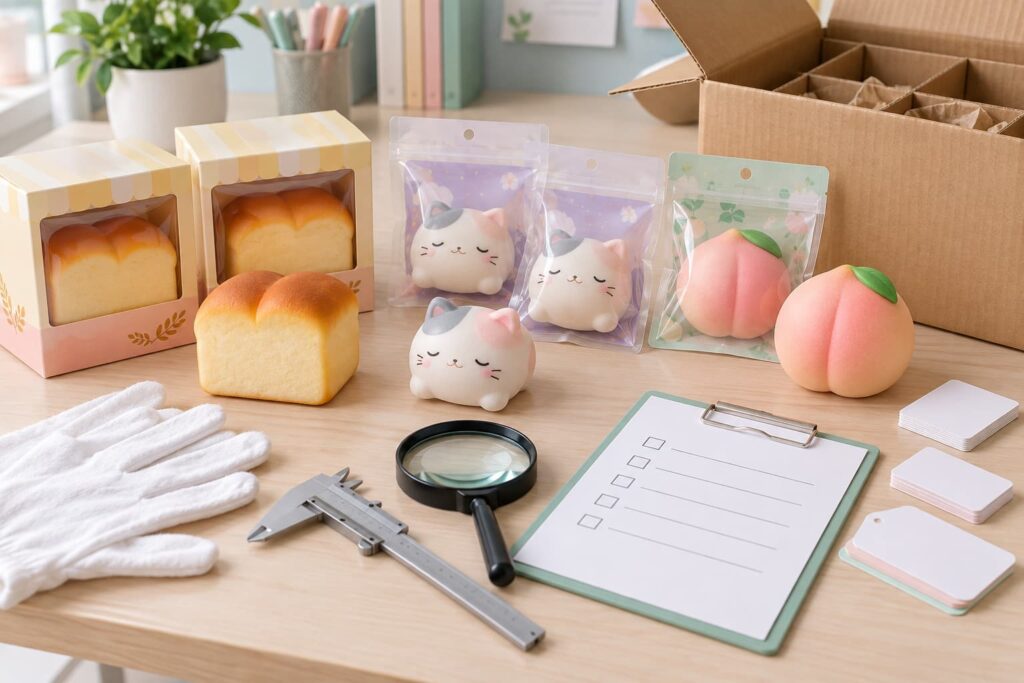
1. Define the Exact Product Before Requesting a Test Quote
A laboratory cannot choose a reliable scope from the word “squishy” alone. The category can include slow-rising PU foam toys, compact TPR or TPE mochi figures, sealed squeeze toys with a soft filling, scented products, keychains, multi-piece sets, or toys combined with accessories. Different structures can create different mechanical, chemical, labeling, and foreseeable-use questions.
Prepare a product identity sheet containing:
- product name, model number, SKU, and clear color photographs;
- intended age group and intended use;
- overall dimensions, weight, construction, and accessible components;
- material description for the body, coating, paint, scent, filling, attachments, and packaging contact surfaces;
- all colors, printed areas, accessories, keychains, cords, or small components;
- retail package, warning, instruction, and label artwork;
- destination country, sales channel, and planned launch date;
- the sample or packaging revision submitted for review.
Do not assume that a report for one plain-color toy automatically covers a scented version, a different coating, a new filling, or an added keychain. Ask the testing laboratory to determine whether variants can be grouped and what technical justification is needed.
2. Separate Three Different Types of Evidence
Buyers frequently receive several files and treat them as interchangeable. A clearer safety documentation checklist separates them.
Laboratory test report
A report records the submitted sample, test methods, results, dates, and laboratory details. It should identify the product closely enough to connect the report to the order. A report is not useful merely because “squishy toy” appears in its title.
Certificate or declaration
A certificate or declaration is issued by the legally responsible party under the applicable system. In the United States, the CPSC explains that the domestic manufacturer or importer is responsible for issuing the Children’s Product Certificate (CPC) for a covered children’s product, based on qualifying third-party test results. The laboratory supplies testing services and results; it does not replace the responsible firm’s certification duty.
Production and traceability records
These records link a compliant design and test sample to the goods actually made and shipped. They may include approved samples, material or component records, production dates and locations, batch references, inspection results, packaging revisions, carton records, and change-control decisions.
A strong file contains all three layers. A test report without product traceability can be difficult to match. A label without supporting evidence is only printed information. An inspection report does not replace required regulatory testing or certification.
3. Build the U.S. File Around the Responsible Importer
For U.S. children’s toys, the applicable federal framework depends on the product and intended age. CPSC business guidance states that ASTM F963 is incorporated as a mandatory children’s toy safety rule through 16 C.F.R. part 1250. The CPSC-accepted version ASTM F963-23 applies to toys manufactured on or after April 20, 2024.
CPSC guidance also explains that toys designed or intended primarily for children 12 years of age or younger generally require third-party testing by a CPSC-accepted laboratory and certification in a CPC for applicable children’s product safety rules. ASTM F963 has a broader toy scope, so buyers should not use a simple age label to avoid a product’s actual classification or foreseeable use.
A laboratory should help identify which sections and additional federal requirements apply to the exact product. Depending on construction and age grading, the review may address issues such as mechanical or physical hazards, small parts, accessible materials, lead, phthalates, flammability provisions, fillings, labels, or other product-specific rules. This article does not prescribe a universal test panel.
Check the seven CPC elements
The CPSC lists seven required information groups for a CPC:
- identification of the product covered;
- citation to each applicable CPSC children’s product safety rule;
- identification of the domestic manufacturer or importer certifying compliance;
- contact information for the person maintaining test records;
- date and place of manufacture;
- date and place of testing; and
- identification of the CPSC-accepted third-party laboratory that performed the testing.
Use the current CPSC CPC guidance rather than copying an old supplier template. CPSC also states that the CPC and supporting test reports must be in English.
Account for certificate eFiling
CPSC guidance states that beginning July 8, 2026, importers of most regulated consumer products must electronically file certificate data with U.S. Customs and Border Protection through the Partner Government Agency Message Set. Importers should review the current CPSC eFiling guidance and coordinate data ownership with their customs broker before the shipment leaves the origin country.
This makes early data preparation more important. Product identity, manufacturer information, testing details, citations, and shipment records should agree. A last-minute PDF exchange is not a substitute for an accurate import data process.
4. Treat Tracking Labels as a Traceability System
CPSC guidance says children’s products designed and intended primarily for children 12 and younger are subject to tracking-label requirements. Required identifying information must be permanently affixed to the product and packaging, to the extent practicable. The information generally needs to help identify the manufacturer or private labeler, production location and date, and detailed batch or run information.
For a small soft toy, the exact placement and method require a product-specific practicability review. Do not simply print “batch number” on a package without a system that links that number to real production records. Before artwork approval, confirm:
- which responsible name appears on the product and package;
- how the model and production run are identified;
- where manufacturing date and location data are stored;
- how the package identifier links to test and inspection files;
- how replacement or repeat orders preserve the correct revision;
- who can retrieve the evidence when a retailer or authority asks.
This workflow should connect with the packaging artwork review. Buyers can use the squishy packaging artwork checklist to organize barcodes, warnings, responsible-party information, and print approval separately from the legal determination of what text is required.
5. Understand the EU Transition Without Mixing Timelines
For the European Union, buyers must work with the rules in force when the toy is placed on the market. The European Commission’s current guidance for placing toys on the EU market describes responsibilities for manufacturers and importers, conformity assessment, technical documentation, required information, and CE marking under the existing system.
The EU has also adopted Regulation (EU) 2025/2509 on toy safety. EUR-Lex states that the regulation applies generally from August 1, 2030, while certain provisions have applied from January 1, 2026. It introduces a digital product passport for toys and changes future documentation and customs workflows. Toys placed on the market in conformity with Directive 2009/48/EC before August 1, 2030 may continue to be made available under the stated transition provisions.
For a 2026 sourcing project, do not incorrectly present the future digital product passport as if every current shipment already follows the full 2030 system. At the same time, brands developing long-lived product lines should begin structuring product identity, material data, technical files, images, responsible-party information, and revision control so those records can support future requirements.
Use the official European Commission toy-market guidance and EUR-Lex summary of Regulation (EU) 2025/2509, then confirm the exact obligations with the responsible economic operator and qualified compliance adviser.
6. Verify That the Report Matches the Order
Before accepting a test report, compare it with the purchase order, approved sample, and packaging. Useful review questions include:
- Does the product name, model, photograph, size, and construction match?
- Are all relevant colors, coatings, scents, fillings, and attachments represented?
- Does the intended age group match the packaging and marketing?
- Is the tested sample the final design rather than an early prototype?
- Are the correct market requirements and current standard versions identified?
- Can the laboratory be verified through the appropriate authority or accreditation route?
- Do report dates, manufacture data, and certificate details make chronological sense?
- Have any material, supplier, color, mold, coating, or packaging-contact changes occurred since testing?
CPSC provides a searchable list of accepted laboratories for U.S. third-party testing. Buyers should verify the laboratory and scope through the official system rather than relying only on a logo shown in a PDF.
7. Control Changes After Testing
A passing result belongs to the tested product configuration. Changes should trigger a documented review before production continues. Create a change log for:
- material formulation or raw-material supplier;
- paint, pigment, coating, scent, powder, or adhesive;
- product dimensions, wall thickness, seams, or filling;
- added accessories, keychains, cords, or removable parts;
- age grading, warnings, instructions, or retail package;
- manufacturing location or process;
- SKU assortment and model grouping.
The buyer, supplier, laboratory, and compliance owner should decide whether the existing evidence remains applicable or whether additional evaluation is needed. Avoid undocumented substitutions, even when a new material appears visually similar.
8. Add Production Controls to the Safety File
Regulatory testing and routine quality control serve different purposes, but they should connect. The approved sample and specification should give production and inspection teams observable checkpoints.
A practical file may include:
- approved product and packaging samples;
- controlled specifications and artwork revisions;
- incoming-material and component references;
- in-process records for dimensions, appearance, assembly, seams, and surface condition;
- pre-shipment inspection results and defect definitions;
- retained samples identified by production run;
- packing lists and carton traceability;
- complaint, corrective-action, and recall contact procedures.
The squishy toy quality control checklist can help organize appearance, hand feel, dimensions, packaging, and pre-shipment checks. It should support—not replace—the applicable laboratory and certification process.
9. Use the 2026 CPSC Alert as a Buyer Checklist
The CPSC’s 2026 alert highlights practical warning signs in the current market: unknown manufacturers, missing safety information, strong chemical odor, oily or unusually sticky surfaces, leakage, weak construction, missing age grading, and missing tracking or responsible-party information. It also warns against heating squishy toys and discusses specific risks for products containing water beads or other fillings.
For a B2B buyer, the lesson is not to apply one generic warning to every product. Instead:
- identify the actual product structure and contents;
- document the intended and reasonably foreseeable use;
- ask the appropriate laboratory to define the test scope;
- approve accurate market-specific packaging information;
- preserve traceability from sample to shipment;
- monitor complaints and regulatory updates after launch.
Do not copy a famous product, character, package, certificate, or test report. Original product development and transparent supply-chain records reduce counterfeit risk and make compliance evidence easier to manage.
10. Send a Complete Compliance RFQ
When contacting a squishy toy manufacturer or laboratory, include:
- target country and sales channels;
- product type, material direction, construction, size, and age grade;
- design files, photos, SKU list, colors, and accessories;
- packaging format and draft artwork;
- estimated quantity and planned shipment date;
- known testing, documentation, labeling, and marketplace requirements;
- the party responsible for certificates, import filings, and record retention;
- any requested retained samples or production-verification plan.
Dongyu Toys supports OEM/ODM development, sampling, packaging discussion, and production coordination for wholesale projects. Buyers remain responsible for identifying and confirming destination-market requirements. Review the custom squishy toy service and send the exact product, market, quantity, and documentation needs through the inquiry form.
Frequently Asked Questions
Is a supplier’s old ASTM or EN 71 report enough for my new custom squishy?
Not automatically. Compare the tested model, materials, colors, construction, age grading, standard version, packaging, and production changes with the new order. Ask a qualified laboratory whether the report can support the exact product or whether new testing is required.
Who issues a U.S. Children’s Product Certificate?
CPSC guidance states that the responsible domestic manufacturer or importer issues the CPC for a covered children’s product, based on qualifying third-party test results. The testing laboratory does not replace that legal responsibility.
Does every squishy toy use the same test plan?
No. Material, construction, filling, attachments, intended age, foreseeable use, destination, and sales channel can change the applicable requirements. Give the laboratory a complete product description and ask for a product-specific scope.
Can I use a CE mark or warning from another product’s packaging?
No. Markings, warnings, responsible-party details, and technical documentation must be determined for the specific product and market. Copying another package can create inaccurate information and intellectual-property risk.
What changed for U.S. importers in July 2026?
CPSC guidance states that, beginning July 8, 2026, importers of most regulated consumer products must electronically file certificate data with U.S. Customs and Border Protection through the designated PGA Message Set. Importers should review current CPSC eFiling instructions with their broker.
When does the EU toy digital product passport apply?
EUR-Lex states that Regulation (EU) 2025/2509 applies generally from August 1, 2030, with certain provisions applying earlier. For 2026 orders, confirm the current transition rules and build structured technical records without claiming that the complete future system already applies.
Make the Safety File Match the Product
The most useful compliance document is not the one with the most logos. It is the one that accurately identifies the product, cites the applicable requirements, is supported by appropriate testing, connects to the responsible business, and remains traceable to the production shipment.
Planning a custom squishy toy program? Send Dongyu Toys your concept, material direction, intended age, destination market, quantity, packaging, and requested documentation. A clear brief helps align sampling, packaging, laboratory communication, and production records before a wholesale order moves forward.