Dongyu Insights
Seasonal Squishy Toys Wholesale: How to Plan a Custom Project Timeline
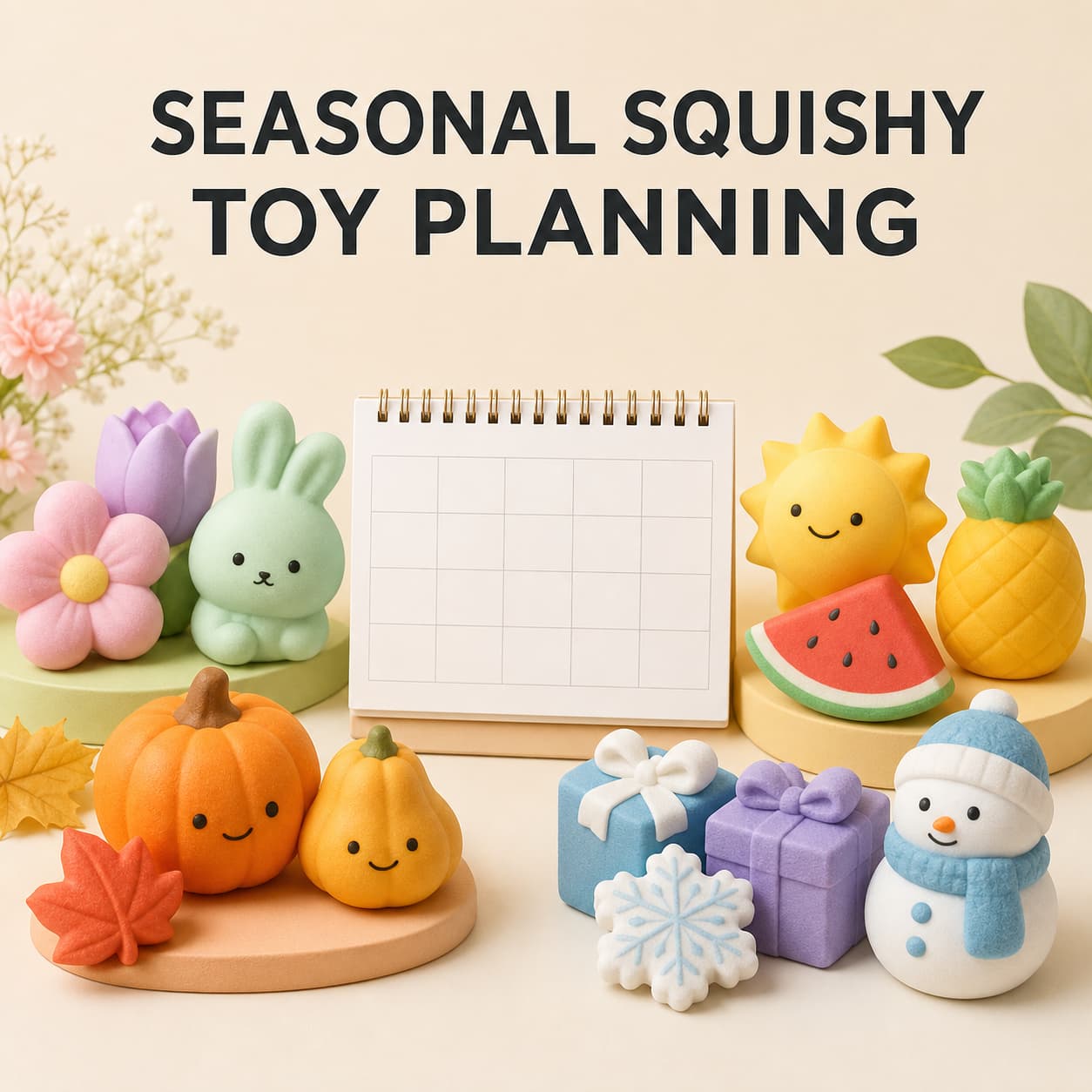
Seasonal products have a limited selling window. A Halloween design that reaches a warehouse after October, or a Christmas gift assortment that arrives after the retailer’s promotional launch, may lose much of its commercial value even if the product itself is acceptable.
For this reason, buyers sourcing seasonal squishy toys wholesale should plan backward from the required retail-ready date. Product design, sampling, revisions, packaging, labels, production, quality checks, shipping, customs handling, warehouse receiving, photography, and merchandising all need space in the project schedule.
This guide explains how importers, retailers, distributors, promotional companies, and online sellers can build a more practical seasonal squishy toy timeline without relying on an unverified fixed lead-time promise.
Start with the retail-ready date, not the holiday date
The holiday itself is not the most useful project deadline. Buyers should first identify the date when finished products must be available for sale.
Depending on the channel, the retail-ready date may be:
- The date products must reach a retailer’s distribution center
- The date an online fulfillment warehouse must receive inventory
- The date product photography and listings must be completed
- The beginning of an in-store seasonal promotion
- The date gift sets must be distributed to event organizers
- The date a trade-show or promotional campaign begins
Retailers often launch seasonal merchandise before the actual holiday. If a buyer starts with the holiday date rather than the required warehouse or launch date, the project may already be several weeks behind the real schedule.
Work backward through every project stage
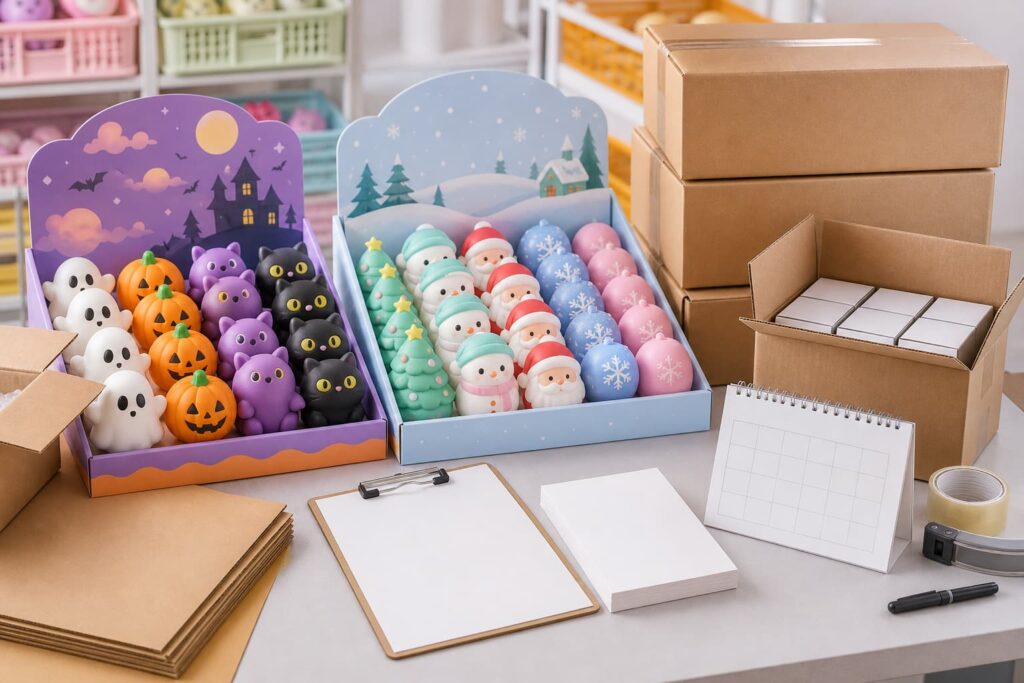
A seasonal custom project should be divided into visible approval stages. Begin with the required arrival date and move backward through the supply chain.
- Retail launch and merchandising preparation
- Warehouse receiving and inventory processing
- International and domestic transportation
- Final packing, inspection, and shipment documentation
- Bulk production and packaging
- Pre-production sample and packaging approval
- Sample revisions when necessary
- Initial product and packaging sampling
- Artwork, labels, specifications, and quotation confirmation
- Product concept and buyer brief
Each project can require a different amount of time at every stage. The schedule should therefore be confirmed against the actual design, quantity, material, packaging, approval process, destination, and transportation method.
Decide whether the project is existing-product customization or new development
One of the first questions is whether the buyer is adapting an existing product or developing a new shape. These directions should not be treated as the same project.
Existing product with seasonal colors or packaging
A buyer may select an existing squishy toy direction and request seasonal colors, an assortment change, a label, a header card, a gift box, or a countertop display.
This can reduce some product-development work, but the final color, finish, branding, package dimensions, label content, and assortment ratio still need approval.
New custom squishy toy shape
A fully custom product may require concept clarification, drawings or three-dimensional direction, shape development, material decisions, sample preparation, color matching, surface-detail review, and one or more revisions.
Thin parts, projecting details, complex printed areas, unusual textures, or a strict character appearance can add more review points.
Buyers should tell the supplier which features are mandatory and which may be simplified to improve feasibility, durability, appearance, or packaging efficiency.
Prepare a complete seasonal product brief
A clear brief helps the supplier understand both the product and the deadline. Sending only a holiday reference image is usually not enough.
A useful brief should include:
- Season, holiday, promotion, or campaign
- Target retail-ready or warehouse-arrival date
- Destination market and sales channel
- Product shape or reference images
- Target size
- PU, TPR/TPE, mochi, slow-rising, or other hand-feel direction
- Required colors and surface finish
- Estimated quantity
- Individual packaging and display requirements
- Logo, artwork, barcode, label, or importer-information requirements
- Assortment ratio
- Approval contacts and decision process
- Preferred shipping direction
Dongyu Toys accepts sketches, reference photos, size information, quantities, target markets, and packaging requirements through its OEM/ODM custom squishy toy service.
Separate product approval from packaging approval
The product and its packaging are connected, but they contain different approval details. Buyers should track them separately so that an approved toy is not delayed by unfinished packaging artwork.
Product approval points
- Overall shape and dimensions
- Material and hand feel
- Softness and rebound behavior
- Color matching
- Surface texture and finish
- Painted or printed details
- Appearance after repeated squeezing
Packaging approval points
- Individual package type and dimensions
- Display box or gift-box structure
- Artwork and color files
- Barcode position and readability
- Product name and assortment identification
- Buyer-supplied warnings or market information
- Country-of-origin and importer details where required
- Pieces per display, inner pack, and outer carton
Packaging artwork should not be treated as a final decorative step. Text corrections, barcode changes, translations, retailer approvals, and print-sample reviews can affect the project schedule.
Build revision time into the sampling plan
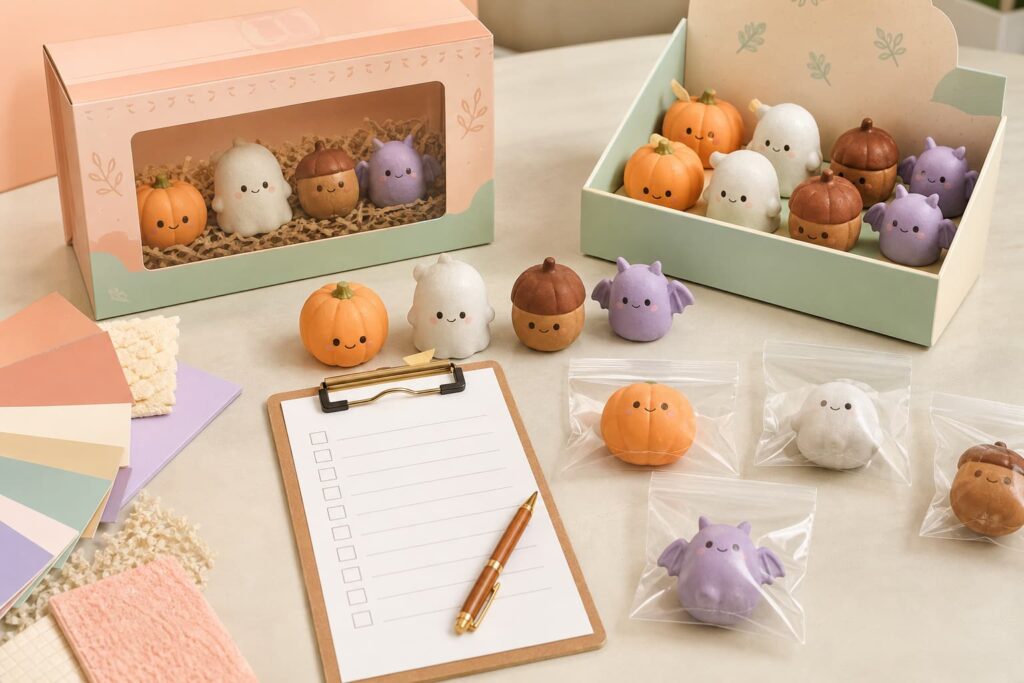
Buyers should not assume that the first sample will automatically be the production-approved sample. A seasonal timeline needs room for review, written feedback, revisions, new photos or videos, and physical resampling when necessary.
To make sample feedback more efficient:
- Collect comments from all decision-makers before replying.
- Mark requested changes directly on photographs or drawings.
- Separate mandatory changes from optional preferences.
- Use measurable descriptions for size and placement.
- Confirm approved details in writing.
- Keep one controlled version of the specification.
- Identify which sample becomes the production reference.
Repeatedly sending separate comments from different team members can create conflicting instructions and unnecessary revisions.
Assign one approval owner
Seasonal projects frequently involve product managers, designers, compliance teams, marketing departments, retailers, and logistics partners. If no one owns the final decision, approvals may remain open while the target date continues to approach.
The buyer should assign one person to:
- Consolidate internal feedback
- Approve or reject product samples
- Approve packaging artwork
- Confirm labels and assortment ratios
- Record decisions and revision versions
- Notify the supplier when a stage is formally complete
This does not remove the need for internal review. It creates a clear communication route between the buying team and supplier.
Confirm target-market requirements early
The destination market can affect product, labeling, packaging, documentation, testing coordination, and the number of samples needed for evaluation.
Buyers should not wait until products are ready to ship before discussing:
- Intended market and age positioning
- Buyer or retailer product specifications
- Required warning and label content
- Packaging-language requirements
- Importer or responsible-party information
- Barcode and warehouse preparation rules
- Applicable product evaluation or testing scope
Requirements vary by product and destination. A report or document associated with another product should not automatically be assumed to cover a new seasonal design.
Plan the seasonal assortment as one collection
Seasonal squishy toys are often sold as a coordinated range rather than a single item. The buyer should review the entire assortment together.
Check whether the collection has:
- A consistent visual theme
- Enough variation in shapes and colors
- A clearly defined number of designs
- A practical quantity ratio for each design
- Consistent packaging dimensions
- A display arrangement that looks balanced
- A plan for individual and assorted SKUs
For additional assortment guidance, read How to Plan a Wholesale Squishy Toy Assortment for Retail Stores.
Do not finalize order quantities without considering the selling window
Seasonal inventory has a shorter full-price selling period than many evergreen products. Buyers should consider both stockout risk and leftover-inventory risk.
Questions to review include:
- How many stores or online channels will carry the products?
- When will the seasonal display begin and end?
- Is the design usable after the holiday?
- Can some colors or shapes remain part of an evergreen assortment?
- Will the products be sold individually, in gift sets, or as mixed displays?
- Does the buyer have previous sales information from a similar program?
- Is a reorder commercially useful if the selling window is already closing?
The supplier can discuss production and packing feasibility, but the buyer remains responsible for its own sales forecast and inventory decision.
Confirm transportation using the required arrival date
A cargo-ready date is not the same as a warehouse-arrival date. Transportation planning may also include pickup, export handling, international transit, customs procedures, domestic delivery, appointments, and receiving.
When requesting logistics information, provide:
- Pickup location
- Destination address or warehouse
- Required arrival date
- Estimated carton count
- Carton dimensions and gross weight
- Total CBM
- Product description
- Requested trade term
- Preferred transportation method
Early figures may be estimates. Final shipping information should be confirmed using finished packed cartons.
Read the related guide, How Squishy Toy Size and Packaging Affect Wholesale Shipping Volume, when planning cartons and freight quotations.
Create a milestone sheet instead of relying on one delivery promise
A useful project schedule should show individual milestones rather than only one final date.
The milestone sheet can include:
- Brief submitted
- Initial feasibility reviewed
- Quotation direction confirmed
- Product sample prepared
- Buyer feedback due
- Revised sample required or waived
- Product sample approved
- Packaging structure confirmed
- Artwork submitted
- Artwork approved
- Pre-production details confirmed
- Production status checkpoint
- Final packing and quality review
- Shipment data confirmed
- Cargo-ready date
- Expected warehouse arrival
- Retail launch
For each milestone, record the responsible party, target date, actual completion date, and any dependency preventing the next step
Common seasonal sourcing mistakes
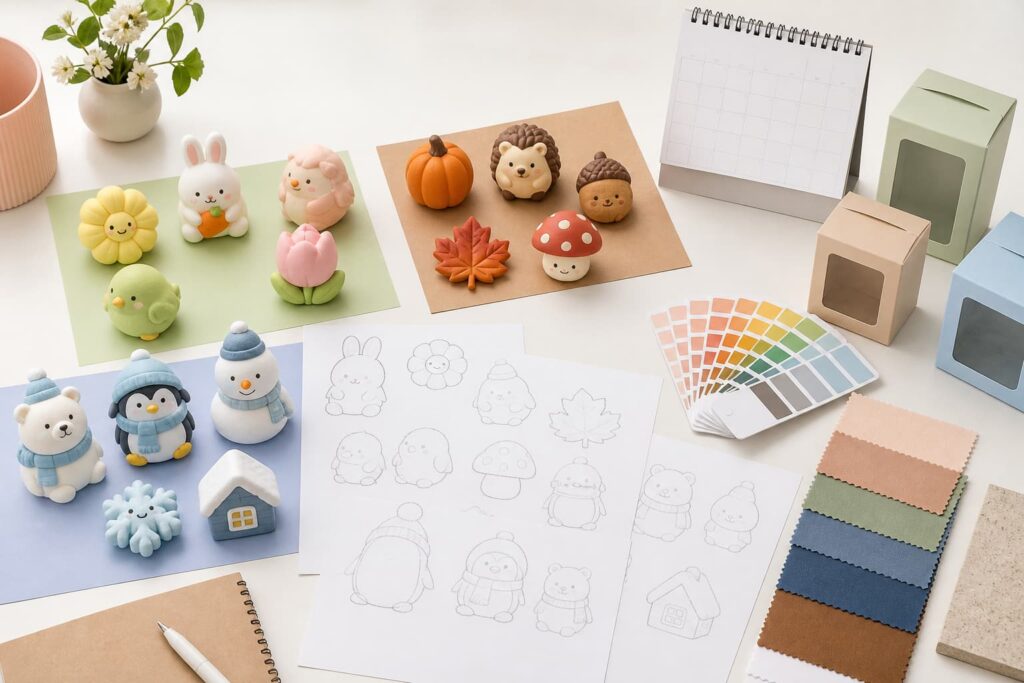
- Starting from the holiday date: products usually need to be available before the holiday campaign begins.
- Assuming a fixed universal lead time: the schedule depends on the actual design, revisions, packaging, quantity, approvals, and shipping plan.
- Submitting incomplete artwork: missing barcodes, translations, labels, or retailer information can hold packaging open.
- Changing the product after packaging is designed: new dimensions may affect the retail package, display tray, and cartons.
- Approving through scattered messages: conflicting comments make it unclear which version is final.
- Leaving market requirements until production: late changes may affect the product, packaging, documents, or sample plan.
- Ignoring warehouse preparation: finished goods may still need labels, appointments, inventory processing, photography, and listing setup.
- Planning a reorder too late: seasonal replenishment only helps if it can arrive while meaningful demand remains.
Frequently asked questions
How early should buyers start a seasonal custom squishy toy project?
There is no universal starting period. Buyers should work backward from the required warehouse-arrival or retail-launch date and obtain a project-specific schedule covering development, samples, revisions, packaging, production, inspection, and transportation.
Is changing the color of an existing squishy toy faster than creating a new shape?
It may involve fewer development steps, but the new color, finish, branding, packaging, labels, assortment, and market requirements still need confirmation. The actual schedule must be reviewed for the selected product.
Should packaging design begin before the product sample is approved?
Packaging direction can be discussed early, but final dimensions and structural details should match the approved product. Artwork preparation can proceed in parallel when the dimensions and information are sufficiently stable.
What date should I give the manufacturer?
Provide the target retail date, required warehouse-arrival date, destination, and any fixed campaign or event date. This is more useful than providing only the holiday name.
Can several seasonal designs be packed in one display box?
Mixed display packing may be possible. Buyers should confirm the number of designs, quantity ratio, product dimensions, display arrangement, labeling, and pieces per carton.
What happens if sample approval is delayed?
Later stages may also move unless time can be recovered without compromising required reviews. The project owner should update the milestone sheet and confirm the revised production, shipping, and launch implications.
Plan your seasonal squishy toy project with Dongyu Toys
Jinhua Dongyu Toys supports OEM and ODM development for seasonal and holiday squishy toy programs, including custom shapes, colors, PU or TPR/TPE hand-feel directions, slow-rising and mochi styles, sampling, packaging, display boxes, labels, quality checks, and shipment coordination.
Send your reference images, target size, estimated quantity, destination market, packaging direction, and required retail-ready date through the Dongyu Toys inquiry form. The project can then be reviewed against the actual development and approval requirements instead of an assumed generic timeline.