Dongyu Insights
Scented Squishy Toys Wholesale: A Buyer Guide to Fragrance Samples and Packaging
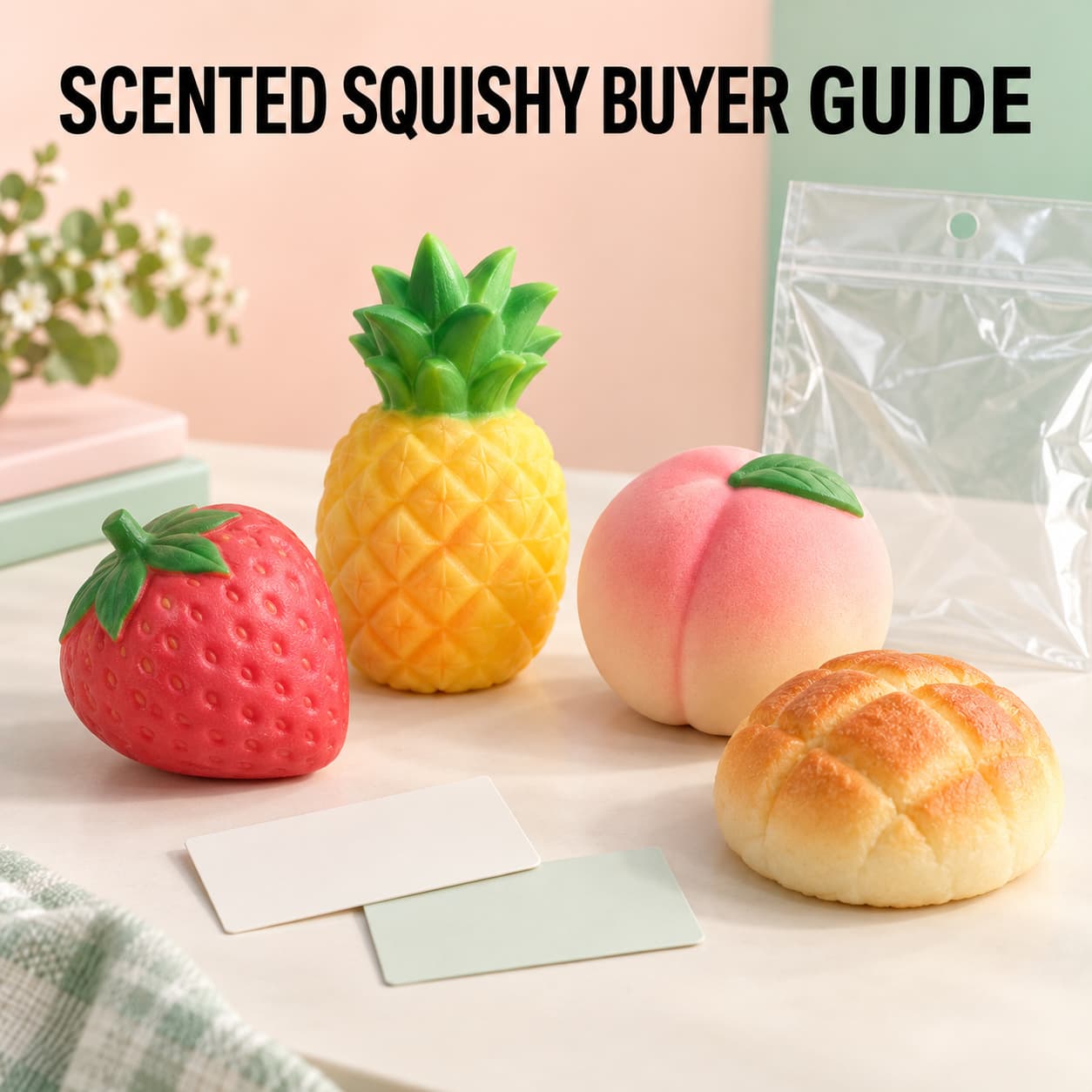
For wholesale buyers, a scented squishy is not simply a standard toy with fragrance added. The scent direction, foam feel, printed finish and package format work together to shape the first impression. If one of those elements is approved separately and later changes, the finished assortment may feel inconsistent at retail. A useful sourcing plan therefore treats fragrance as part of the product specification from the first sample.
This guide explains how importers, retailers and private-label sellers can prepare a clearer brief for scented squishy toys wholesale. It focuses on practical decisions: matching scent families to recognizable shapes, comparing coded samples, reviewing products after sealed storage, planning assortments and documenting approvals. It does not replace product-specific testing or the requirements of your destination market.
Why scent changes the wholesale buying process
Visual design attracts attention, while fragrance can add a second layer to the product story. A strawberry shape paired with a berry direction is easy for a shopper to understand. A bread-shaped slow-rising squishy may fit a warm bakery direction. The commercial advantage is strongest when the sensory cues reinforce one another instead of competing.
Fragrance also introduces decisions that do not exist in a basic unscented program. Buyers need to define the desired scent family, acceptable intensity, packaging conditions, comparison method and change-control process. Words such as “sweet,” “fresh” or “strong” are subjective. Two people can interpret the same word differently, so physical samples and written references are essential.
Start with a product-and-scent concept matrix
Before asking a manufacturer for samples, list each shape, colorway, target customer and scent direction in one simple matrix. This prevents a common mistake: developing attractive individual items that do not form a coherent retail assortment.
Use familiar pairings where clarity matters
- Fruit shapes: strawberry, peach, pineapple, citrus or mixed-fruit directions.
- Bakery shapes: vanilla, cream, caramel or warm-bread directions.
- Dessert shapes: chocolate, berry, vanilla or candy-inspired directions.
- Character shapes: a signature scent chosen to support the brand story rather than imitate a food.
These are creative starting points, not formulas. The final choice should suit the product design, packaging, intended age grading and market requirements. Buyers should also decide whether one scent will unify the full collection or whether each SKU will use a different scent. A single shared direction is simpler to manage; multiple directions can make a display more engaging but increase the number of approvals.
Define the strength in comparison terms
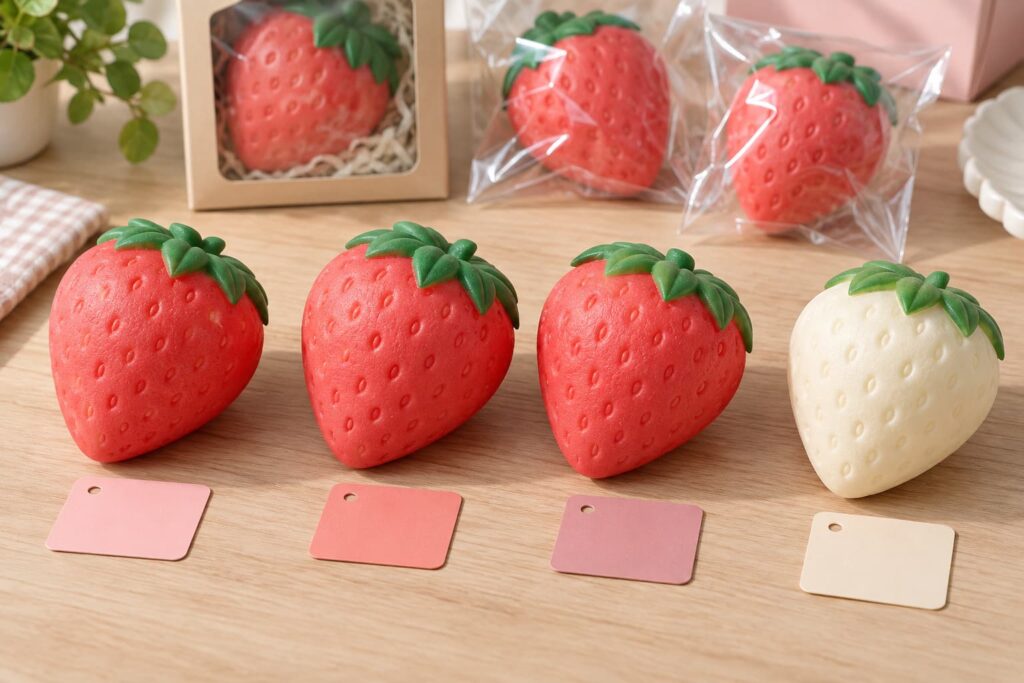
Instead of requesting “medium scent,” ask for coded alternatives such as A, B and C, plus an unscented control. Then record which version is preferred and why. A practical scorecard can include first opening impression, character accuracy, scent balance, foam feel and impression after sealed storage. This turns subjective feedback into a repeatable buying decision.
How to compare fragrance samples more consistently
A fragrance sample review should be controlled enough that your team is comparing the products rather than different handling conditions. Label every sample with a code. Keep the product shape, base material, color and package format the same when the goal is to compare scent only. If several variables change at once, it becomes difficult to identify why one sample performs better.
- Record arrival condition. Note the date, package type and whether the package was fully sealed.
- Use a short acclimation rule. Apply the same waiting period before every first assessment.
- Compare an unscented control. This helps the team separate the fragrance impression from the natural material odor.
- Limit simultaneous comparisons. Too many strong samples in one session can make differences harder to judge.
- Repeat the review. Recheck the selected sample after storage in its proposed package.
- Keep a signed reference. Retain the approved code and written comments for later production comparison.
If buyer teams work in different locations, send matching coded sets and use the same scorecard. A written decision such as “B approved; softer berry direction than A; same intensity as reference set” is more useful than “the pink one smells best.”
Evaluate scent together with material and squeeze performance
The choice between PU foam, TPR or TPE should begin with the required touch, recovery behavior, shape detail and application—not fragrance alone. For many slow-rising designs, buyers discuss PU foam because it can support a soft compression and gradual recovery experience. Mochi-style products may use different soft-material constructions. The correct specification depends on the actual design and destination-market requirements.
During sample review, check whether the scented version still matches the approved tactile reference. Compare:
- compression feel and recovery behavior;
- surface tackiness and hand feel;
- paint adhesion and printed-detail clarity;
- visible pores, seams or deformation;
- odor balance immediately after opening;
- condition after the proposed storage period.
Do not approve the look, feel and scent from unrelated samples. The most useful approval unit is the complete configuration: selected material, final shape, finish, scent code and representative package.
Packaging is part of the fragrance specification
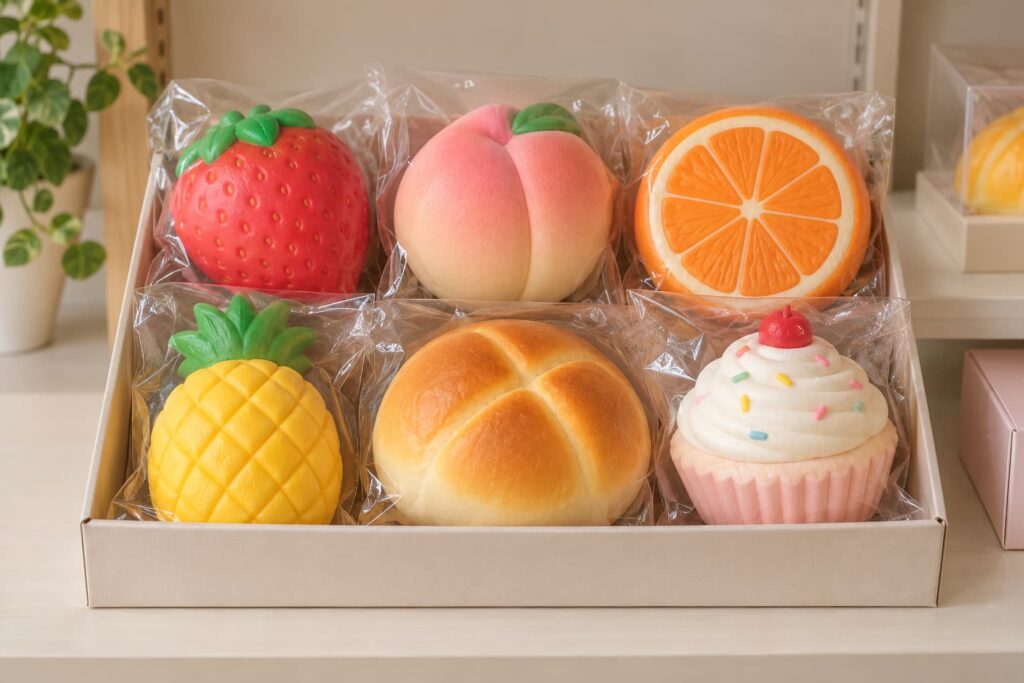
A scented item presented loose will not create the same opening experience as the same item stored in a sealed bag or window box. Packaging also affects merchandising, protection, labeling space and how the product arrives after transport. For this reason, the package should be included in the sampling plan early enough to review the complete experience.
Common package directions to discuss
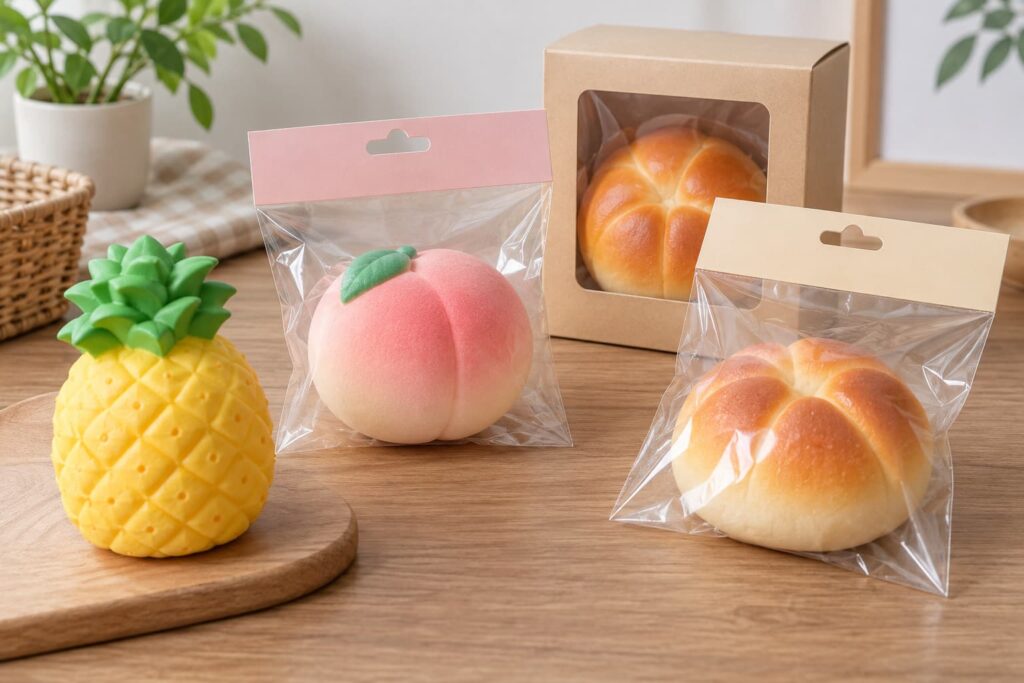
- Clear individual bag: shows the product clearly and offers room for a header card or label.
- Window box: supports a more structured presentation and additional brand storytelling.
- Counter display tray: helps retailers present a coordinated impulse assortment.
- Gift set: groups several shapes or scent families into a planned collection.
Ask for an assembled packaging sample, not only a digital dieline. Review visibility, movement inside the pack, pressure points, opening experience and all required label areas. If your program includes a private-label logo, keep the logo placement, scent name, SKU code and compliance text clearly separated in the artwork file.
Dongyu Toys describes custom shape, color, scent, logo and packaging options on its custom squishy toy service page. A buyer can use that page as a starting point, then submit a project-specific brief for feasibility review.
Build an assortment that a retailer can understand
A wholesale assortment should make sense on the shelf, not just in a spreadsheet. Start with a small number of recognizable product families. Fruit and bakery shapes are useful examples because they support clear visual and scent stories, but the final mix should match the buyer’s channel and audience.
For each proposed SKU, document its role:
- Hero item: the shape that communicates the collection immediately.
- Color anchor: a product that creates strong visual contrast in the display.
- Variety item: a different shape or scent family that encourages collection.
- Entry item: a simple configuration suitable for the intended price architecture.
Do not assume that more scents always create a stronger range. Every additional scent can require another sample, approval record and production reference. A disciplined launch assortment is often easier to evaluate and reorder. Future extensions can then be based on real sell-through feedback rather than guesswork.
Quality control and change control for scented programs
Fragrance perception can vary with time, packaging and storage conditions. A practical quality plan therefore needs a retained approved sample and a written inspection standard. The document should identify which characteristics are visual, tactile, olfactory or packaging-related and how disagreements will be handled.
Include these points in the approval record
- sample code, version and approval date;
- shape dimensions and approved color reference;
- material and recovery reference;
- fragrance code and comparison notes;
- paint, print and logo positions;
- individual package structure and artwork version;
- agreed inspection points and destination market;
- process for approving any later change.
Ask the supplier to flag changes that may affect the approved sensory experience. If the fragrance, material, coating, package film or storage configuration changes, the buyer may need a new comparison sample. This is especially important for a private-label line where repeat orders should remain consistent with the original customer experience.
Safety and market requirements must be product-specific
Toy compliance is not established by a generic statement or a decorative icon. The responsible requirements depend on the product, age grading and destination market. In the United States, the Consumer Product Safety Commission explains that toys intended primarily for children 12 and under are subject to applicable federal toy safety requirements and third-party testing by a CPSC-accepted laboratory. Buyers should confirm the current rules for their exact product and market.
Fragrance documentation should also be reviewed for the intended use. The International Fragrance Association publishes standards and supporting documentation for the safe use of fragrance ingredients, but an IFRA-related document is not a substitute for finished-product toy compliance. Ask which documents are available for the proposed fragrance and confirm what additional testing or assessment your market requires.
Never place an unverified certification mark on packaging or marketing material. Agree on the testing scope, sample configuration and responsible party before mass production. If the product or package changes after testing, ask whether the change affects the assessment.
What to send a scented squishy toy manufacturer
A quote-ready brief reduces assumptions and gives the manufacturer a better basis for questions. Include:
- reference drawing, 3D file or clear product images;
- target size and preferred material or required squeeze behavior;
- shape, colorway and surface-finish requirements;
- scent family and two or three comparison directions;
- whether an unscented control is required;
- logo method and artwork files;
- individual packaging and display requirements;
- intended age grading, sales country and channel;
- estimated quantity by SKU;
- testing, labeling and documentation requirements;
- target launch window, while allowing the supplier to confirm feasibility.
Avoid asking for a final price with only a product photo. Size, material, surface finish, scent variants, package structure and quantity can all affect feasibility and quotation. A structured brief helps both parties identify open questions before samples are made.
Frequently asked questions
Should buyers request scented and unscented samples?
Yes, an unscented control can make comparison more useful. It helps reviewers separate the added fragrance from the base product’s natural material and packaging odor.
Can the same scent be used across several shapes?
That can be a practical way to unify a collection and reduce the number of approval variants. However, the scent should still be reviewed in each final product-and-package configuration because the complete experience may differ.
When should packaging be reviewed?
Review it before final approval, using a representative assembled pack. A digital layout alone cannot show the product’s movement, sealed opening impression or physical presentation.
What makes a fragrance request quote-ready?
Define a scent family, preferred character, comparison method, package type, quantity by SKU and destination market. Ask for coded samples rather than relying only on subjective adjectives.
Does fragrance documentation prove the whole toy is compliant?
No. Ingredient or fragrance documentation and finished-product toy compliance serve different purposes. Buyers should confirm the applicable requirements and testing scope for the exact product and destination market.
Prepare your custom scented squishy project
A successful scented collection begins with decisions that can be sampled, compared and recorded. Match the fragrance to the product story, evaluate coded options with an unscented control, review the item in its proposed packaging and keep one approved configuration as the reference.
If you are planning fruit, bakery, character or private-label scented squishies, review Dongyu Toys’ squishy toy product categories and custom service process. Then send your concept, quantity, target market, scent direction and packaging requirement for a project-specific discussion.