Dongyu Insights
Carrot Squishy Toys Wholesale: PU Design, Leaf Crown & OEM Quote Guide
Carrot squishy toys wholesale buyers need more than an orange silhouette and a low unit price. An elongated vegetable toy raises practical questions about tip recovery, leaf attachment, display depth and shipping volume. For a custom PU foam project, those details should be settled before artwork becomes a quotation and a quotation becomes an order.
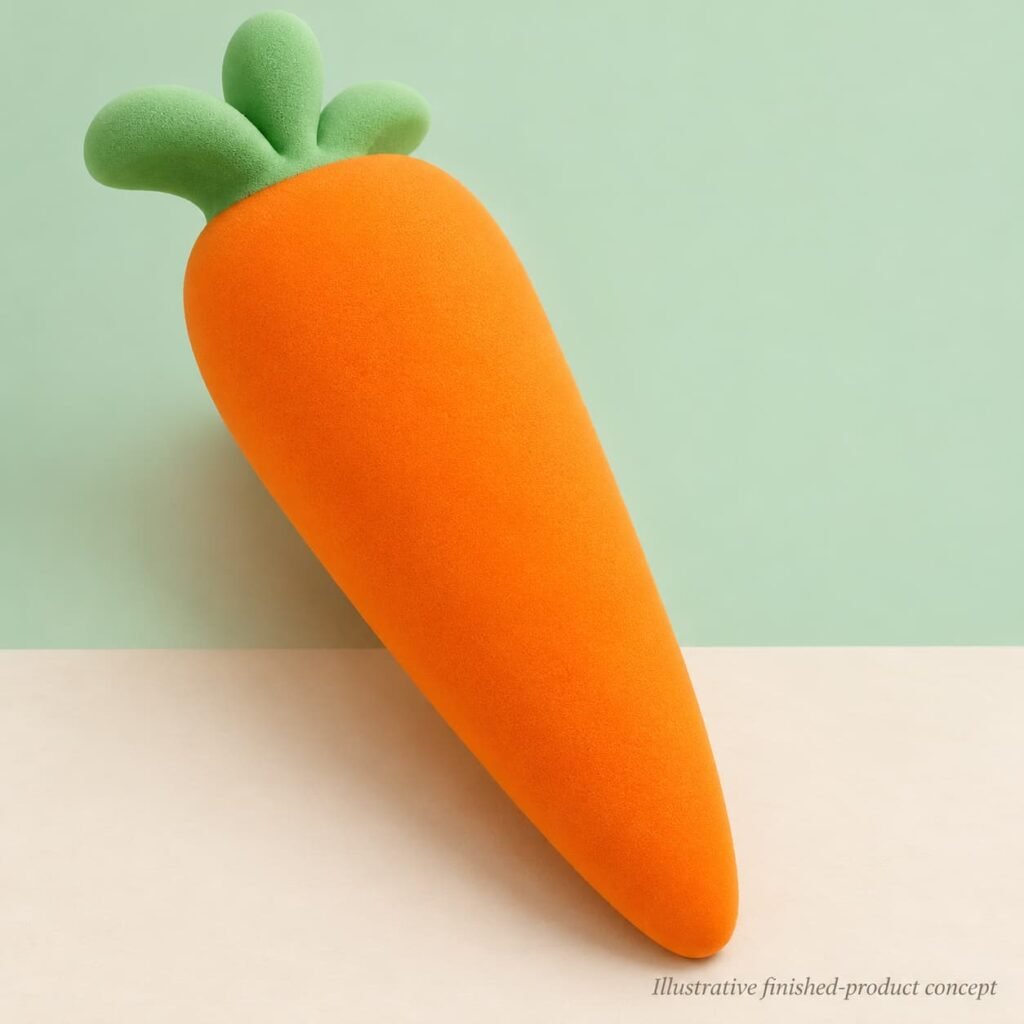
This guide develops an original faceless carrot concept: a long tapered orange root, a rounded tip and three broad green leaves. It is a proposed OEM design, not a branded retail replica, an existing Dongyu mold or an approved physical sample. Use the worksheets below to prepare a manufacturer enquiry that can be checked against a real sample.
What the overseas market evidence actually shows
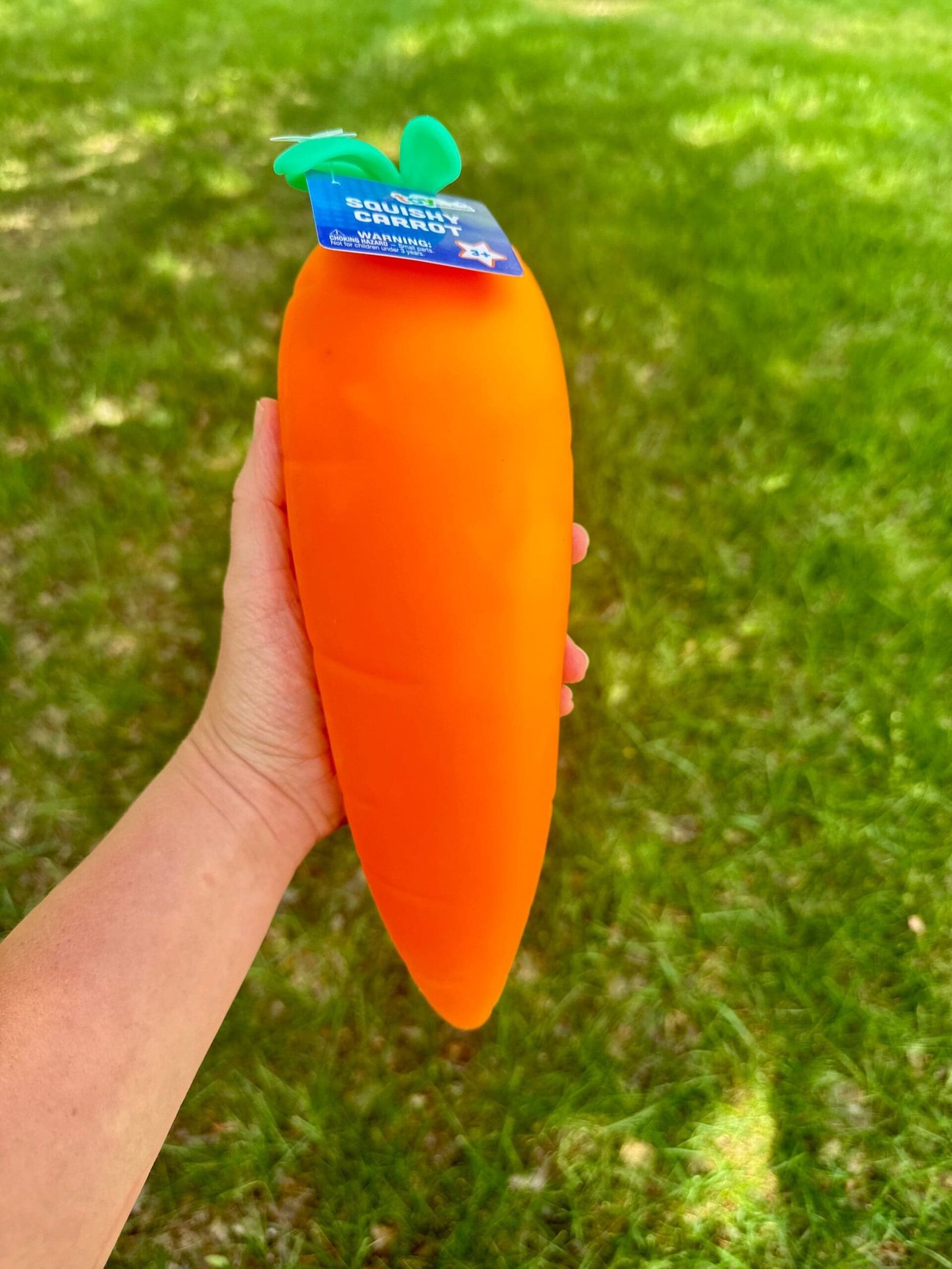
Research on November 4, 2026 found jumbo carrot squeeze toys in US retail listings and UK toy listings. One US merchant provides a clear photograph of an elongated carrot held in a hand, showing a broad upper root and a rounded taper. That is useful shape evidence, but the page does not establish independent sales leadership.
A public wishlist platform also includes a jumbo carrot product among its squishy selections. Wishlist saves are a limited demand clue, not Google search volume or completed purchases. Direct Google Trends comparisons could not be retrieved for the US, UK or Germany during this research. Consequently, this article treats the carrot as a category worth evaluating, not the most-searched squishy in those markets.
The commercial opportunity is an original vegetable-shaped private label project. Retail references do not establish their exact construction as suitable for a new PU specification. A supplier must assess the requested foam, finish and leaf geometry independently. Review Dongyu’s OEM/ODM custom service before sending the project brief.
Start a custom carrot squishy brief with measurable decisions
A buyer saying “jumbo” may mean a hand-filling root, a long overall silhouette or a large shelf presence. Those are different requirements. Record overall height including leaves separately from root length. Record maximum root width and front-to-back depth so the factory does not quote a flat novelty when the buyer expects a full rounded product.

| Brief field | Buyer input | Factory confirmation |
|---|---|---|
| Project | Original carrot, private label retail channel | New development or an available authorized shape |
| Material | PU foam direction; unscented initial brief | Proposed formulation, finish and sample construction |
| Dimensions | Overall height, root length, width, depth | Measurement method and achievable tolerances |
| Leaves | Three broad rounded leaves; substantial crown | Feasible geometry and connection method |
| Appearance | Orange root, sage green crown, no character face | Color references, decoration method and limitations |
| Hand feel | Reference squeeze and recovery behavior | Physical sample and agreed review conditions |
| Commercial | Quantity scenarios, destination, arrival needs | MOQ, tooling, sample fees and schedule assumptions |
| Packaging | Retail channel, display orientation, barcode location | Pack proposal, dimensions and carton plan |
This is a working project brief, not an industrial standard. Leave unknown values marked “to confirm” instead of inserting a competitor’s measurements. The reference product’s listed size is not a Dongyu specification and should not quietly become a manufacturing promise.
Sketch the long root before adding decorative details
Lock the major silhouette first. Draw the root centerline, widest shoulder, beginning of the taper and rounded end. A short triangular carrot and a long rounded carrot can share the same colors while creating very different squeeze and package expectations. Do not let a perspective rendering hide that difference.
For the concept shown here, the visual target is an elongated root roughly three times longer than its width. That is an illustrative proportion, not a dimensional requirement. The production drawing needs actual dimensions agreed with the supplier. Keep the tip visibly rounded; avoid a needle-like end added only to make the vegetable look realistic.
Give the leaf crown its own approval question
Do not approve leaves only from the front view. Their thickness, spacing and transition into the root affect handling and packing. Ask whether the crown and root are formed together or joined, and how the proposed connection will be evaluated. Do not assume that a soft appearance means an attachment is durable.
Use broad rounded leaves as a design direction, then ask the factory to identify thin sections, difficult transitions or finishing concerns. Any geometry change should return to the buyer for review. The goal is an agreed commercial product, not an attractive image with an unexplained construction.
Annotate three views without inventing engineering dimensions
Prepare front, side and top views on one sheet. Use H for overall height, L for root length, W for maximum width and D for depth. Add a separate crown detail identifying leaf count, crown position and the boundaries between orange and green. The dimensions should refer to a relaxed, unloaded sample in an agreed orientation.
- Separate shape lines from painted boundaries.
- Identify measurement endpoints with extension lines.
- Specify which view controls a disputed feature.
- Use physical color references for approval, not a screen screenshot alone.
- List unconfirmed geometry and material questions beside the revision record.
A simple orange root can still show unwanted color variation around the shoulder or crown. Ask how the finish is applied and what appearance variation is acceptable. Do not prescribe a coating method from an AI illustration. Color, tactile feel and recovery must be reviewed together on the intended sample construction.

Use the 3D concept to review shape, not to approve tooling
A colored 3D concept helps reveal whether the root has become too flat, whether the leaves obstruct each other and whether the tip fits the intended pack. Compare its outline directly with the sketch and three-view sheet. Reject unexplained shifts in length, shoulder width, leaf count or tip shape.
The illustrations in this article are not CAD, tooling drawings or proof of mold feasibility. A factory still needs to review geometry, production method, finish and the relationship between crown and root. Request its proposed technical drawing or other appropriate development evidence before committing to tooling.
Keep separate identifiers such as CAR-01-GEO-R01, CAR-01-COLOR-R01 and CAR-01-PACK-R01. Link them to a sample ID. If the crown changes in geometry revision R02, record whether the package and quotation also change. An email reading “latest version approved” is not enough when several attachments carry different revisions.
Compare carrot squishy manufacturer quotations on the same basis
Ask for a cost breakdown covering development, tooling where applicable, samples, product, decoration, retail pack and export carton. Keep freight and trade terms visible. A lower unit price can describe a different root depth, leaf construction or packaging scope rather than a more efficient offer.
For MOQ, ask what changes the minimum: foam formulation, color, decoration, tooling or printed packaging. Request quantity scenarios using the same specification. Do not combine an undecorated sample price with a fully branded production pack when comparing suppliers. Dongyu’s MOQ guide explains the broader purchasing questions.
Confirm sample revisions, approval milestones and the point at which the schedule becomes firm. An arrival deadline needs time for development, review, production and transport; none of those durations is established by this article. Ask the supplier to state assumptions and exclusions in writing.
Approve the physical sample with a carrot-specific matrix
Agree methods, conditions, sampling approach and acceptance limits before evaluating a sample. The matrix below is a procurement worksheet. It does not replace applicable market assessment or independently establish product safety.
| Check | Review method to agree | Approval record |
|---|---|---|
| Root silhouette | Relaxed front and side comparison | Dimensions, photographs and revision ID |
| Tip recovery | Defined handling sequence and recovery observation | Reference behavior and unacceptable changes |
| Leaf crown | Supplier-defined intended-use evaluation | Connection details, observations and agreed limits |
| Color and finish | Consistent lighting, physical references, handling review | Accepted variation, marking or transfer observations |
| Retail pack | Packed sample review after agreed storage and handling | Leaf pressure, tip deformation, rubbing and presentation |
| Traceability | Reconcile sample, drawing, artwork and order | Signed version list and retained reference |
Separate visual acceptance from compliance evidence. Tell the supplier the destination, intended age positioning and sales channel, then request relevant documentation for the actual product and construction. Do not transfer a retailer’s age statement or another supplier’s certification claim to this project.

Design private label packaging around the long silhouette
Test horizontal and upright presentation before choosing artwork. A narrow bag can flatten the leaves; an oversized window box can increase shipping volume without improving visibility. Evaluate the actual packed sample rather than estimating the fit from a render.
Place branding on the pack first if a product mark would interrupt the root’s appearance. Confirm whether any on-product decoration is feasible and how it will be checked. Request final packed dimensions, carton quantity and carton measurements for freight comparison. Avoid presenting the toy as food, and have intended-market labeling reviewed before final artwork approval.
Buyer FAQ
Can a carrot squishy be developed in PU foam?
PU is the direction of this proposed project. Ask the manufacturer to assess the required dimensions, crown structure, feel and finish. A retail photograph cannot verify the construction or prove that an identical design is feasible.
What is the MOQ for custom carrot squishy toys?
No confirmed Dongyu MOQ is stated here. Send the specification and quantity scenarios; ask for separate constraints for product development, colors and packaging.
Can the retail reference be copied for our brand?
Use generic vegetable features to describe category expectations, not another brand’s protected design, logo or packaging. Develop original geometry and artwork, and resolve ownership and permission questions before production.
Are the images finished samples?
No. The square image is an illustrative finished-product concept. The other images communicate sketch, design and shape-review stages. All require physical sample verification.
Request a custom PU carrot squishy quotation
Send Dongyu your original reference direction, annotated dimensions, leaf concept, quantity scenarios, destination, packaging preference and deadline. Include the revision list and unresolved engineering questions. Explore the product categories, then request a feasibility review and sample quotation. Ask for written confirmation of material, construction, MOQ and approval scope before placing an order.