Dongyu Insights
Custom Squishy Toy MOQ: What Changes Minimum Order Quantity?
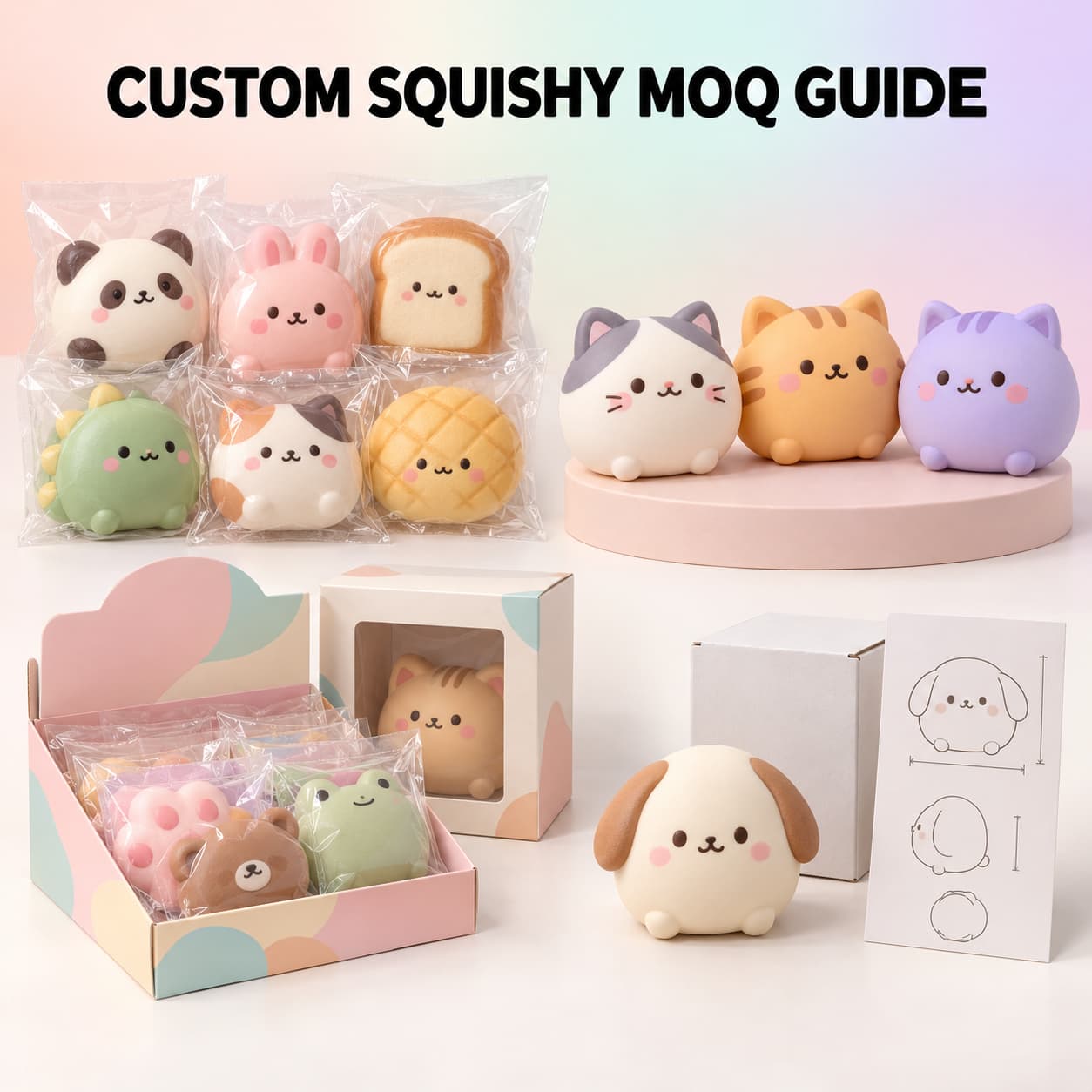
When buyers ask for a custom squishy toy MOQ, they often expect one universal number. In practice, the minimum order quantity depends on what is being customized and how many versions must be produced. A ready-stock shape with a simple label is a different project from a new character mold, several colorways, printed details, and a retail display box.
This guide helps importers, retailers, promotional distributors, and private-label brands define the order before requesting a quote. It does not promise a fixed minimum. Instead, it explains which decisions change the production setup, how to compare supplier quotations, and how to reduce unnecessary complexity in a first order.
Why There Is No Single MOQ for Every Squishy Toy
An MOQ is not only a sales rule. It can reflect the smallest practical run for material preparation, molding, painting, printing, packaging conversion, assembly, and carton packing. Each additional design or packaging version may create another setup.
For example, “1,000 pieces” could mean one design in one color, or it could mean four characters with two colors each. Those orders have the same total quantity but very different production requirements. Before comparing prices, buyers should confirm whether the minimum applies to the total order, each design, each color, or each packaging version.
Four Customization Routes That Change the Minimum Order
1. Ready-Stock Product With Standard Packaging
The simplest route starts with an existing product and its normal packing method. The shape, material, color, decoration, and package remain unchanged. This route usually requires the fewest new production steps and can be useful for testing a category, creating a mixed wholesale assortment, or validating demand before investing in a private-label program.
Ask whether the quoted item is currently available, made to order from an existing mold, or offered only in full-carton quantities. “Stock mold” does not always mean finished goods are ready for immediate shipment.
2. Existing Shape With Custom Color or Decoration
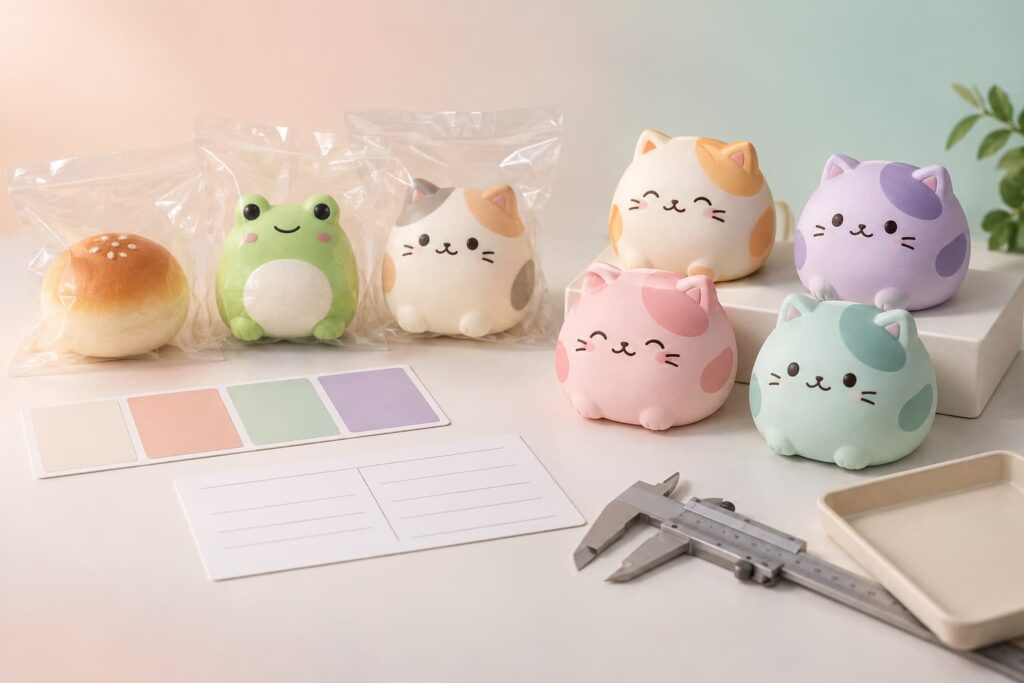
Using an existing mold can remove the need for new tooling, but custom colors and painted details still require preparation. A color-matched body, a new face print, multiple paint masks, glitter, scent, or a special surface finish may introduce separate material or decoration runs.
The quotation should state how many colors are included, whether the minimum is per colorway, and which decoration method is planned. For a first order, one coordinated color palette is often easier to control than many low-volume variations.
3. Private Label Packaging on an Existing Product
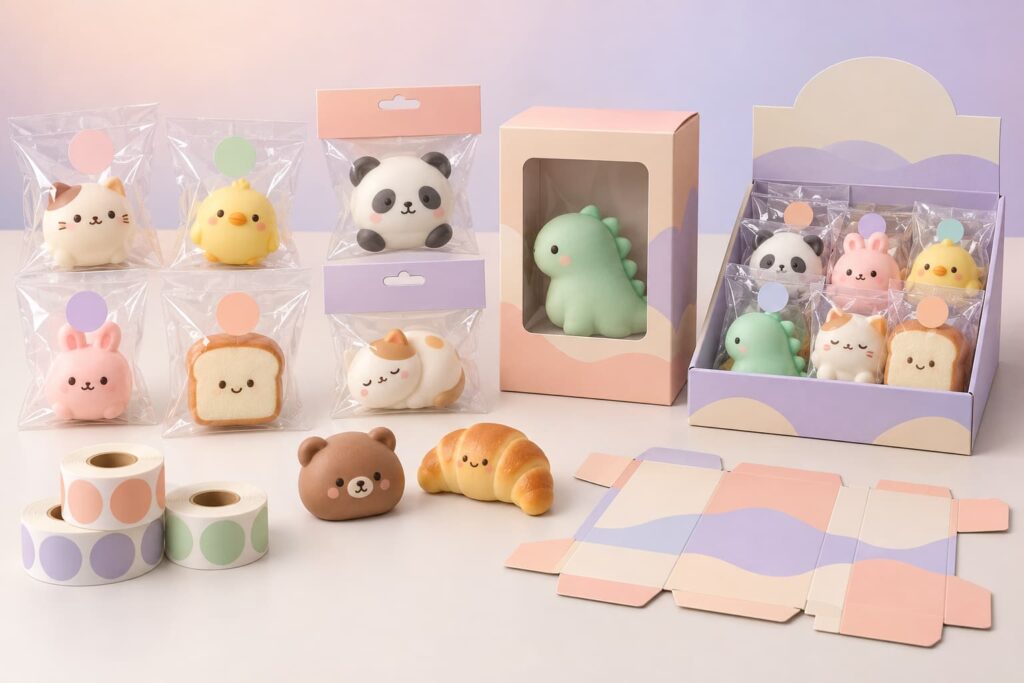
Private label can range from a small brand sticker on a clear bag to a printed header card, window box, blind bag, or countertop display. The toy and the package may have different supplier minimums. Printed film, paperboard, labels, inserts, and display cartons are normally produced through separate processes.
Buyers should therefore ask two questions: what is the minimum for the toy, and what is the minimum for each printed packaging component? If packaging quantities exceed the first toy order, confirm whether unused packaging can be stored, reused for a repeat order, or redesigned as a more flexible universal pack.
4. Fully Custom Shape With a New Mold
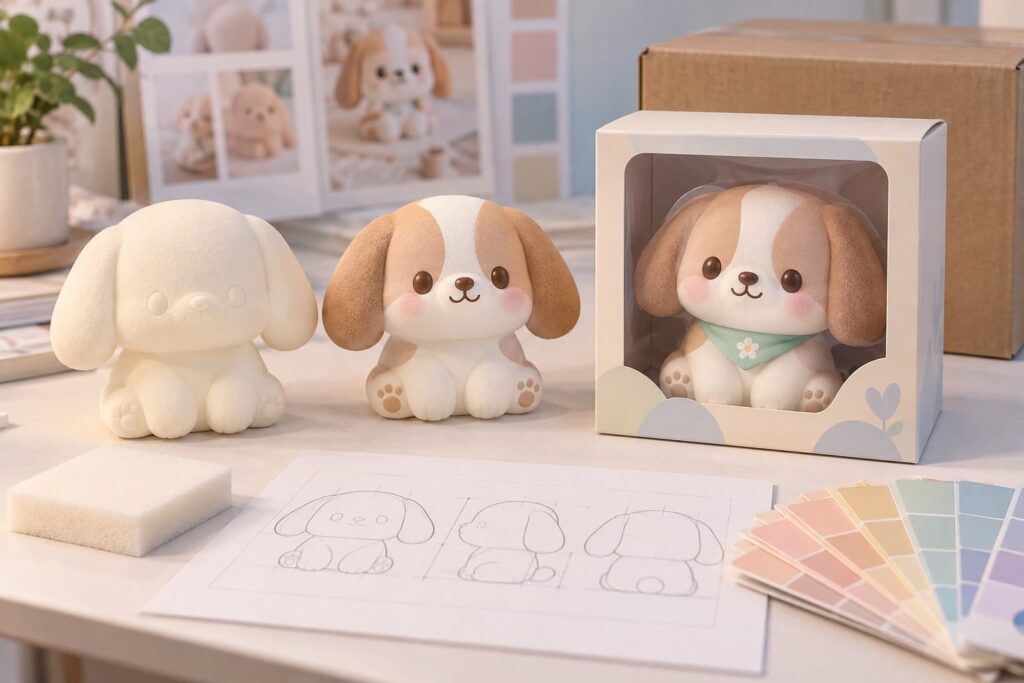
A unique mascot, food shape, promotional object, or original character usually needs design review, tooling, sampling, and approval before bulk production. Size, undercuts, thin parts, surface texture, paint separation, and the chosen material can all affect feasibility.
A new mold is only one part of the project. The supplier may also need to prepare color standards, decoration fixtures, sample packaging, and inspection references. Buyers should separate one-time development charges from the bulk unit price and ask what happens if the first sample needs changes.
The Main Cost and MOQ Drivers Buyers Should Define
Material and Squeeze Experience
Slow-rising PU foam, soft TPR/TPE constructions, mochi-style products, and other squeeze formats do not use the same process. Even when two products look similar in a photo, their hand feel, rebound, surface behavior, and packing needs may differ. Define the intended tactile experience before discussing the minimum.
For material planning, describe what matters: slow recovery, stretch, softness, translucency, a dry-touch surface, or a firmer squeeze. A physical reference sample or short video is often more useful than a general phrase such as “very soft.”
Product Size and Material Use
Mini, palm-size, and jumbo products create different material consumption and carton volume. A larger item may also need more protective packaging or a different display format. Always include approximate dimensions in the RFQ; a reference photo without scale is not enough for an accurate comparison.
Number of Designs, Colors, and Assortment Ratios
A collection should be planned SKU by SKU. If a buyer wants six characters in three colors, the supplier may treat the project as eighteen variants rather than one order. Paint masks, artwork files, packaging labels, barcode data, and carton ratios can multiply quickly.
State the quantity per design and per color, not only the total. For mixed displays, provide the exact assortment ratio—for example, whether every case contains equal quantities or whether one lead character has a higher share.
Logo and Surface Decoration
A logo can be applied to the toy, a tag, a sticker, or the retail package. The best method depends on the available print area, product texture, number of colors, and how the item deforms when squeezed. Very fine lines or large solid prints may not behave the same way on a soft curved surface as they do on paper.
Send vector artwork where possible and identify the required logo size, colors, and position. Ask for a decorated sample or print proof before authorizing bulk production.
Retail Packaging and Market Information
Packaging affects more than appearance. It may carry the product name, age grading, warnings, importer information, barcode, recycling marks, instructions, or other market-specific content. The buyer remains responsible for confirming what is required in the destination market and sales channel.
Keep package versions under control. A separate language, barcode, retailer label, or regional warning panel may create another print file and another packing instruction. When appropriate, a common base package plus a market-specific label can be easier to manage than several completely different boxes.
Sample Quantity Is Not the Same as Production MOQ
A sample is for evaluating shape, dimensions, squeeze feel, rebound, color, finish, decoration, and packaging. It does not prove that a very small bulk order can be produced under the same commercial conditions. Sampling may use manual processes or development materials that differ from an efficient production run.
Before paying for development, confirm:
- what the sample includes and excludes;
- whether it is made from the intended production material;
- how many revision rounds are included;
- which changes may require new tooling or a new sample;
- how the approved sample will be identified for bulk comparison; and
- when the production MOQ and schedule become final.
Dongyu Toys uses a brief, sample, production, quality-check, and packing workflow. Buyers can review the production process before preparing an inquiry.
How to Compare MOQ Quotations Correctly
A lower number is not automatically the better offer. Two quotations may describe different products, packaging, inspection scopes, or trade terms. Build a comparison sheet with the same assumptions for every supplier.
- Define the product: material direction, size, weight or feel reference, shape, and surface finish.
- Define every variant: design count, colors, decoration files, and quantity per SKU.
- Define the package: individual packing, label, card, box, display, barcode, and carton ratio.
- Separate development: tooling, sample, artwork, and revision charges should not be hidden inside the unit price.
- Confirm the quantity basis: total order, per design, per color, per package version, or per carton.
- State the destination market: testing, labeling, documentation, and importer requirements must be reviewed for the actual market.
- Confirm the quotation terms: currency, validity, trade term, packing basis, and what is not included.
Practical Ways to Simplify a First Custom Order
Reducing complexity is often more useful than simply asking for a “low MOQ.” Consider these options during the first quotation round:
- start from one proven shape before developing a large collection;
- use one body color and vary only small painted details;
- use a universal package with interchangeable labels;
- limit the number of SKUs in the first display;
- avoid tiny parts and difficult paint separation;
- choose one destination-market version for the initial run; and
- reserve additional characters or colors for a repeat order after sell-through is measured.
These choices do not guarantee a particular minimum, but they give the manufacturer a clearer production plan and make the quote easier to evaluate.
A Quote-Ready Custom Squishy Toy Brief
Send the following information when requesting a custom squishy toy quotation:
- product reference, sketch, or original character views;
- preferred material or squeeze-feel reference;
- approximate dimensions;
- number of designs and colorways;
- quantity per design and total quantity;
- logo artwork and decoration position;
- individual package and display requirements;
- sales channel and destination country or region;
- target launch date; and
- sample and approval expectations.
If the design is still open, say which features are fixed and which can change. Dongyu Toys can then discuss whether an existing shape, a modified private-label route, or a new OEM mold is the more practical starting point. Explore the squishy toy product directions and the custom OEM/ODM service before sending your brief.
Frequently Asked Questions
What is the MOQ for custom squishy toys?
There is no universal minimum. It depends on whether the project uses an existing product or new mold, plus the material, size, colorways, decoration, packaging, and quantity per SKU. Request a project-specific MOQ after the specification is reviewed.
Can I order a stock squishy with my own logo?
Some existing products may support a logo on the toy, label, tag, bag, or box. Feasibility depends on the product surface, print area, artwork, packaging method, and order plan. A decorated proof should be approved before bulk production.
Does using an existing mold always mean a lower MOQ?
It can reduce tooling work, but custom color, printing, scent, finish, or packaging may still create their own production minimums. Ask the supplier to separate the toy minimum from packaging-component minimums.
Can several designs share one total MOQ?
That depends on whether the designs share the same mold, material, color preparation, decoration method, and packaging. Do not assume the total can be divided freely. Confirm the minimum and price for each SKU and assortment ratio.
What should I send to get an accurate quote?
Send a reference or drawing, size, material or hand-feel direction, design count, colors, quantity per SKU, packaging request, destination market, and launch timing. Clear inputs reduce revisions and make supplier quotations more comparable.
Request a Project-Specific MOQ Review
Your first MOQ discussion should produce a clear order structure, not just a number. Share your product idea, estimated quantity, size, material direction, number of variants, packaging preference, and destination market with Dongyu Toys. We can review the customization route and prepare a project-specific sampling and quotation discussion. Send your custom squishy toy inquiry.