Dongyu Insights
Squishy Toy Carton Packing Guide: Case Packs, CBM & Shipping Protection
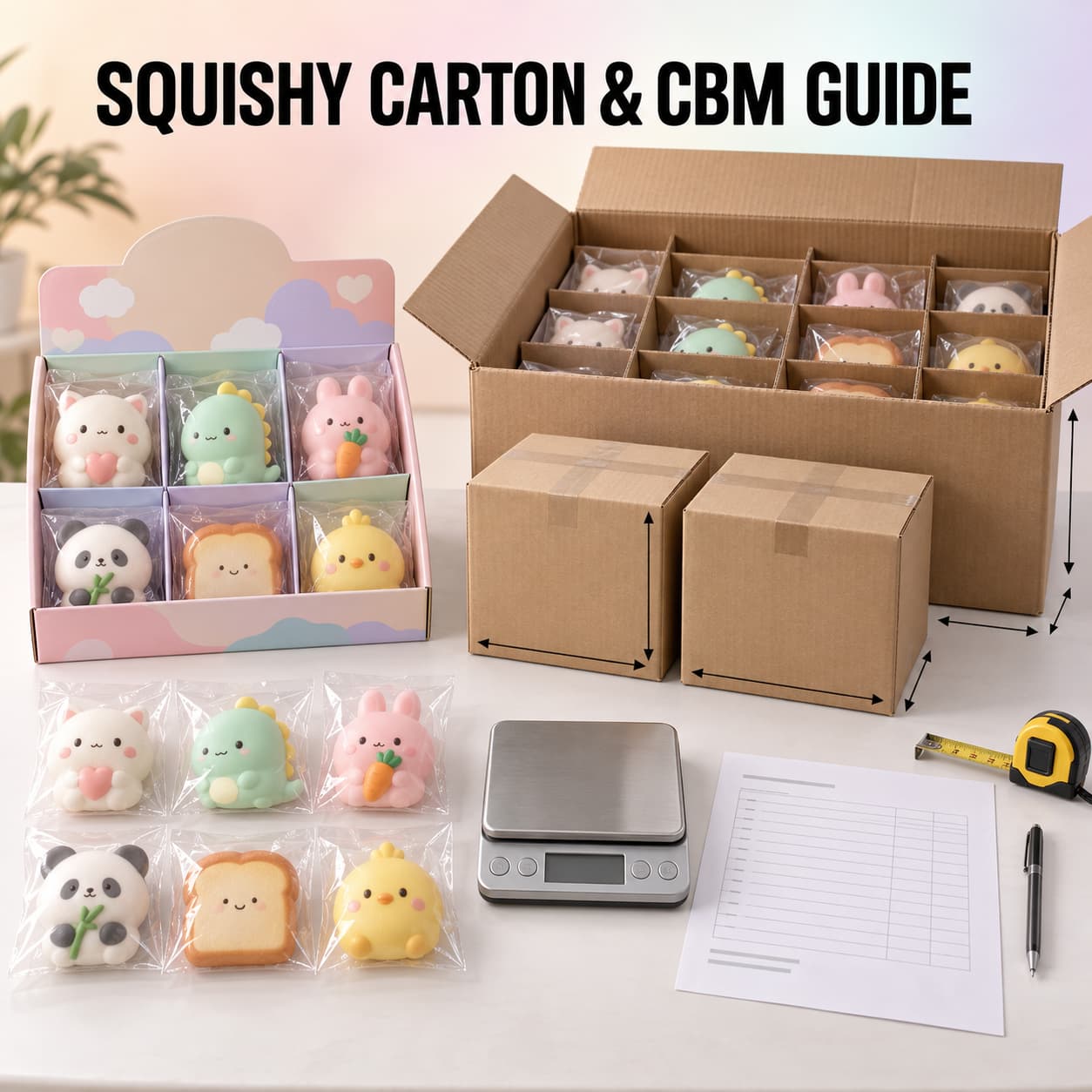
For wholesale buyers, the price of one squishy toy is only part of the sourcing calculation. The way each item is bagged, grouped into a retail display, loaded into an inner carton, and protected inside a master carton can change the shipment volume, handling risk, and landed cost. A clear squishy toy carton packing plan therefore needs to be agreed before a buyer compares freight quotations or approves mass-production packaging.
This guide explains how importers, retailers, promotional-product buyers, and private-label sellers can organize case packs, carton dimensions, CBM, mixed-SKU rules, and transport protection. It does not prescribe one universal carton size or packing quantity. Those values depend on the approved toy shape, material, size, retail package, assortment, and shipping route.
Start With the Selling Unit, Not the Master Carton
A reliable packing specification begins with the smallest unit the customer will receive. For a squishy toy program, that selling unit may be an individually packed slow-rising PU toy, a TPR or TPE mochi squishy in a sealed bag, a gift box, or a multi-piece retail set. If the selling unit changes, the carton plan may also change.
Before requesting carton data, confirm these details:
- the approved product shape, dimensions, and material;
- whether the toy is compressed or packed in its natural shape;
- the individual bag, printed box, blister, or other retail package;
- the number of units in one retail set or display;
- the SKU assortment and color ratio;
- label, barcode, warning, and target-market requirements.
This sequence matters because soft toys can have similar product dimensions but very different packed volumes. A loose polybag, a printed gift box, and a countertop display do not use carton space in the same way.
Understand the Packing Hierarchy
Buyers and suppliers should use the same terms when discussing wholesale squishy toy packing. A typical hierarchy may include the following levels:
- Individual unit: one toy with its approved bag, label, or retail box.
- Retail set or display: several units arranged for shelf or countertop presentation.
- Inner carton: a smaller grouping used to organize products inside the shipping carton.
- Master carton: the outer corrugated carton handled during warehousing and transport.
- Case pack: the number and assortment of sellable units inside a carton or display case.
Not every order needs every level. The correct structure should protect the goods while avoiding unnecessary packaging. Ask the supplier to show the hierarchy in the quotation or packing specification so that “12 pieces per box” cannot be confused with 12 pieces per master carton.
Case Pack Is Not the Same as MOQ
A squishy toy case pack describes how units are grouped for packing or retail distribution. A minimum order quantity describes the minimum commercial order accepted for a product or customization. They affect each other, but they are not interchangeable.
For example, a buyer may select a six-piece display format while the production order contains many displays. The final order should be divisible by the approved assortment and case-pack structure. When several colors or characters are mixed, write the ratio explicitly—for example, “equal assortment where practical” is less precise than a stated quantity for each SKU.
Buyers planning a custom program can review the custom squishy toy MOQ guide and then ask for a carton configuration based on the final order quantity.
Which Carton Data Should Appear on the Packing Specification?
Do not compare freight using an early estimate after the retail package has changed. Request updated figures for the approved packaging version. A practical carton data sheet should include:
- pieces per individual package, inner carton, display, and master carton;
- master-carton length, width, and height, with the unit of measure;
- net weight and gross weight per carton;
- total master-carton quantity;
- total pieces and SKU assortment;
- total shipment CBM;
- carton material or construction when specified;
- carton marks, purchase-order reference, and destination information;
- the packaging revision or approval date.
These fields create a traceable link between the approved sample, the commercial invoice, the packing list, and the freight quotation. They also help warehouse teams check whether the received case pack matches the purchase order.
How to Calculate Squishy Toy Carton CBM
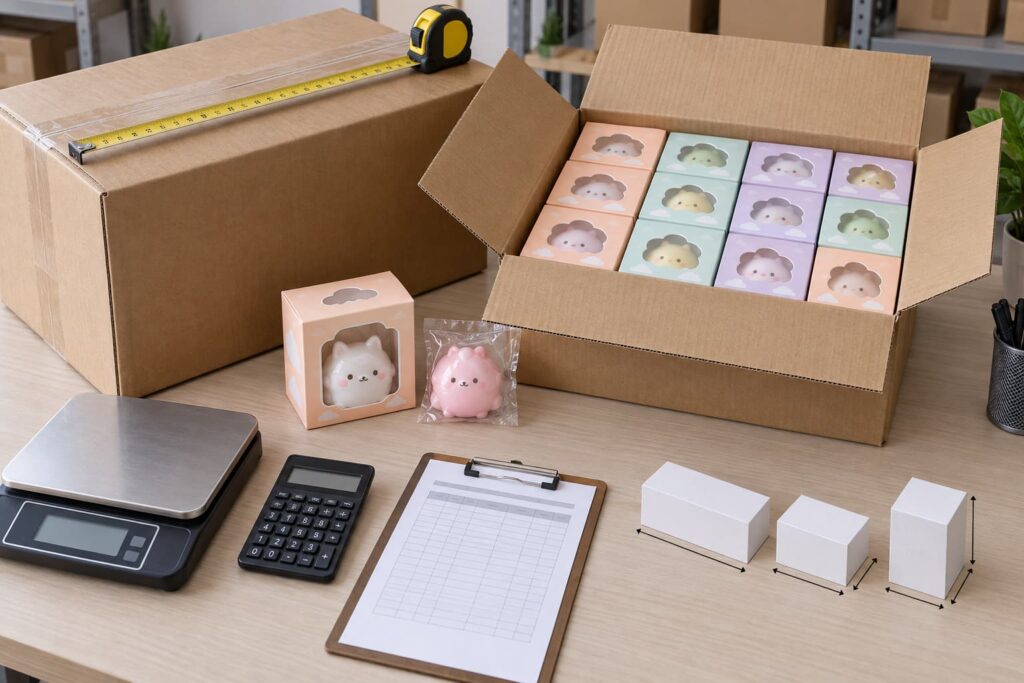
CBM means cubic meter and describes shipment volume. For one rectangular master carton, use:
Length (m) × width (m) × height (m) = CBM per carton
If dimensions are measured in centimeters, use:
Length (cm) × width (cm) × height (cm) ÷ 1,000,000 = CBM per carton
As an illustrative calculation only, a carton measuring 60 × 40 × 40 cm has a volume of 0.096 CBM. If a shipment contained 20 cartons of that confirmed size, its calculated carton volume would be 1.92 CBM. These numbers are an example, not a Dongyu Toys product specification.
Measure the packed outer carton rather than relying on a nominal box size. Bulging, overfilling, or a late packaging change can affect the final dimensions. For mixed carton sizes, calculate each carton group separately and add the results.
Actual weight and dimensional weight are different
Carriers may compare a package’s actual weight with a dimensional or volumetric weight based on the space it occupies. The method and divisor can vary by carrier, service, route, and unit system. UPS explains that billable weight may be based on actual or dimensional weight, while FedEx likewise directs shippers to calculate dimensional weight using the applicable service method. Buyers should therefore ask their carrier or freight forwarder for the current rule instead of applying a universal divisor.
For air or parcel shipments, bulky retail boxes can become especially important. For sea freight, CBM and consolidation conditions may be central. In both cases, confirm the final packed data before making a landed-cost decision.
How Retail Packaging Changes Packing Density
Retail packaging serves presentation, information, and protection, but every layer uses space. The best choice depends on the sales channel and buyer priorities.
- Simple individual bag: usually compact, but labels, sealing method, ventilation needs, and surface protection still require review.
- Printed retail box: offers more branding area and stacking structure, while increasing packed dimensions.
- Counter display: can support retail merchandising, but its assembled or flat-packed configuration must be defined.
- Multi-piece gift set: improves presentation but may require a tray or insert to keep items positioned.
A packaging decision should not be based on appearance alone. Compare shelf presentation, barcode placement, packing labor, carton utilization, transit protection, and disposal expectations in the target market. Dongyu Toys can discuss packaging options through its custom squishy toy service, subject to the final product and buyer requirements.
Set Clear Rules for Mixed-SKU Cartons
Mixed assortments can make a wholesale range more attractive, but they also create counting and receiving risks. The packing document should answer:
- Can different designs or colors share one master carton?
- Is the assortment equal, or does each SKU have a fixed ratio?
- Are inner cartons single-SKU or mixed?
- How is the assortment identified on the outer carton?
- Can the warehouse scan or verify each SKU without opening every retail package?
- How are partial cartons handled?
For online sellers, a master carton containing clearly separated inner packs may simplify fulfillment. For distributors shipping sealed cases to stores, a retail-ready assortment may be more useful. The packing plan should match the actual receiving and selling workflow.
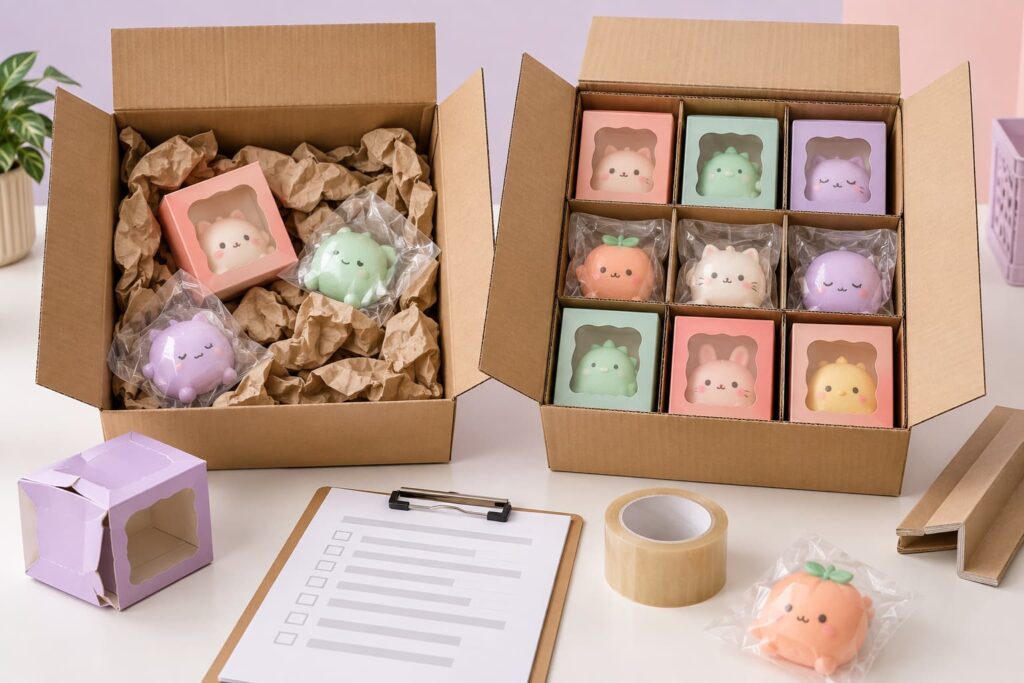
Protect Soft Squishy Toys During Transport
Softness does not eliminate shipping risk. Slow-rising PU toys may be vulnerable to surface rubbing, prolonged deformation, or contact with unsuitable packaging. TPR and TPE items can have different surface and shape-retention behavior. The solution must be evaluated for the specific product rather than assumed from the category name.
Common protection considerations include:
- preventing uncontrolled movement inside the carton;
- avoiding excessive compression that could distort the product or retail box;
- separating painted or delicate surfaces where needed;
- using dividers, trays, inner cartons, or suitable void fill when justified;
- checking carton closure and tape application;
- reviewing stack strength for the expected distribution environment;
- keeping the product clean and dry throughout packing and storage.
ISTA advises that package development should consider the product, package, and distribution environment as a system. A buyer may request an appropriate packaging evaluation or transit-test plan, but the exact protocol should be agreed for the project. Do not treat a generic carton photograph as evidence of testing or certification.
Build a Pre-Shipment Carton Check
Before shipment, the inspection checklist should connect physical cartons with approved documents. Depending on the order and inspection scope, useful checks may include:
- verify the product, packaging, color, and assortment against the approved sample;
- count the units per inner pack, display, and master carton;
- measure representative sealed cartons;
- record representative gross and net weights where required;
- check carton marks, barcodes, purchase-order numbers, and destination labels;
- inspect carton condition, sealing, internal movement, and visible deformation;
- reconcile total pieces, cartons, and CBM with the packing list.
Sampling method, acceptance criteria, and responsible parties should be agreed before inspection. The presence of a checklist does not replace applicable product-safety, labeling, or target-market requirements.
Use Carton Data in a Landed-Cost Worksheet
A useful landed-cost comparison should connect commercial and logistics data. Include the product price, retail packaging, case pack, cartons, total CBM, gross weight, freight basis, duties or taxes where applicable, destination handling, and local fulfillment costs. Use quotations from the relevant service providers rather than estimates presented as guaranteed costs.
When comparing two packaging options, calculate the cost per sellable unit—not only the cost per carton. A slightly more expensive retail package may support a premium sales channel, while a compact option may reduce freight exposure. The correct decision is the one that fits the product, route, retail strategy, and damage-risk tolerance.
Information to Send With Your RFQ
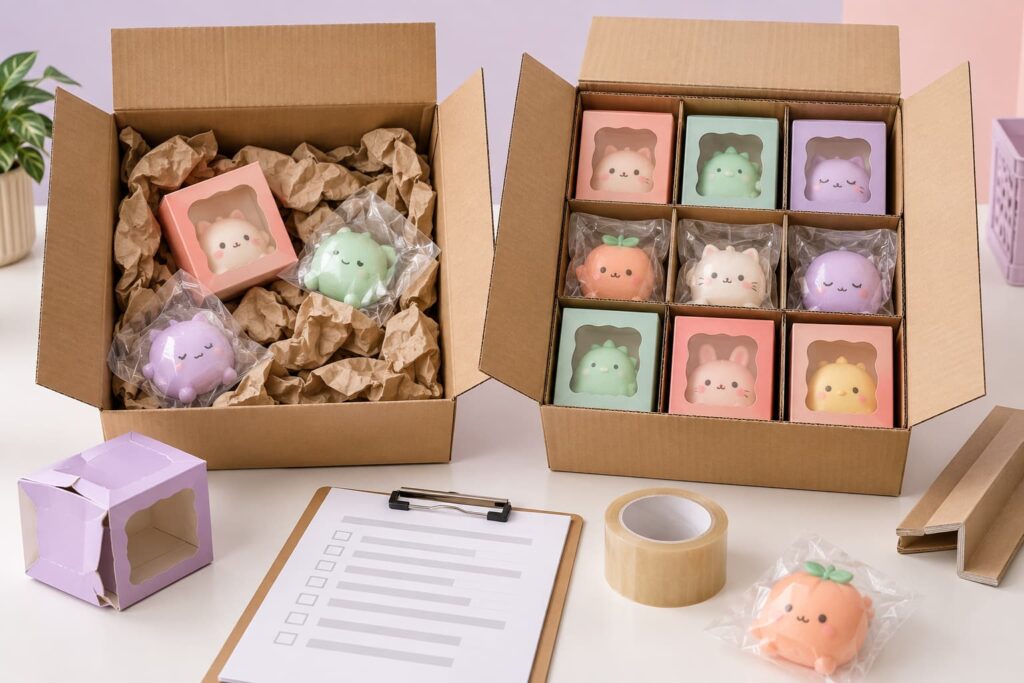
To receive a more useful carton proposal, send the supplier a complete request:
- product reference, drawing, or target dimensions;
- preferred material and squeeze or slow-rising behavior;
- estimated order quantity and SKU assortment;
- individual packaging and retail-display requirements;
- barcode, label, carton-mark, and destination requirements;
- preferred case pack or warehouse handling limits;
- shipping mode and destination country or market;
- any requested carton measurement, inspection, or test documentation.
You can browse squishy toy product ideas and then send the project details through the Dongyu Toys inquiry form. Carton configuration, final measurements, and logistics estimates should be confirmed after the product and packaging specification is settled.
Frequently Asked Questions
What does case pack mean for wholesale squishy toys?
Case pack is the number and arrangement of sellable units inside a case, display, inner carton, or master carton. The document should identify the packaging level clearly so the buyer knows whether the number refers to individual toys, retail sets, or displays.
How do I calculate CBM for squishy toy cartons?
Multiply the packed carton length, width, and height in meters. If using centimeters, multiply the three dimensions and divide by 1,000,000. Multiply the result by the number of cartons of that size, then add other carton-size groups.
Should a buyer use estimated or final carton dimensions for freight?
Early estimates are useful for planning, but freight booking and landed-cost decisions should use the latest confirmed packed dimensions and weights. Update the figures after changes to the toy size, retail box, display, assortment, or case pack.
Can different squishy designs be packed in one carton?
They can be packed as a mixed assortment when the buyer and supplier agree on the ratio, separation method, carton identification, and counting process. The packing list should make the assortment easy to verify.
Does a soft squishy toy still need internal protection?
Often yes, depending on material, finish, shape, retail packaging, carton load, and distribution conditions. The goal is to control movement, compression, rubbing, contamination, and carton damage without adding unnecessary packaging.
What should I confirm before approving a master carton?
Confirm pieces per carton, assortment, dimensions, net and gross weight, carton construction where specified, internal arrangement, sealing, carton marks, total carton count, CBM, and the packaging revision used to produce those values.
Plan the Carton Before You Compare Freight
A dependable wholesale packing plan links the approved squishy toy and retail package to a measurable case pack, master carton, CBM, weight, protection method, and packing list. That information gives buyers a better basis for freight comparison, warehouse planning, and pre-shipment checks.
Preparing a custom squishy toy project? Share the product size, material, quantity, assortment, retail package, shipping destination, and case-pack preferences with ของเล่นตงยี่. The team can review a practical OEM/ODM packing direction for your specific inquiry without treating preliminary estimates as final shipment data.