Dongyu Insights
Custom PU Waffle Squishy: OEM Quotes, Grid Finish and Pack Approval
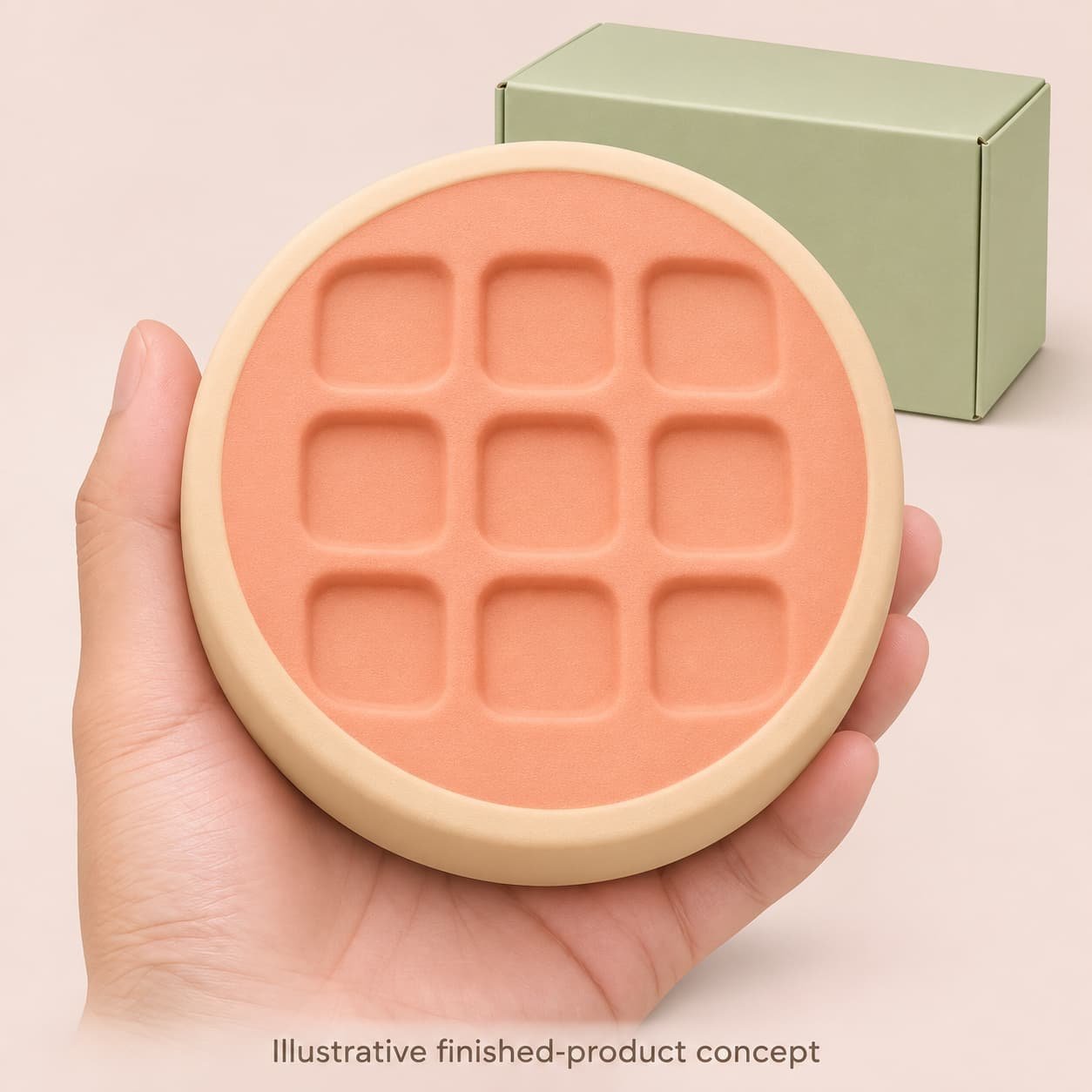
A custom PU waffle squishy has two surfaces to approve: the raised grid you press and the recessed wells you see. A sample can look crisp in a studio photo yet feel ridged in the hand, or show a lighter patch where the finish does not reach the bottom of a well. Before ordering a wholesale run, agree how the grid, rim and underside will be judged, and check the same features after the toy has been packed.
The example here is a round, low-profile waffle with nine shallow wells, a dusty peach face and a pale oat rim. It is a proposed slow-rising foam design, not a stocked item, a tooling drawing or an approved physical sample.
Build a Quote Brief Around the Grid
Start with an overall diameter and thickness at rest, then identify the clear space the retail pack needs. Draw a broad rim around a three-by-three grid, rather than allowing the outer wells to end abruptly at the edge. Tell the factory whether the continuous rim or the nine-well count matters more if both cannot be kept at the requested size. That decision prevents a small diameter adjustment from changing the recognizable design without approval.
| Item | Buyer brief | Factory to confirm |
|---|---|---|
| Envelope | Round puck, rounded perimeter and flat underside. Fill in target diameter and height. | Feasible dimensions, tolerance, measuring locations and estimated mass. |
| Grid | Nine shallow square wells with rounded corners, aligned inside a continuous rim. | Well depth, corner radius, web width, draft and minimum foam thickness below a well. |
| เสร็จสิ้น | Matte dusty peach face, pale oat rim, no character, toppings or added scent requested. | Color references, proposed finish sequence, masking route and feasible boundary variation. |
| แพ็ค | Single toy, face visible on opening; quote a pack that does not press on the grid. | Support and contact locations, clearance, pack components, dimensions and proposed artwork panels. |
| Order | Enter launch and reorder volumes, color count, destination, sales channel and intended users. | MOQ basis, sample milestones, quote assumptions and documentation needs. |
Give each well an address
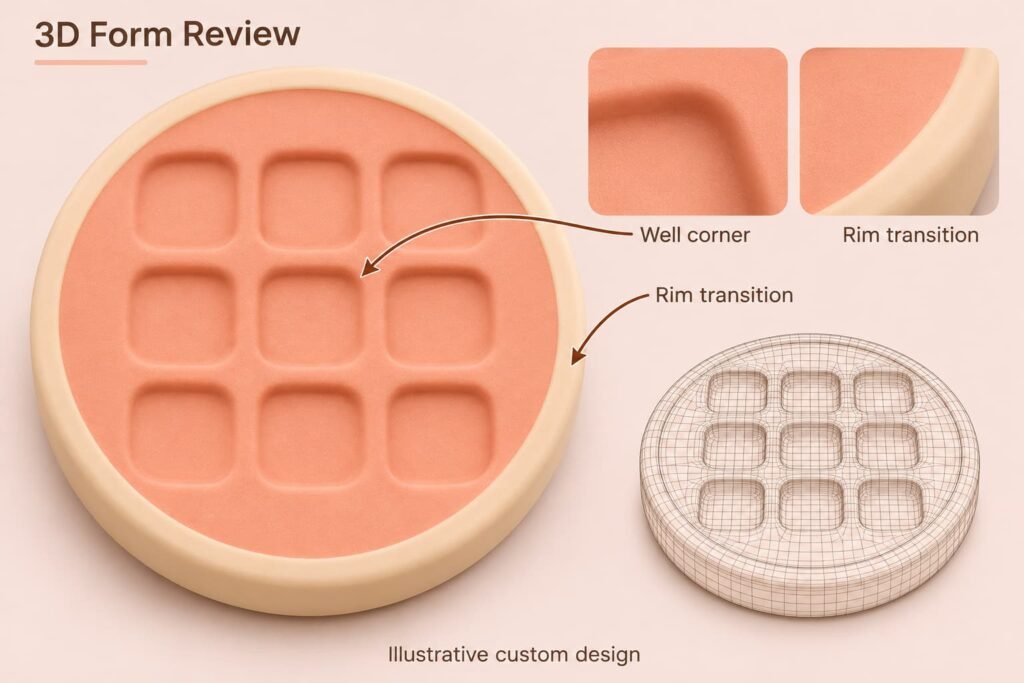
Put an orientation arrow on the face view. Label rows A to C from top to bottom and columns 1 to 3 from left to right. Mark the rim R and the underside U. A photo labeled “B2: finish pools at the near corner” is actionable. “The waffle looks uneven” is not. On the side view, mark the intended color transition and ask the supplier to draw its proposed parting line on a separate overlay.
Specify whether the bottom of each well should match the face color or simply remain free from visible coating defects. Side lighting can make the wells look darker even if the coating is uniform. Review the sample under both diffuse light and low-angle light, using the same viewing position for all samples. Treat the sketch and render as instructions about appearance, not as measurements or evidence of performance.
Compare Quotes for the Same Retail Unit
If a suitable and permitted existing mold is available, ask what can change without changing tooling. An original grid, a wider rim and a new diameter are not necessarily part of a color-only quote. Ask for separate lines for tooling, sampling and revisions, coating setup, bulk unit cost, packaging and the shipping assumptions. Give every supplier the same pack count and destination so a lower unit price is not simply a different quote scope.
- Ask which minimum applies to the foam body, each finish and each printed packaging version.
- Price a common carton with a branded label and a fully printed box as separate options. Confirm whether the quoted price includes the insert.
- Request the sample sequence and identify the approvals that trigger any later charges or schedule changes. Do not assume the first appearance sample uses the final finish or pack.
When two retailers want different packaging, quote one common toy and two artwork versions first. Confirm the quantities and any unused print stock separately. See the custom squishy toy MOQ guide for questions about split minimums.
Approve the Grid Before Approving the Box
Ask the manufacturer to confirm the thinnest foam section under the wells and the expected shape at the rim after squeezing. Agree separate handling locations at B2, one outer well and the rim. Look for a raised web that remains flattened, a crease that persists, or finish damage at a rounded corner. Use the slow-rise recovery guide to agree repeatable observation conditions; do not adopt another SKU’s time as a requirement.
Use separate revision IDs for form, finish and packaging, such as WAF01-G02, WAF01-C01 and WAF01-P01. Record who approved each revision and link it to the corresponding physical sample. A deeper well reopens the form, finish and recovery reviews. An artwork-only change does not require a new geometry approval, but changing an insert or internal box depth does require another pack-fit check.
Check what actually touches the face
Ask for a packed sample with the proposed production insert and liner, not a loose toy placed in a convenient box. Start by supporting the flat underside and compare that with any rim support the supplier proposes. Photograph where the toy touches the pack. After an agreed storage and handling interval, compare it with a loose reference from the same sample round. Record what you see on opening and again at the agreed observation time, so temporary compression is not confused with a persistent mark.
| Check | Evidence | Hold for review if |
|---|---|---|
| Grid and rim | Face photo with grid addresses, profile photo and agreed dimensions. | A well is visibly distorted, the rim breaks the agreed outline, or dimensions exceed limits. |
| เสร็จสิ้น | Same-light photos of B2, an outer well, rim and underside. | Coating pools, misses a corner or crosses the approved boundary beyond the agreed reference. |
| Recovery | Separate observations at B2, an outer well and the rim under agreed conditions. | The face or perimeter fails the agreed recovery or appearance limit. |
| Packed unit | Insert revision, contact map, unpacking photos and final retail artwork. | The face carries a persistent impression, the unit rotates, or the pack differs from the approval. |
Keep the signed loose and packed samples together with the acceptance notes. This is a procurement worksheet, not a safety or laboratory standard. Share the target market and intended users early so the responsible parties can assess the food-shaped presentation and any applicable requirements before approving artwork or placing the order.

FAQ
Can we change the waffle color without new tooling?
Ask for that route if an existing permitted shape meets your requirements. Request a finish sample on the actual grid, since a flat swatch cannot show the appearance inside the wells.
Should a logo go into one well?
For a first order, price package branding separately. A small recessed face may be harder to read after squeezing. If a toy imprint matters, approve it on a representative decorated sample before committing.
What is the MOQ for a wholesale waffle squishy?
Request a project-specific quote. Give the supplier units per color, whether the grid needs new tooling, and how many artwork versions you need.
Request a Custom PU Waffle Squishy Quote
Send the target envelope, annotated grid, physical color references, order quantity and packaging direction. Review Dongyu Toys’ OEM and ODM development service or request a custom PU waffle squishy quote and sample plan.
