Dongyu Insights
Crunchy Peanut Squishy Wholesale: How to Qualify a Pilot Lot

A crunchy peanut squishy can sound right in a supplier video and still disappoint in a mixed carton. One lobe may crackle under light pressure while the other feels almost empty; a hand-picked sample may recover differently from units pulled off the packing line. If you are buying crunchy peanut squishies wholesale for a private label, approve the repeatability of the enclosed filling, not just the best sample. That means checking both lobes, the waist and the closure before and after the toy spends time in its retail pack.
This guide concerns an original TPR-shell concept: a dusty-apricot peanut pod with two rounded lobes, a shallow waist and molded dimples. It does not identify an existing mold, stock item or approved filling. The drawings communicate the exterior; they do not establish what is inside. If you are still deciding the shape or surface, start with the peanut squishy design guide. Use the steps below once the discussion turns to a filled prototype and a representative pilot lot.
Write down where the crunch should happen
“Crunchy” might mean an audible crackle, a granular sensation in the hand, or both. Choose which shoppers should notice first. For this two-lobed shape, specify whether the two ends should feel broadly alike or intentionally different. A slight size asymmetry may be part of the silhouette; it need not mean that one end is meant to go quiet. Decide whether a persistent dent after ordinary handling is acceptable and describe when the toy should be back in its saleable shape. Do not use an edited video to set a sound level or invent a recovery time you cannot reproduce.
| Decision | Buyer entry | Supplier response |
|---|---|---|
| Handling experience | Length and grip target; tactile feel or sound as the priority; an approved comparison reference if available | Proposed fill and whether the effect changes after handling or rest |
| Three review zones | Larger lobe, smaller lobe and waist on the drawing; note which areas should not feel unusually hard or empty | Assessment of redistribution, transitions and any uneven feel the construction may introduce |
| Exterior | Apricot color reference, shallow dimple texture, front presentation face, no printed decoration on the shell | Proposed finish and tolerances, likely seam location and where the closure can be examined |
| Channel and pack | Destination, intended audience, shelf or mail order, and whether the pack allows handling | Pack fit, contact materials and a packed sample using the proposed insert and carton layout |
| Pilot and commercial order | Pilot purpose, launch quantity by variant, intended reorder size and delivery point | Pilot origin, assumed production method, separate minimums and written quote exclusions |


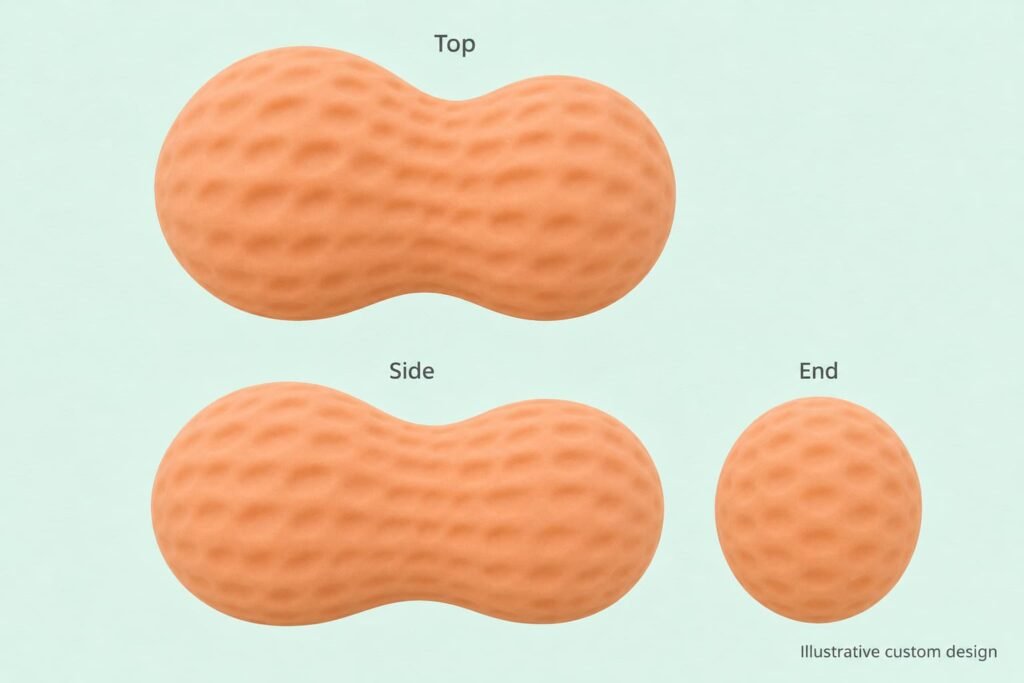
Map the closure without designing it for the factory
Call the larger end A, the smaller end B and the waist W. Put those identifiers on a top view, alongside a side view for depth and an end view for the cross section. Circle the display face. Reserve a non-display zone for the supplier to assess as a potential closure location; do not draw a plug diameter or place a seam across the waist as if the tooling were already approved. Have the supplier mark its actual closure and explain how an inspector can find it without cutting a saleable unit open.
Request the shell compound identifier, proposed thickness range and how it is verified; the fill identifier, target fill mass and variation; and the closure method, inspection access and agreed defect limits. Ask how the material combination will be evaluated for the intended destination and audience. A net weight can flag a difference, but it does not tell you whether the material moved into one lobe or whether the wrong construction was supplied. Pair weight with the zone checks instead of treating the scale reading as proof.
Keep a simple revision list: PN-A02 for the exterior, PN-C01 for the construction proposal, PN-P01 for the pack. Record the physical sample identifier and the production lot separately. If the supplier changes the filling or closure but leaves the color and dimensions unchanged, the construction revision still changes. Record whether each alteration requires a fresh pilot, packaging check or destination assessment. Avoid approving a changed sample by replying to an email chain whose subject only says “apricot approved.”
Check a packed pilot, not just a loose master
Ask where the pilot came from. Tooling, filling and packing should represent the proposed production route as closely as practical; otherwise record what is different. Agree which units the buyer and inspector will compare, how selected cartons and positions will be recorded, and how long the packed units are held before review. Keep a loose master for appearance and feel, but use packed units to detect changes caused by storage or contact with the insert. Do not infer a pass from the one unit the vendor filmed.
| Check | What to record | If it differs from the approved reference |
|---|---|---|
| A and B: feel and sound | Use the same handling sequence and comparable room conditions; note resistance, sound and return behavior separately | Compare additional units from different carton positions; hold approval if one end repeatedly behaves differently without an agreed reason |
| W: waist shape | Compare the resting outline before and after the agreed sequence; note deep creases or persistent collapse | Ask whether the change follows the waist geometry, filling distribution or how the pack supports it |
| Closure and shell | Look for separation, tears, seepage, residue or exposed filling under the agreed inspection procedure | Isolate affected units, hold the lot and escalate; do not rework a leaking unit into saleable stock |
| Retail pack contact | Record insert rub marks, sticking, dents or pressure points on both lobes and the waist after the agreed packed hold | Fix the pack or construction as appropriate, then repeat the affected check on the revised combination |
| Identity and traceability | Match toy, fill and pack revision to the signed record, carton ID and intended market | Resolve mismatches before releasing the lot; do not treat an unrelated report or label proof as evidence |
Use agreed handling for comparative checks; do not puncture the toy or improvise abuse tests during routine inspection. If sound is a selling feature, keep an unedited comparison recording with the same recording setup as a communication aid, not as a validated test. For shipment-wide decisions, connect this matrix to the pre-shipment quality checklist. The matrix is a buyer tool, not an industry standard or a substitute for product assessment.
Ask for a wholesale quote that separates the pilot from the run
- Pilot: Ask what is included in sample and revision charges, who pays for the packed pilot, and what the sample represents.
- Repeat orders: Request order minimums by toy style, fill option, color and printed pack. Ask whether setup needs to be repeated or whether unused packs can be held for a reorder.
- Quote basis: Compare identical quantities, revisions, handover points and pack counts. Record tooling, testing coordination, packaging and delivery separately if they are excluded from the unit price.
- Brand packaging: For the first run, consider branding the pack rather than printing on the highly textured body. Keep the toy clearly presented as a toy, not a food item. Ask who reviews your claims and artwork for the destination.
Buyer FAQ
Can a supplier change the fill without changing the appearance?
It may be possible, but it is not an equivalent substitution by default. Review the revised documentation and retest the agreed sensory and pack checks on that construction before authorizing the change.
Can we approve from a short squeeze video?
Use video to compare a proposal before paying for samples. It cannot replace closure inspection, feel in the hand or review of production-representative packed units.
Should an insert grip the peanut tightly at the waist?
Do not pick an insert by still photos. Compare a supportive insert with one that grips the waist, and check the unpacked unit for indentation, sticking and recovery using your agreed hold conditions.
Request a pilot proposal for your peanut squishy
Review Dongyu’s OEM and ODM development service, then send your crunchy peanut squishy brief. Include your first-run quantity by variant, intended market and audience, A/B/W marks, a short feel reference, retail-pack direction and desired delivery point. Ask for an itemized pilot and bulk quote, open construction questions, and a proposed way to show that the first lot matches your approved sample.