Dongyu Insights
Custom TPR Axolotl Squishy Design: Gills, Tail and Sample Approval
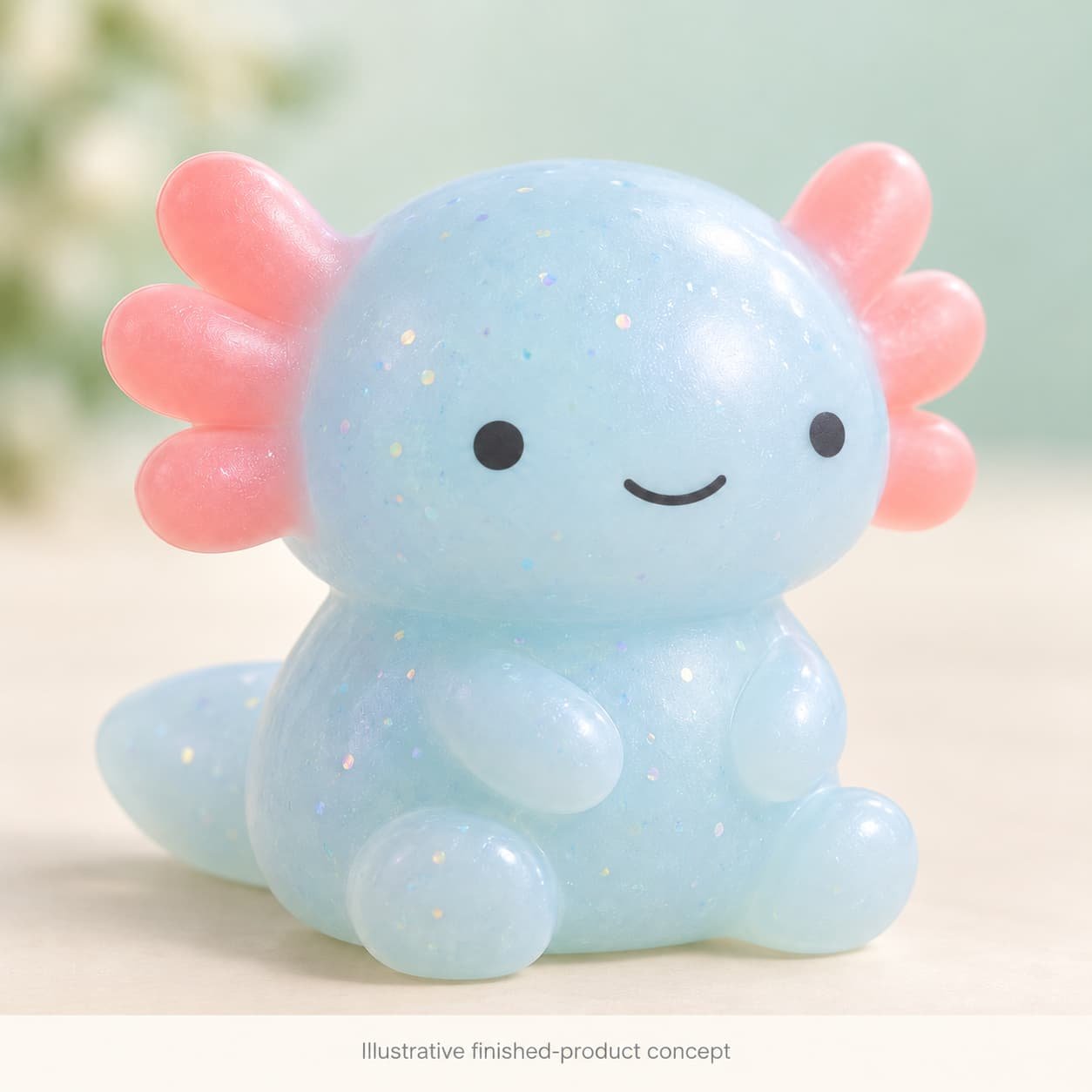
Custom TPR axolotl squishy design needs a clear rule for the features that make the character recognizable: the broad head, side gills, small limbs, and tail. If those features change between the sketch, colored artwork, and sample, the buyer may approve three different products without noticing.
This guide develops one original seated axolotl concept with a powder-blue body, coral gills, a small printed face, and a low tail. Its purpose is to show buyers how to brief a supplier, compare design revisions, and approve a physical sample. The four images are illustrative custom designs, not actual Dongyu samples, calibrated CAD, or manufacturing approval.
Dongyu’s glitter axolotl product page is a useful category reference for a colorful translucent character and custom packaging. That page does not identify a specific material. For the project below, request a TPR development direction separately and have the supplier confirm the material, construction, decoration, and feasibility before treating the concept as a production specification.
Use market demand as a starting point, not a copying brief
Public Faire axolotl listings include squeeze toys marked Bestseller. The category also contains different constructions and finishes. A platform label supports investigating a category; it does not establish global sales leadership, verify a material, or guarantee demand for an original design.
Look for shared commercial features rather than a character to reproduce. Compact seated bodies, external gill shapes, simple faces, pastel colors, and translucent finishes appear in public product listings. Your brief should define a new combination of proportions and details, without copying a branded sculpt, expression, package, or licensed character.
Choose one lead product for development. A single gift-shop item, an aquarium-shop character, and an assorted display have different packaging and identity needs. Record your channel and proposed users before choosing the presentation. Do not convert a competitor’s age label, price, size, or performance claim into your own specification.
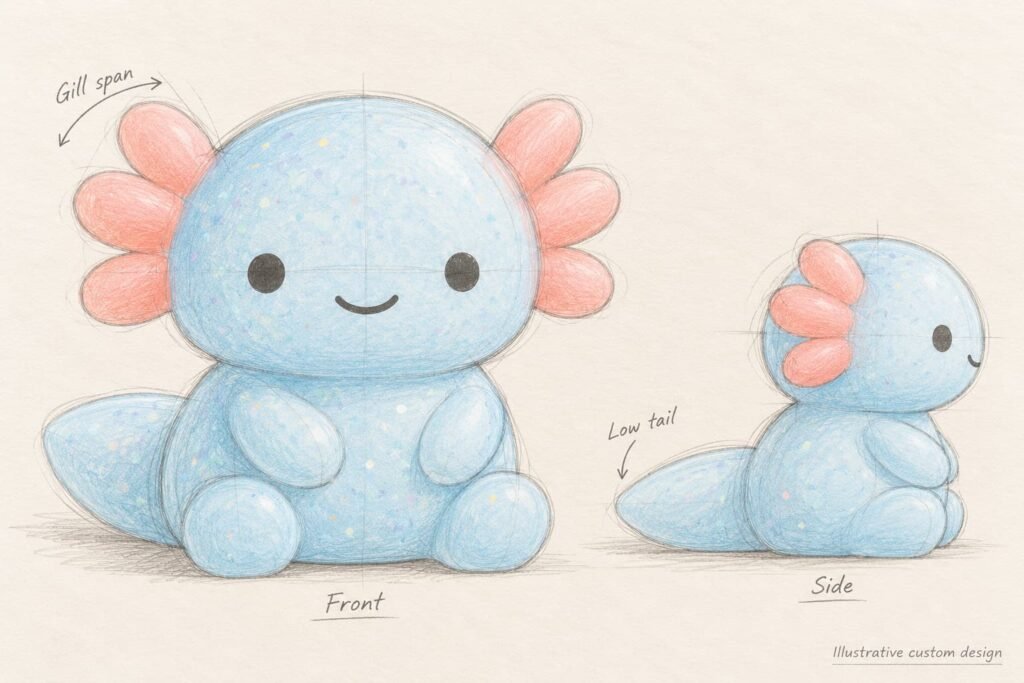
Stage 1: sketch the character around a feature register
Start with the head-to-body relationship and the seated footprint. Then add the gills, limbs, and tail. The concept here uses three short rounded gill lobes on each side of the head, two small front arms, two blunt feet, and a broad low tail. This count is an identity choice, not a safety recommendation.
Give the important features stable identifiers. For example, G1 can refer to the upper gill lobe in a marked front view, while T1 identifies the tail. Show the naming direction explicitly; “left” is ambiguous if one person means the viewer’s left and another means the character’s left.
Keep the feature register short: location, intended outline, color, and unresolved construction question. A supplier can then report that a particular gill root needs revision without changing all six lobes or silently replacing the whole head.
Do not use the sketch to invent a minimum wall thickness or bending limit. Mark those engineering questions as pending. The drawing communicates the original character; the supplier must review the proposed geometry and construction.
Stage 2: specify both body size and total character envelope
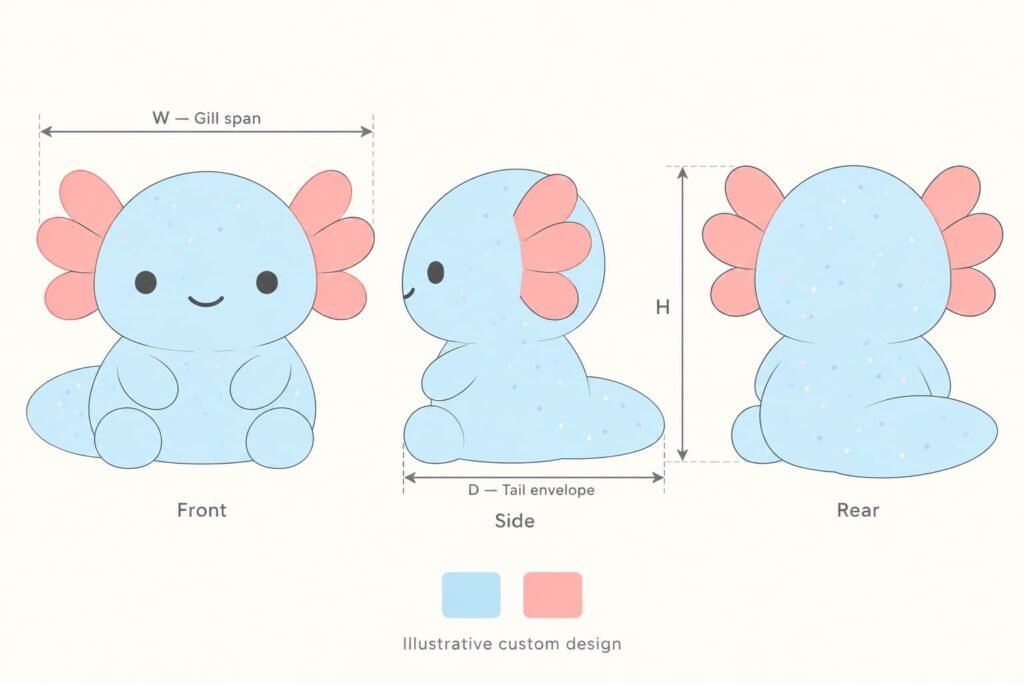
A body-width dimension alone can miss the widest part of an axolotl toy. Record the maximum envelope across the gills as well as the body width when both matter. Define overall height in the seated position and front-to-back depth including the tail. Identify whether all measurements refer to the uncompressed state.
Use front, side, and rear views for this character. The front shows gill arrangement and face placement, the side shows the tail and seated depth, and the rear shows how gills relate to the back of the head. Clearly label every view; do not call a second front-like picture a top view.
The design illustration uses schematic letters rather than numerical dimensions. Request a supplier-reviewed drawing with units, measurement points, and agreed variation. AI-generated drawings must not be scaled or measured as engineering files.
| Brief item | Buyer records | Supplier confirms |
|---|---|---|
| Character identity | Original seated axolotl; feature register and revision | Consistent interpretation across the development files |
| Material direction | TPR; desired physical feel reference | Proposed compound, construction, surface, and sample route |
| Size envelope | Body width, gill-to-gill width, seated height, tail-inclusive depth | Values, units, points, conditions, and acceptable variation |
| Gill geometry | Three rounded lobes per side; intended outline and position | Root geometry, transitions, tooling implications, and revisions |
| Color and face | Powder-blue body, coral gills, small flat face artwork | Color application, translucency, decoration method, and approval reference |
| Packaging | Channel, presentation direction, branding, destination | Fit, product contact, artwork, and documentation scope |
Separate gill shape from gill construction
Describe the visible design first
State the lobe count, rounded outline, spacing, and relationship to the head. Show whether the lobes are short and compact or extend beyond the body significantly. For this concept, compact paddle-like forms are the design direction; they are not proof of durability or a tested safe geometry.
Ask how the roots and transitions will be made
A colored image cannot reveal whether the gills are integral with the body, a different material region, separately attached, or made using another construction. Ask the supplier to explain the proposal and identify any changes required at the roots or head transitions.
Discuss the complete object rather than requesting a softer body and assuming every small feature behaves identically. Have the supplier identify which material and process decisions affect the head, gills, limbs, and tail. Do not transfer a root dimension or joining method from an unrelated product.
Track appearance and physical review separately
The gills can be visually correct while the physical sample still needs further review. Record appearance approval separately from handling, durability, and destination-market assessment. Define suitable review methods and acceptance rules with the responsible supplier and qualified reviewers before making a pass claim.
Plan the face and translucent color as separate approvals
Keep the face on its own artwork layer with eye spacing, smile position, orientation, and reference points. A small face can move noticeably relative to a wide head. Use the current drawing as the placement reference and ask how the supplier proposes to apply the decoration.
Do not assume the eyes are separate inserted pieces because they appear dark in a render. The lead concept requests flat face decoration, with the actual method pending review. If the method changes, record that change rather than approving a picture that hides it.
Translucency and color also need a physical reference. The same blue may look different against a pale shelf, a darker backing card, or under different lighting. Agree how to view the sample, and record the intended opacity or translucency instead of using “jelly feel” as a complete material specification.
If sparkle is requested, identify the intended appearance and ask the supplier to explain its location and construction. Visible specks in an AI image do not establish whether an effect is in the body, a filling, or a coating. Review the actual proposal and relevant documentation. The color matching guide covers the broader physical-reference workflow.
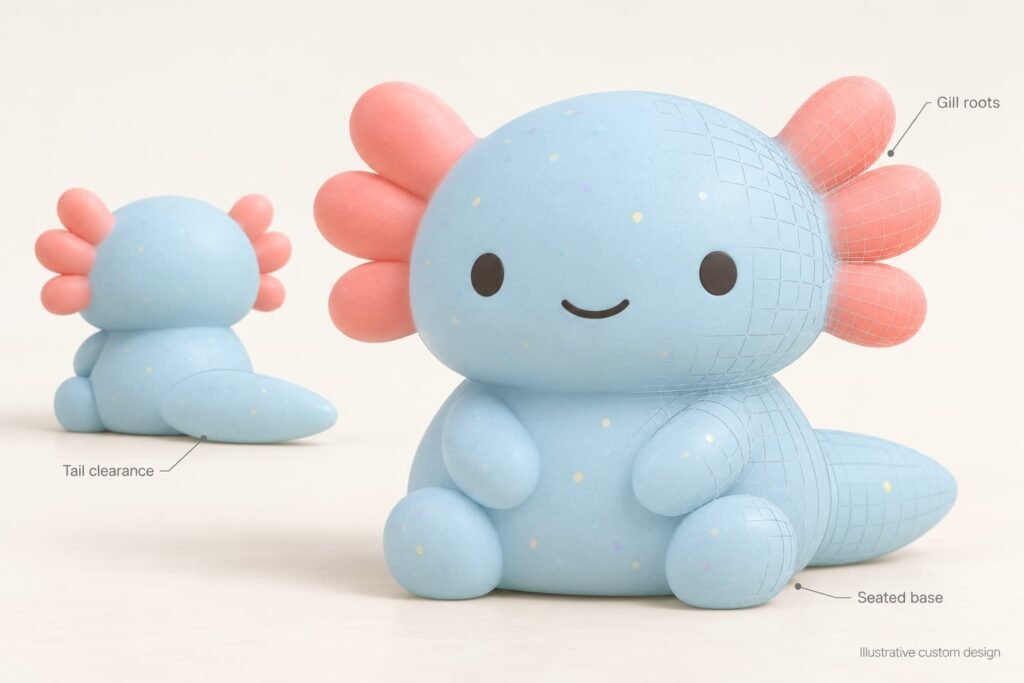
Stage 3: review the whole 3D volume, including the rear
A useful shape review should expose questions that the front sketch cannot answer. Check where the gills join the head, whether the arms merge visually into the belly, how the tail sits behind the body, and which points touch the display surface.
Use a rear or side view alongside the main volume. A partial mesh overlay can distinguish an illustrative geometry review from the finished-product visualization, but it does not make the image an actual CAD deliverable. Request the supplier’s reviewed technical files through the agreed development process.
The tail is part of the packaging envelope even when it is mostly hidden in the hero photo. Mark its position and intended outline. If the tail or gill span changes, update the design sheet and packaging brief together. Do not approve a new volume while keeping dimensions from an older revision.
Use version control that follows the changed feature
For each revision, record the project code, file identifier, date, owner, change, and approval scope. A practical entry might read: AXO-A-R03, G2 outline adjusted after supplier review, decoration unchanged, physical sample pending. The example is a record format, not an approved engineering change.
- Identity lock: agree the silhouette, feature count, and facial direction.
- Technical review: record the proposed construction, dimensions, and unresolved issues.
- Decoration lock: link the color reference and face artwork to the same shape revision.
- Sample review: identify the received sample and record each accepted or unresolved item.
A request to change coral to pink should not silently change gill length. Likewise, a geometry revision may require a new pack check even if the colors stay the same. Keep superseded files out of the current release set.
Build a feature-specific sample acceptance matrix
Use the matrix below to agree what will be checked and who decides. It is a buyer communication tool, not a legal or industrial standard. Test conditions, sampling approach, and numerical acceptance criteria remain to be agreed for the actual product.
| Area | Review question | Evidence to record |
|---|---|---|
| Character envelope | Do body, gill span, height, and tail depth match the reviewed drawing? | Sample ID, drawing revision, measurement method, results |
| Gill roots and lobes | Does the sample match the agreed geometry and construction? | Supplier explanation, close-up views, agreed physical-review results |
| Face decoration | Are position, orientation, color, and surface condition acceptable? | Artwork revision, placement reference, agreed handling-check record |
| Body appearance | Do color, translucency, and optional sparkle match the reference? | Physical reference, viewing conditions, appearance decision |
| Squeeze behavior | Does the actual sample meet the agreed tactile brief? | Method, conditions, observations, acceptance rule |
| Pack fit | Are gills and tail accommodated without unintended pressure? | Pack revision, contact-point photos, post-pack condition |
Use Dongyu’s sample approval checklist for the wider release record. A favorable appearance decision does not substitute for the appropriate product and target-market requirements review.
Let the package support the character instead of squeezing its outline
Ask for a pack trial using the current physical sample, not a render. Check the widest gill points, tail clearance, contact with printed areas, and how the toy sits after unpacking. Agree any storage or transport evaluation with the supplier instead of assuming a box that closes is acceptable.
For the lead concept, place private-label identity on the packaging first. If a product mark is requested, define a separate artwork area and review its feasibility. Do not add fine branding to a small gill merely because a digital annotation fits there.
The square image is labeled Illustrative finished-product concept. Use verified product photography for final sample-specific claims and retail specifications. An attractive AI visualization cannot establish feel, construction, durability, or a completed sample.
FAQ
Can the gills and body use different colors?
Submit separate color regions, then ask how the supplier proposes to create them. Approve the method and actual sample rather than assuming the color boundary implies a particular construction.
Is the Dongyu reference product confirmed as TPR?
The public axolotl page does not identify the material. This guide proposes a TPR development direction that requires written supplier confirmation.
Should the packaging size follow body width?
No. Include the complete reviewed envelope, particularly gills and tail, and assess fit with the actual sample and proposed packing method.
What belongs in the first inquiry?
Send the current feature brief, proposed size, TPR direction, color and face files, quantity scenarios, sales channel, destination, packaging plan, and unresolved questions.
Request review of your custom TPR axolotl brief
Contact Dongyu Toys with your custom TPR axolotl squishy design and ask for a written development proposal. Confirm the gill construction, complete size envelope, decoration, sample review, and packaging responsibilities before authorizing the next stage. MOQ, pricing, tooling costs, and schedules should be quoted for the confirmed scope.