Dongyu Insights
Food-Shaped Squishy Toys Wholesale: Design, Packaging & Buyer Guide
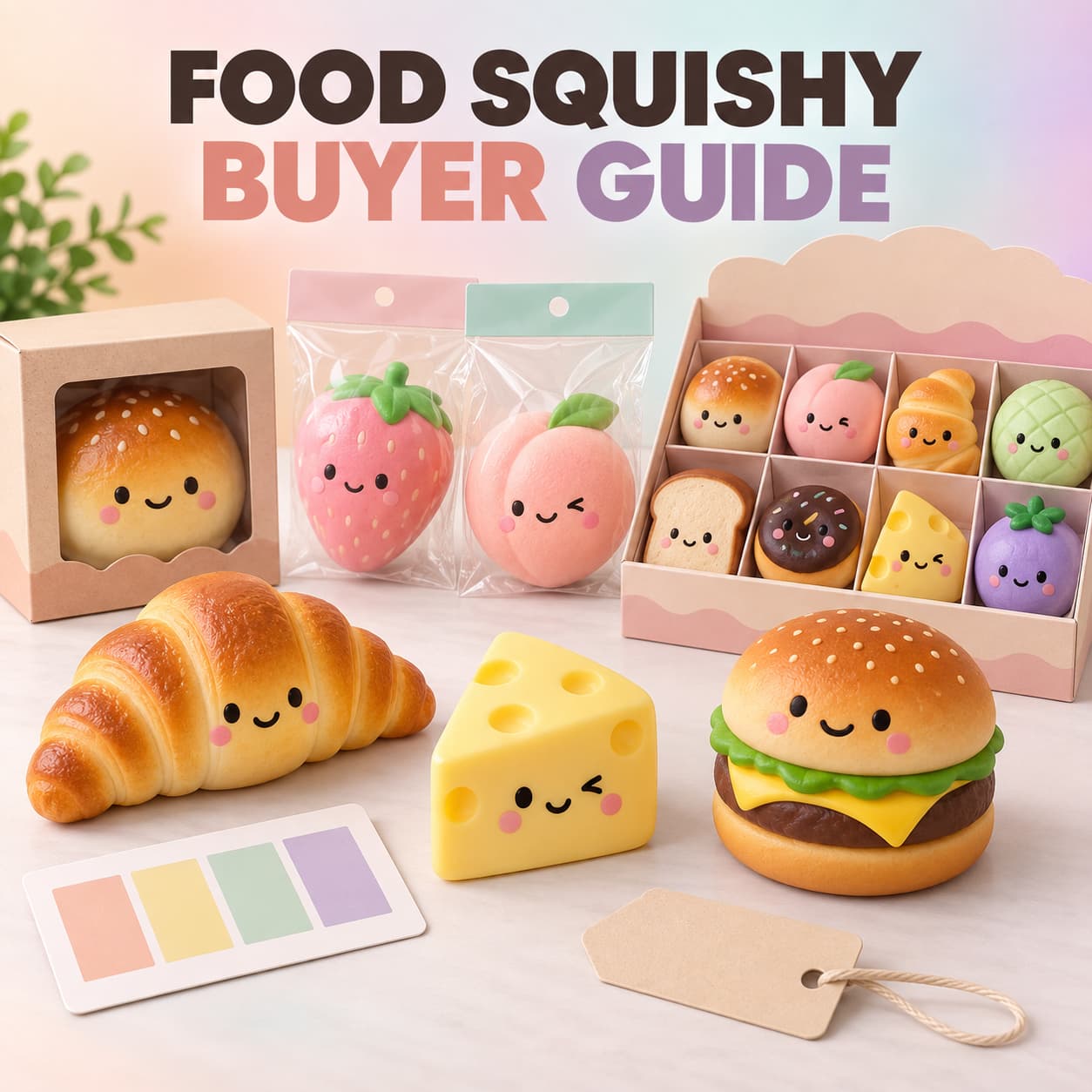
Food-shaped squishy toys wholesale programs can serve several very different buyers: a toy retailer building a bakery collection, a gift shop testing fruit characters, a restaurant creating a branded giveaway, or an online seller launching a themed set. All of them may use bread, dessert, fruit, cheese, burger, or drink-cup shapes, but they do not need the same material, size, realism, packaging, or assortment plan.
Current public product results show a clear commercial pattern. Bakery squishies are frequently sold as individually packed buns, croissants, toast, donuts, and cakes in eight- or twelve-piece countertop displays. Fruit styles often use bright colors and simple faces. Promotional suppliers also offer food-related stress relievers with a logo imprint area. The opportunity is real, but buyers still need to translate an appealing food idea into a safe, manufacturable, retail-ready toy.
This guide explains how to define the product role, select a practical material direction, simplify the shape, plan a coordinated assortment, approve samples, and prepare packaging and quality requirements. It does not provide universal prices, MOQs, lead times, warnings, or test plans; those depend on the exact design, order, target market, and supplier quotation.
Start With the Selling Job, Not the Food List
A buyer can find hundreds of possible food shapes, but a strong range begins with the job each SKU performs. Decide where the toy will be sold and why a customer should pick it up.
- Impulse retail: compact, instantly recognizable shapes that look clear from the front of a display.
- Gift and collectible retail: coordinated colors, character expressions, named series, and more protective packaging.
- Promotional merchandise: a shape connected to the buyer’s business, with a practical logo or message area.
- Online bundles: a visually balanced set with clear size and material information for product listings.
- Seasonal programs: limited colorways or packaging built around a campaign period rather than a permanent range.
A bakery display and a restaurant giveaway may both contain a bun, but the commercial brief is different. The retail version may prioritize character variety and shelf presentation. The promotional version may prioritize brand recognition, a stable imprint area, event distribution, and simple individual packing.
Choose a Food Squishy Assortment Architecture
Do not combine random shapes merely because they are all food. A collection looks more intentional when the buyer defines one visual family and a controlled role for every item.
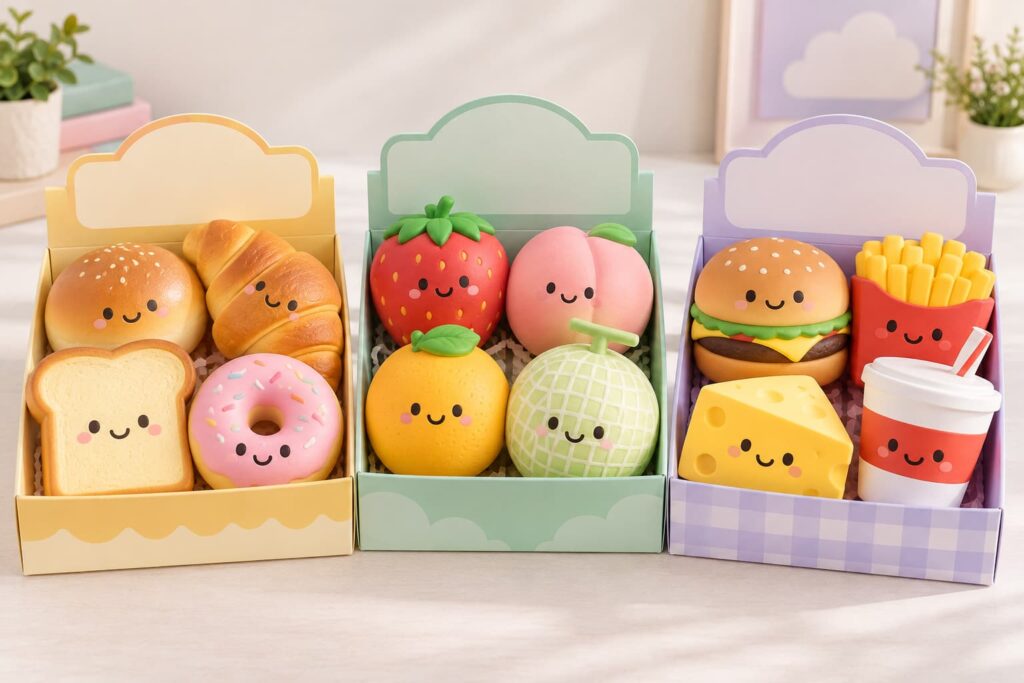
Bakery collection
Buns, croissants, toast, donuts, waffles, and cake slices naturally share warm colors and textured surfaces. Slow-rising PU foam can support larger forms, molded crust details, painted gradients, and a visible recovery experience.
Fruit and vegetable collection
Strawberries, peaches, citrus, melons, corn, and carrots provide strong color blocking and familiar silhouettes. Depending on the intended feel and size, the range may use PU foam or a soft elastomer route. Do not assume every fruit-shaped product uses the same construction.
Snack or meal collection
Burgers, fries, cheese wedges, pizza, drink cups, and takeaway-style shapes can work for novelty retail or a food-service campaign. These designs often need more careful color separation and shape simplification so the layers remain readable after squeezing.
Start with three to five anchor SKUs rather than developing too many unrelated molds at once. A small coordinated set is easier to sample, photograph, package, and explain to retailers. Expansion can follow after the buyer learns which shape, size, and tactile response perform best.
Match Material to the Customer Experience
The food name does not determine the material. Define what the customer should feel and see.
PU foam for a slow-rising bakery experience
PU foam is commonly associated with slow-rising squishies. It can suit buns, bread slices, croissants, cakes, and larger fruit forms where gradual recovery and a soft foam surface are central to the product experience. Buyers should approve the physical sample for density, compression, recovery behavior, coating, painted details, and surface feel.
TPR or TPE for compact elastic shapes
TPR or TPE directions can suit smaller, denser, elastic, or mochi-style products. They may be useful for pocket fruit, mini snack characters, keychains, or variety packs. Material names alone do not define softness, tack, stretch, durability, or dust pickup, so the target feel still needs a sample reference.
Filled squeeze formats need a separate brief
A toy with an outer skin and internal gel, liquid, powder, bead, sand, or other filling is not equivalent to a solid or foam squishy. The filling, seam construction, foreseeable use, age grading, packaging, and target-market requirements must be identified. Do not approve a filled product from appearance alone.
The buyer should send the intended hand feel, approximate size, expected use, sales channel, and destination with the request. Dongyu Toys’ wholesale customization guide provides a broader framework for choosing material, color, packaging, and samples.
Turn a Food Reference Into a Manufacturable Toy
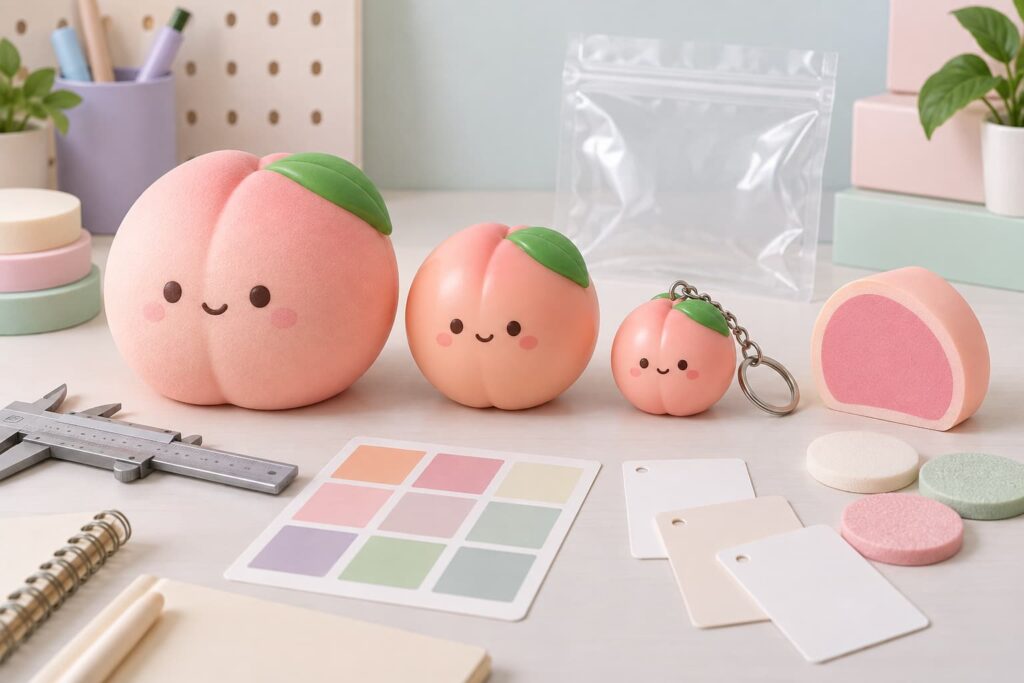
A photograph of a pastry or fruit is a useful starting reference, not a finished manufacturing specification. Real food contains thin edges, fragile layers, irregular textures, deep undercuts, and color variation that may not translate well to a repeatedly squeezed product.
During design development, review:
- silhouette: can a shopper identify the food from a small image or across a counter?
- proportions: is the product thick enough to squeeze and recover without awkward weak areas?
- thin parts: can stems, handles, toppings, ears, or fries be shortened, thickened, or integrated?
- surface detail: which crust, seed, frosting, grill, or fruit-skin details need molding, paint, or printing?
- color separation: can layers be produced consistently without excessive decoration steps?
- flat areas: is a stable imprint, label, or packaging panel needed for branding?
- package fit: will the final orientation protect painted and projecting details?
The goal is not maximum visual complexity. The goal is a recognizable product whose shape, tactile behavior, finish, and packaging can be repeated at the approved quality level.
Choose Cute, Realistic, or Branded Styling Deliberately
Food squishies generally follow three visual routes.
- Cute character styling: simplified shapes, pastel colors, faces, and a coordinated series identity.
- Realistic food styling: stronger crust gradients, seeds, texture, layers, and natural proportions.
- Brand-linked styling: colors, silhouette, mascot features, packaging, or an authorized logo that connects the toy to a campaign.
Do not copy a competitor’s product, restaurant trade dress, character, or packaging. If the design represents a real brand or licensed food, confirm ownership and authorization before supplying artwork or asking for a sample.
Food realism also deserves a risk review. In 2026, U.S. and UK authorities highlighted safety and traceability concerns involving some food-shaped or counterfeit squishy products. The exact requirements depend on the jurisdiction and product. Buyers should ask qualified specialists to review age grading, foreseeable mouthing, small parts, materials, scent, fillings, labeling, instructions, and food-imitation risks rather than relying on a generic “not edible” phrase.
Decide Whether Scent Adds Value
A bakery, fruit, or dessert concept may appear to invite fragrance, but scent changes the development brief. The buyer should define whether scent is essential to the product promise or simply decorative.
If scent is requested, document:
- the target fragrance character and acceptable intensity;
- the material and manufacturing route used with the fragrance;
- the sample condition and time after production when approval occurs;
- packaging and storage conditions;
- target-market substance, labeling, and documentation requirements;
- how an unscented control or alternative SKU will be identified.
A strong smell should never be used to hide poor material quality or treated as proof of performance. Buyers developing fragranced products can use the same sample comparison method for intensity, surface feel, packaging, and batch references.
Plan Size and Assortment for the Shelf
A fruit that works as a small keychain may become expensive and bulky as a jumbo item. A detailed burger may read well at palm size but lose clarity when reduced too far. Evaluate the product as a set, not only as individual renders.
For each SKU, record:
- finished dimensions and target weight;
- material and tactile response;
- colorway and decoration steps;
- individual packaging dimensions;
- units and SKU ratio per display;
- display orientation and replenishment method;
- master-carton quantity, dimensions, weight, and CBM after confirmation.
A balanced display needs readable contrast. Avoid eight products with nearly identical brown profiles unless the package artwork and arrangement help customers distinguish them. A bakery set may use different silhouettes; a fruit set may use color; a meal set may use recognizable categories.
Use Branding Where It Survives the Product
Direct logo printing is only one branding method. Curved, textured, highly compressible surfaces may offer a small or unstable imprint area. Depending on the product, a buyer can consider:
- a simplified one-color mark on a flatter product area;
- a molded brand element that is included in the custom design;
- a header card, hang tag, label, belly band, window box, or display box;
- a coordinated brand-color assortment;
- a removable package insert or campaign card.
Ask for an artwork proof at actual size and a physical decorated sample. A readable logo in a large digital mockup may become unclear when printed on a small foam bun. Packaging can carry detailed brand information while the toy remains visually clean.
Approve the Product and Package Together
A food squishy should be reviewed in the exact package direction because clear film, trays, window boxes, and display pressure can affect appearance and surface contact.
The approval record should cover:
- shape, dimensions, proportions, and visible seams;
- softness, squeeze resistance, and recovery behavior;
- surface finish, tack, powder, coating, and odor;
- molded texture, painted gradients, faces, seeds, toppings, and logo placement;
- individual bag, box, tray, insert, and display dimensions;
- age grading, warnings, responsible-party information, and traceability fields as determined for the target market;
- SKU assortment, case pack, carton, and approved artwork revision.
Keep dated photographs and an identified physical reference where practical. If material, pigment, coating, scent, filling, artwork, accessory, or manufacturing location changes, document the change and review whether the approval and compliance evidence remain applicable.
Build Packaging for the Actual Sales Channel
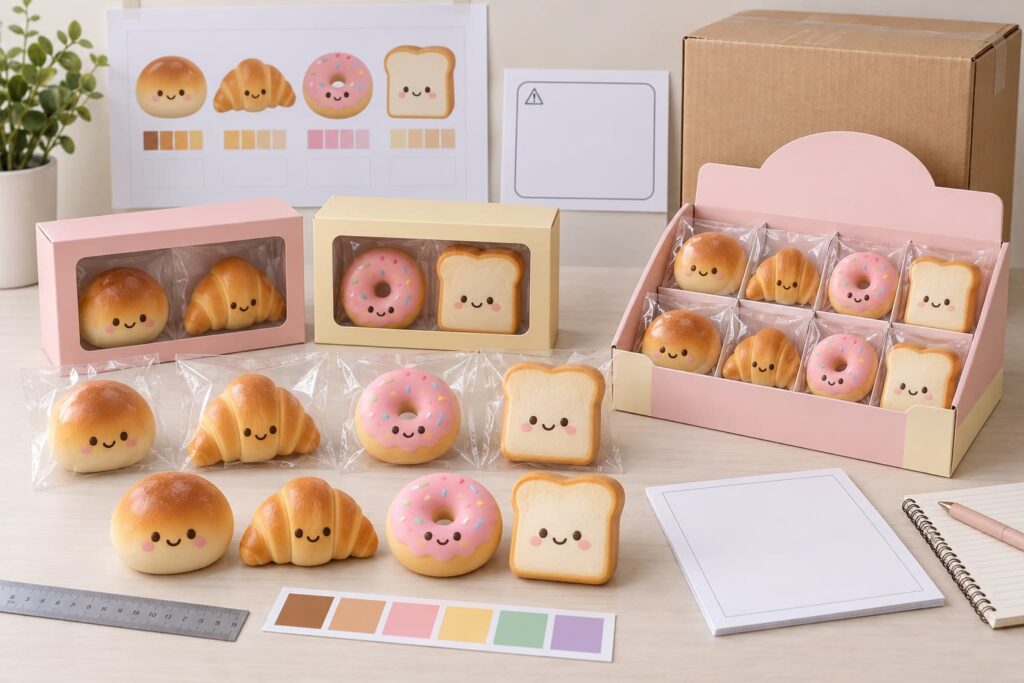
Individual clear bag
This format can keep units organized and visible, but the film, closure, ventilation needs, printed information, and product contact should be reviewed for the specific item and market.
Window box
A window box provides more artwork area and can protect detailed bakery shapes. It also increases package volume and requires the insert or orientation to hold the toy consistently.
Countertop display
A display can present a coordinated assortment at checkout. Confirm the unit count, color and SKU ratio, header visibility, packed dimensions, replenishment method, and how the display fits into the shipping carton.
Promotional bulk pack
Event giveaways may use simpler packing, but product identification, instructions, warnings, traceability, and destination-market requirements still need review. “Promotional” does not automatically mean the item is outside toy or consumer-product rules.
Inspect the Details That Make Food Shapes Sell
A pre-shipment check should use the approved sample and specification. Useful food-squishy checkpoints include:
- recognizable silhouette and correct SKU assortment;
- size, color, gradient, printed face, and surface texture;
- missing, smeared, or transferred paint;
- cracks, tears, weak thin parts, or exposed filling;
- unexpected stickiness, oiliness, residue, or strong odor;
- squeeze response and recovery compared with the approved reference;
- clean individual packaging and correct orientation;
- artwork revision, product identification, and traceability information;
- display quantity, mixed-SKU ratio, carton marks, and packing list.
Inspection does not replace applicable safety testing or certification. It helps confirm that the bulk order remains consistent with the approved product and package.
Information to Send for a Useful Food Squishy Quote
Prepare the following before contacting a manufacturer:
- food theme, sketch, authorized reference, or original character direction;
- retail, promotional, collectible, online, or seasonal sales channel;
- target dimensions and material/hand-feel direction;
- cute, realistic, or brand-linked visual style;
- estimated order quantity and number of SKUs;
- color ratio, scent request, and branding method;
- individual package, display, and carton preferences;
- destination market, age grade, and known testing or labeling needs;
- target launch date and sample approval process.
Browse Dongyu Toys’ product directions, review the sampling and production process, or use the inquiry form to send a food-shaped squishy concept. Final feasibility, MOQ, price, sample timing, packaging, and testing requirements should be confirmed for the specific project.
Frequently Asked Questions
Which material is best for food-shaped squishy toys?
There is no universal best material. Slow-rising PU foam often suits larger bakery and dessert forms, while TPR or TPE directions may suit compact elastic fruit, mochi, or keychain styles. Filled toys require a separate construction and risk brief. Approve the physical sample rather than relying only on a material name.
Can I print my restaurant logo directly on a food squishy?
Sometimes, if the design provides a sufficiently flat and stable area. Curved or textured surfaces may limit print size and clarity. Compare direct printing with molded details, hang tags, labels, window boxes, or display packaging.
How many designs should a first wholesale assortment contain?
A focused three-to-five-SKU set can be easier to develop and merchandise than a large mixed range, but the right number depends on the display, MOQ structure, budget, sales channel, and buyer strategy. Confirm how each design affects molds, sampling, decoration, packaging, and case pack.
Should bakery and fruit squishies be scented?
Scent is optional. Use it only when it adds clear value and can be sampled, documented, packaged, and reviewed for the target market. Define fragrance character and intensity rather than requesting “strong scent.”
What packaging works for food squishies wholesale?
Common directions include individual clear bags, window boxes, multi-piece gift sets, and countertop displays. Choose based on product contact, protection, branding area, shelf presentation, label requirements, packing density, and freight impact.
Do food-shaped squishies need special safety review?
They need a product- and market-specific review. Their food-like appearance, scent, size, detachable parts, filling, age presentation, packaging, and foreseeable use may affect the assessment. Do not rely on a generic warning or another product’s report.
Build a Food Collection That Works Beyond the Photo
The best food squishy assortment is easy to recognize, satisfying to squeeze, practical to produce, clear to merchandise, and supported by the right packaging and target-market records. Begin with the sales channel, select a focused family, simplify the shapes, and approve the physical product and package together.
Developing a bakery, fruit, snack, or branded food squishy collection? Send Dongyu Toys your original concept, desired size, feel, quantity, packaging, destination, and launch goal. A precise brief makes the first OEM/ODM sample discussion more useful and reduces late changes.